UAE Cloud Seeding Explained: How the Country Creates Rain
Learn how UAE’s cloud seeding works: salt flares, nanomaterials, AI technology, and 172 flights in 2025. Complete guide to NCM rain enhancement operations.
By Vadim Kouznetsov, published

With unstable weather conditions across the UAE, the country’s cloud seeding programme is back in the spotlight. The National Centre of Meteorology (NCM) actively conducts operations to boost rainfall, and the UAE has become a global leader in this weather modification technology.
Here’s everything you need to know about how cloud seeding works, the technology behind it, and what’s next for rain enhancement in the Emirates.
What Is Cloud Seeding?
Cloud seeding is a weather modification technique that increases precipitation from clouds. The process involves introducing substances into clouds that act as condensation or ice nuclei.
These particles provide a surface for water vapour to condense or freeze onto, forming larger, heavier droplets that fall as rain. Put simply, cloud seeding gives clouds the catalyst they need to produce rain when they might not otherwise do so.
Related: UAE Weather Update: Rain and Hail Hit the Country
How the UAE Conducts Cloud Seeding Operations
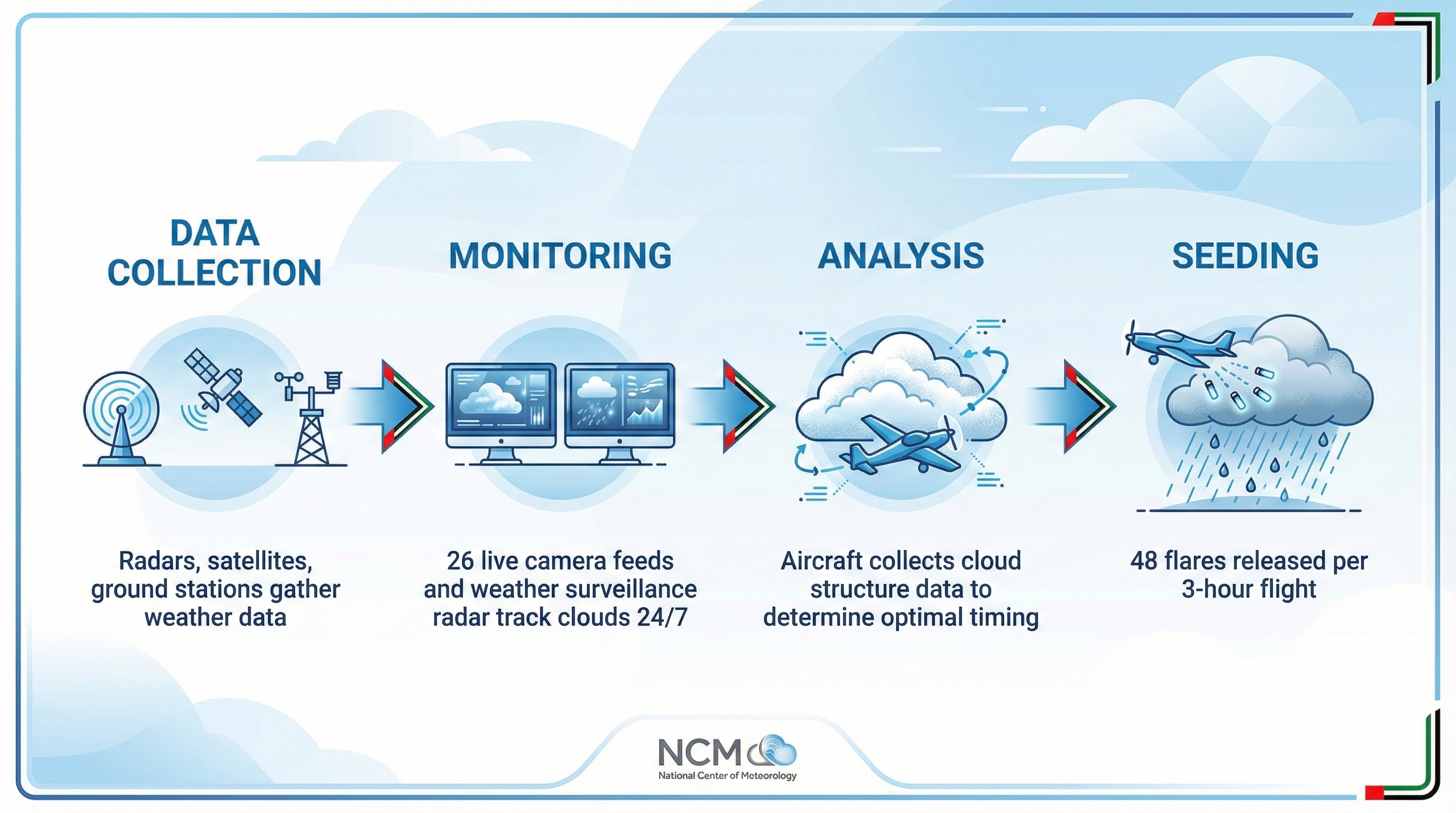
The NCM’s cloud seeding operation follows a systematic process:
Data collection: Experts gather information from radars, ground stations, and satellites to create daily weather forecasts. Meteorologists evaluate this data to identify cloud formations suitable for seeding.
Monitoring: A weather surveillance radar (WSR) tracks atmospheric pressure and cloud formations 24 hours a day. Live camera feeds from 26 locations across the UAE provide real-time visual data.
Analysis: When a suitable cloud forms, a special aircraft flies around it to collect data on its structure. This analysis determines the optimal time and location for seeding.
Seeding: When conditions are right, aircraft equipped with special flares fly into the clouds. The flares release seeding agents that help form rain droplets.
Related: UAE AI Cloud Seeding: Complete Guide to Environmental Innovation 2025
Seeding Agents and Technology
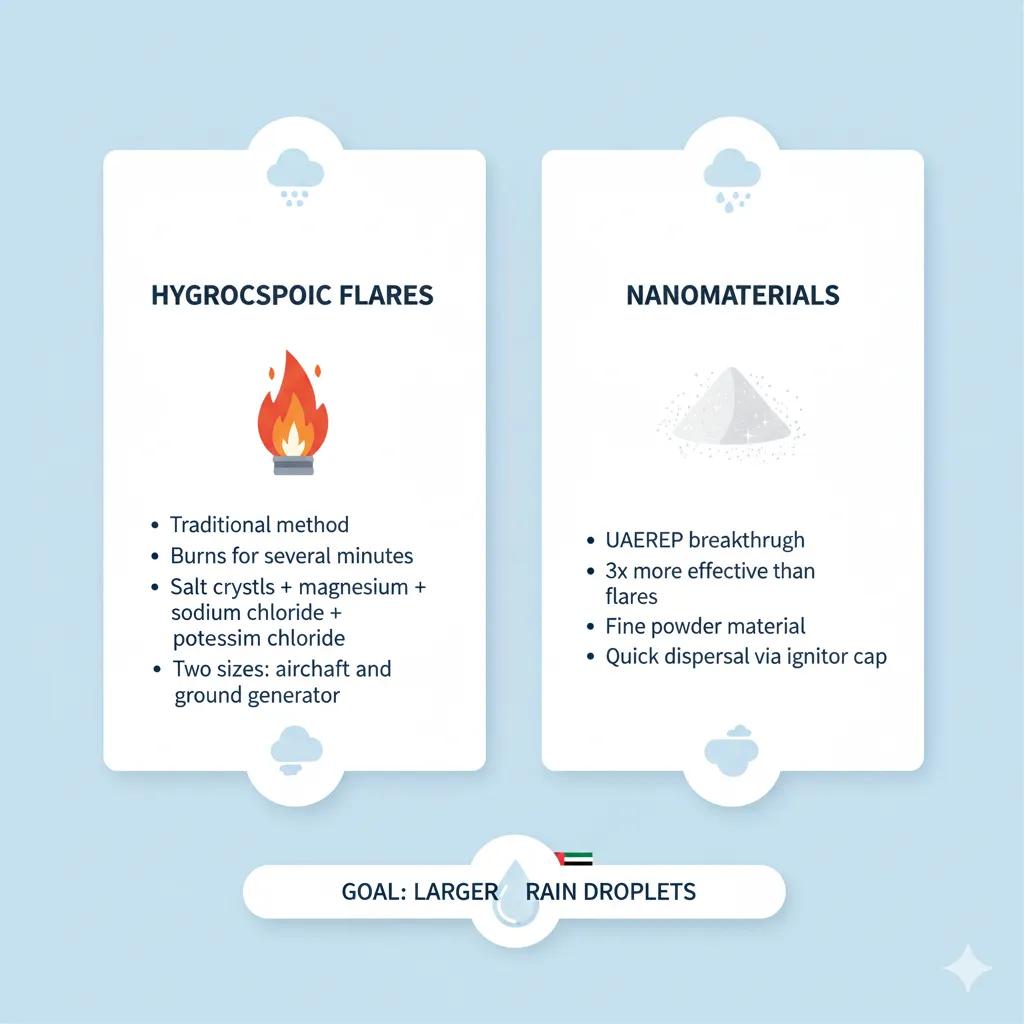
The UAE uses two primary types of seeding agents, both now manufactured locally:
Hygroscopic flares are the traditional seeding method. Available in two sizes (aircraft and ground generator versions), these flares burn for several minutes when released from aircraft. The burning process disperses material into the cloud’s updrafts, helping small droplets grow into larger ones.
Nano-materials represent a breakthrough from the UAE Research Programme for Rain Enhancement Science (UAEREP). This fine powder is up to three times more effective than hygroscopic flares. Rather than burning, an ignitor opens a cap to disperse the material quickly.
The NCM’s aircraft typically carry 48 flares for a single three-hour flight.
Ground-Based Generators
Beyond aircraft operations, the NCM uses ground-based generators (GBG) positioned strategically in mountainous areas. These towers take advantage of local topography and air currents to release hygroscopic materials into low-lying clouds.
The ground generators accelerate the collision and coalescence process, increasing rainfall without the need for aircraft.
Related: UAE Winter 2025: Record-Breaking 2°C Temperature Drop and Weather Forecast
The Future of Rain Enhancement in the UAE
The NCM continues exploring innovative technologies to improve effectiveness. Current advancements and experiments include:
Electric charging: The NCM is testing new materials through electric charging, where electrical charges are delivered directly into clouds to stimulate precipitation.
AI and numerical models: Advanced numerical models simulate chemical, physical, and electrical interactions within clouds with high accuracy. The NCM is also developing artificial intelligence applications to autonomously analyse cloud conditions in real-time and determine optimal seeding moments.
Experimental techniques: The programme has explored creating vertical air currents with jet engines and using lasers to stimulate cloud formation, though these remain experimental.
Related: UAE AI Strategy 2031: 20% GDP Target Creates New Career Opportunities
2025 Cloud Seeding Statistics
Since the start of 2025, the NCM has carried out 172 cloud-seeding flights. These operations aim to boost rainfall by 10 to 25 percent.
The efforts are particularly significant following the last winter season, which saw a considerable drop in precipitation compared to the previous year.
Related: Middle East Emerges as Global AI Innovation Hub: PwC Report
Key Takeaway
The UAE’s cloud seeding programme combines traditional seeding agents with cutting-edge technology including AI, nanomaterials, and electric charging experiments. With 172 flights completed in 2025 and a goal of increasing rainfall by 10-25%, the NCM continues to advance weather modification science. The programme operates through aircraft carrying 48 flares per three-hour mission, 26 monitoring stations across the country, and strategic ground-based generators in mountainous regions.
Frequently Asked Questions
What is cloud seeding and how does it work?
Cloud seeding is a weather modification technique that introduces substances into clouds to act as condensation nuclei. These particles provide a surface for water vapour to condense or freeze onto, forming larger droplets that fall as rain.
Does the UAE make rain artificially?
The UAE enhances natural rainfall through cloud seeding operations. The process increases precipitation from existing clouds by 10 to 25 percent, but requires suitable cloud formations to work.
What materials does the UAE use for cloud seeding?
The UAE uses two main seeding agents: hygroscopic flares containing salt crystals mixed with magnesium, sodium chloride, and potassium chloride, and newer nanomaterials that are up to three times more effective than traditional flares.
How many cloud seeding flights has the UAE conducted in 2025?
The NCM has carried out 172 cloud-seeding flights since the start of 2025. Each flight typically lasts three hours with aircraft carrying 48 flares.
Is cloud seeding safe for the environment?
The seeding agents used are primarily salt-based compounds that occur naturally in the environment. The UAE Research Programme for Rain Enhancement Science (UAEREP) continues to study and develop safe, effective materials.
How does the UAE know when to seed clouds?
The NCM uses weather surveillance radar, satellite data, ground station information, and live camera feeds from 26 locations across the UAE. A team of meteorologists evaluates this information to identify suitable cloud formations.
What new technologies is the UAE testing for rain enhancement?
The NCM is experimenting with electric charging to deliver electrical charges directly into clouds, AI applications for real-time cloud analysis, and even lasers and jet engines to stimulate cloud formation.
Further Reading
The UAE week, every Monday
The week's stories on jobs, visas, money and daily life in one short email. Unsubscribe in one click.