Why the UAE Is Getting Rain and Cool Weather This April
Rain and cool temperatures across the UAE this April are normal spring weather. NCM explains why it’s happening and when summer heat returns.
By Vadim Kouznetsov, published

Rain in Dubai? Cool temperatures in April? If you’ve been checking the sky with suspicion this week, you’re not alone.
The National Centre of Meteorology (NCM) confirms that the UAE is experiencing a period of unsettled but pleasant spring weather, with showers expected intermittently from Thursday through Monday. Temperatures have dipped below what many residents expect for this time of year.
Here’s why it’s happening and how long it will last.
Key Takeaway: The UAE’s April rain and cooler temperatures are a normal part of the spring transition between winter and summer. Meteorologists at the NCM say colliding air masses — cooler winter air meeting warmer, humid summer air — cause cloud formation, wind activity, and rainfall. Conditions are expected to stabilise as summer approaches, with weather variability decreasing from around 21 June.
Is Rain Normal in the UAE in April?
Yes. Dr Ahmed Habib, a meteorology expert at the NCM, confirmed that rainfall during this period is entirely typical.
“This is a transitional season between winter and summer, and spring typically brings variable weather, including rainfall of different intensities across the UAE,” he said.
Similar conditions occurred in April 2024. And this pattern isn’t limited to the Emirates — it’s common across the wider Middle East during spring.
The UAE receives most of its annual rainfall between November and April. The country’s cloud seeding programme can also enhance natural precipitation when conditions are favourable, though the current rainfall is driven by natural weather systems.
Why Is It Raining Now?
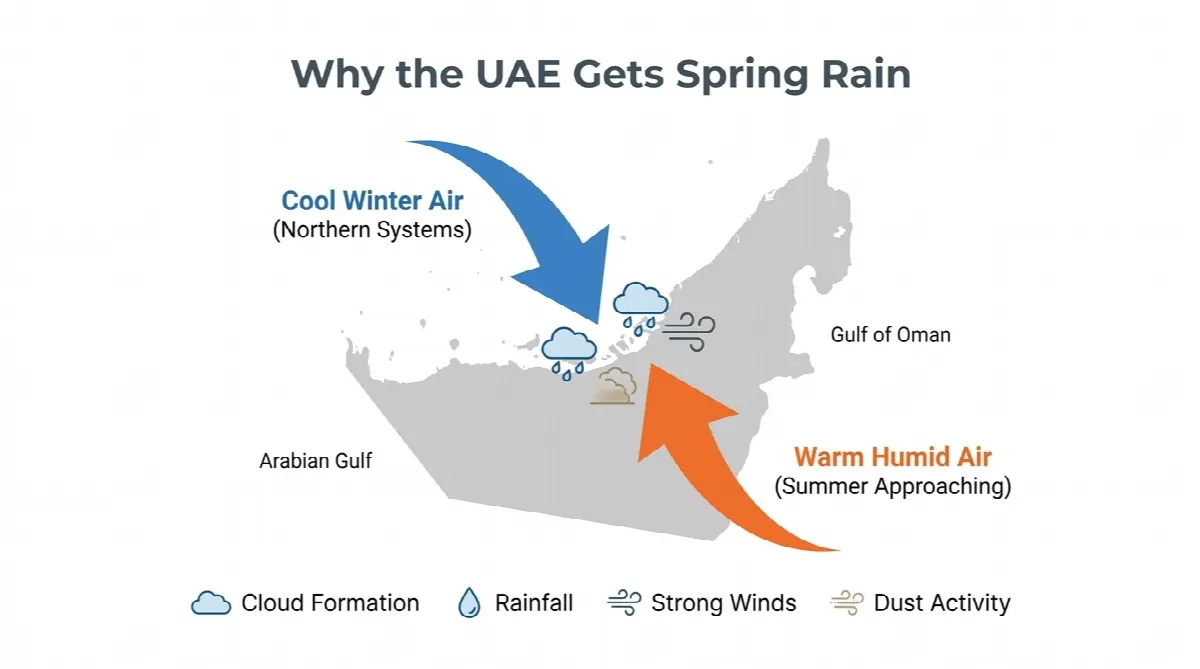
The main driver is the collision of different air masses.
During spring, cooler air remaining from winter meets warmer and sometimes humid air moving in as summer approaches. When these air masses collide, the interaction triggers:
- Cloud formation
- Strong winds
- Dust activity
- Rainfall — light to moderate across most areas, with heavier showers possible in western and eastern regions
This is the same mechanism that produces spring storms across much of the Northern Hemisphere. The UAE’s geography — sitting between the Arabian Gulf and the Gulf of Oman — amplifies the effect as maritime moisture meets inland air.
Why Does It Still Feel Cold?
The alternating temperatures are part of the same seasonal transition.
Dr Habib explained that it depends on which air mass is dominant at any given time:
- Cooler northern air systems push temperatures down, making conditions feel distinctly mild
- Warmer southern air masses bring temperatures back up
This explains why you might experience a warm day followed by two or three noticeably cooler days. It’s not a shift in season — it’s two seasons competing for dominance.
When moisture and low-pressure systems are present alongside these temperature swings, the result is cloud development and rain.
How Do Current Temperatures Compare to Normal?
The NCM says current temperatures remain within the historical range for April. There’s been no abnormal cold snap or unusual departure from seasonal averages.
Temperatures may fluctuate slightly above or below the average, but that’s standard for spring. The UAE’s winter can bring genuinely cold conditions — as low as 2°C recorded in January 2025 — while summer temperatures regularly exceed 47°C from June onward.
April sits in the middle, and the variability is the defining characteristic of this season.
How Long Will the Rain and Cool Weather Last?
The NCM expects weather fluctuations to continue throughout the spring period.
Rain showers that began Thursday should continue intermittently until Monday. Most rainfall will be light to moderate, with heavier showers possible in scattered areas.
Beyond this week, spring variability will persist until conditions begin to stabilise around 21 June — the start of astronomical summer. From that point, temperatures rise steadily and weather becomes more predictable.
“As long as we remain in the spring period, we can expect these weather variations,” Dr Habib confirmed.
What Should UAE Residents Do?
Spring weather in the UAE requires a few practical adjustments:
- Check the NCM forecast daily — conditions can shift quickly during transitional seasons
- Carry a light jacket if you’re heading out in the evening — temperature drops can be significant after sunset
- Drive cautiously during rain — UAE roads become slippery quickly, and visibility drops in showers
- Expect dust — wind activity accompanying these weather systems can reduce air quality
- Enjoy it — these are genuinely pleasant conditions before summer heat arrives and outdoor temperatures become restrictive
For anyone new to the UAE, this spring window — alongside the winter months — is when outdoor living is at its most comfortable. Make the most of it.
FAQ
Is rain normal in Dubai in April?
Yes. April falls within the UAE’s rainy season (November to April), and spring rainfall is a typical feature of the transitional period between winter and summer.
Why is it raining in the UAE right now?
Cooler winter air masses are colliding with warmer, humid air moving in as summer approaches. This interaction causes cloud formation, wind activity, and rainfall across the region.
How long will the rain last in the UAE this week?
The NCM expects intermittent rain showers from Thursday through Monday. Most rainfall will be light to moderate, with heavier showers possible in western and eastern regions.
Why does it feel cold in Dubai in April?
Temperature swings depend on which air mass is dominant. When cooler northern systems prevail, temperatures drop noticeably. When warmer southern air moves in, temperatures rise again. This alternation is normal for spring.
Are current UAE temperatures unusual for April?
No. The NCM confirms that temperatures remain within the normal historical range for this time of year, with minor fluctuations above or below the seasonal average.
When will summer weather start in the UAE?
Weather variability typically decreases around 21 June (the summer solstice), when temperatures begin rising steadily and conditions stabilise. By July, the UAE is firmly in summer mode.
Does the UAE use cloud seeding to make it rain?
The UAE operates a cloud seeding programme through the NCM, but current rainfall is driven by natural spring weather systems. Cloud seeding enhances precipitation when suitable cloud formations are already present.
Is it safe to drive during rain in the UAE?
Extra caution is required. UAE roads can become slippery quickly during rainfall, and reduced visibility is common. Reduce speed, increase following distance, and avoid sudden braking.
Will there be dust storms during this period?
Wind activity accompanying the colliding air masses can cause dust in some areas. Check the NCM forecast for dust alerts and reduce outdoor activity when air quality drops.
What’s the best time of year for outdoor activities in the UAE?
The spring months (March–April) and winter months (November–February) offer the most comfortable outdoor conditions, with temperatures typically between 18°C and 30°C.
Further Reading
The UAE week, every Monday
The week's stories on jobs, visas, money and daily life in one short email. Unsubscribe in one click.