CBSE Schools in UAE Launch Global Curriculum April 2026: What Parents Need to Know
CBSE announces Global Curriculum for 106 UAE schools starting April 2026. Learn how this affects fees, international recognition, and your child’s education.
By Vadim Kouznetsov, published

Key Takeaway: India’s Central Board of Secondary Education will launch the CBSE Global Curriculum in April 2026 across all 106 CBSE-affiliated schools in UAE and other countries, following successful discussions with GCC education regulators including KHDA, ADEK, and SPEA at Dubai’s first international conference.
The educational landscape for Indian expatriate families in the UAE just shifted dramatically. A new curriculum framework promises to balance global standards with academic affordability.
What Is the CBSE Global Curriculum?
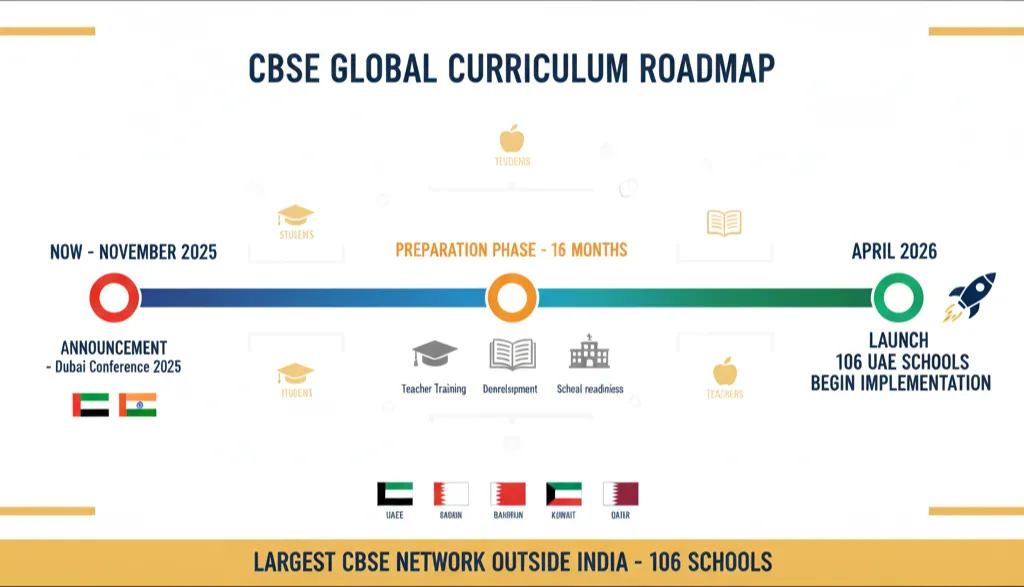
The Central Board of Secondary Education (CBSE) announced its new CBSE Global Curriculum at the first international and 31st annual conference of Sahodaya School Complexes in Dubai. The initiative marks CBSE’s transformation into a truly global education board.
This replaces earlier announcements about launching an “international board.” CBSE clarified the programme will be called the CBSE Global Curriculum, maintaining continuity with existing CBSE framework whilst adding international dimensions.
The curriculum will affect all CBSE-affiliated schools operating outside India. With 106 CBSE schools currently operating in the UAE, this represents the largest CBSE network outside India.
Understanding different curriculum options in UAE schools helps parents navigate these changes effectively.
When Does Implementation Begin?
Implementation begins in April 2026. Schools have approximately 16 months to prepare for curriculum transition.
The timing aligns with the traditional April-March academic year followed by Indian curriculum schools. However, UAE regulations now require these schools to conform to the unified August-July schedule whilst maintaining flexibility for CBSE examination periods.
The UAE 2025-2026 school calendar provides the official framework within which CBSE schools must operate.
Which Schools Are Affected?
All 106 CBSE-affiliated schools in the UAE must implement the Global Curriculum. These schools serve the large Indian expatriate community across Dubai, Abu Dhabi, Sharjah, and other emirates.
Schools include:
GEMS Modern Academy in Dubai (the only Indian curriculum school with Outstanding KHDA rating). Multiple CBSE schools across Dubai, Abu Dhabi, Sharjah, and Northern Emirates. Institutions serving various fee levels from affordable to premium segments.
The changes extend beyond UAE to all CBSE schools in Gulf Cooperation Council countries including Oman, Bahrain, Kuwait, and Qatar.
Parents currently researching outstanding schools in Dubai should consider how curriculum changes might affect their school choice decisions.
What Did GCC Regulators Say?
Dubai’s Knowledge and Human Development Authority (KHDA), Abu Dhabi Department of Education and Knowledge (ADEK), and Sharjah Private Education Authority (SPEA) participated in discussions alongside education officials from Oman, Bahrain, Kuwait, and Qatar.
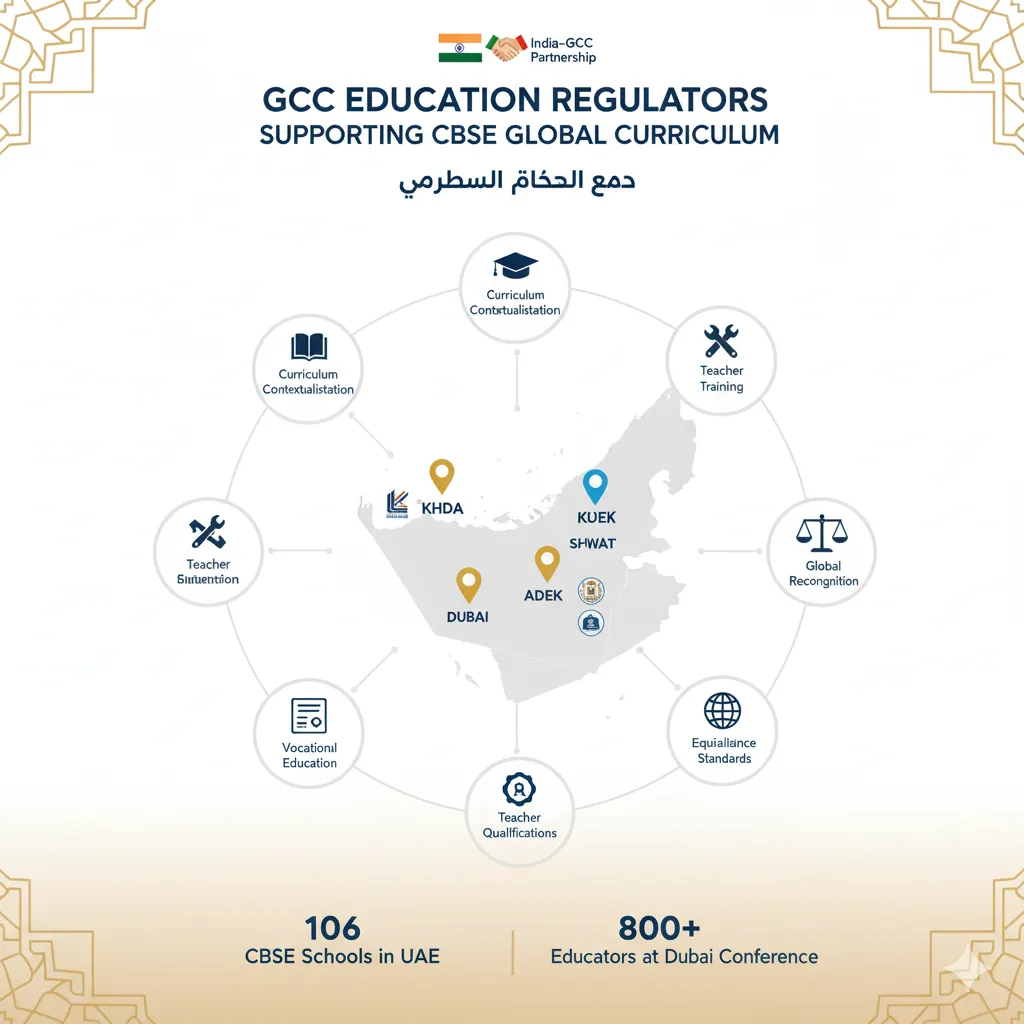
The regulators welcomed the initiative and agreed to explore collaboration on several key areas:
Curriculum contextualisation for Gulf region requirements. Teacher training programmes specific to the Global Curriculum. Vocational and technical education integration. Teacher qualification standards alignment. Equivalence benchmarks for international recognition. Global recognition of CBSE certificates.
Regulators appreciated CBSE’s commitment to balancing academic rigour with affordability. They expressed full support for the Global Curriculum implementation.
The education authorities commended CBSE schools in the Gulf region for strong compliance, quality standards, and student performance.
How Will This Affect School Fees?
CBSE maintains its commitment to affordability alongside academic standards. This represents a key differentiator from premium international curricula.
CBSE schools in UAE currently operate across multiple fee brackets. GEMS Modern Academy charges between AED 38,246 to AED 56,706 for Indian curriculum stream. Budget CBSE schools offer fees starting around AED 15,000 annually. Mid-tier CBSE institutions typically charge AED 25,000 to AED 45,000.
The Global Curriculum aims to maintain this affordability whilst enhancing international recognition and standards.
Parents should monitor school communications about fee adjustments related to curriculum transition costs.
Understanding Dubai school fees and regulations helps families budget for education expenses effectively.
What Makes the Global Curriculum Different?
The Global Curriculum builds on India’s National Education Policy (NEP) 2020 whilst incorporating international dimensions. The conference theme was “Rooted in Wisdom, Rising with Vision – Reimagining Education through NEP 2020.”
Key expected features include:
Enhanced international content and perspectives. Greater emphasis on critical thinking and problem-solving. Improved global recognition for higher education admission. Maintained connection to Indian values and culture. Vocational and technical education pathways. Teacher training aligned with international standards.
The curriculum aims to prepare students for both Indian and international university admissions.
Who Attended the Dubai Conference?
More than 800 CBSE school leaders and educationists from India and the Gulf region attended the two-day event in Dubai.
Participants included:
CBSE senior officials from India. GCC Ministry of Education representatives. UAE education authority leaders from KHDA, ADEK, and SPEA. Government of India officials. Consul General of India in Dubai. School principals and administrators from UAE CBSE schools. Education policy experts and curriculum specialists.
This represented the first international conference for CBSE’s Sahodaya School Complexes, marking a historic moment in the board’s global expansion.
What Happens to Current Students?
Implementation details for current students remain under development. Schools will likely phase in changes across different grade levels.
Typical transition patterns include:
Gradual introduction starting with lower grades. Completion of existing curriculum for senior students near examinations. Teacher training programmes before full implementation. Parent information sessions explaining changes. Assessment framework adjustments.
Parents should contact their child’s school directly for specific transition plans.
The Dubai school calendar 2025-2026 provides the timeline framework schools must work within.
Will This Improve International Recognition?
Yes. Enhanced international recognition represents a primary goal of the Global Curriculum.
Current CBSE certificates receive recognition from many international universities, particularly in India, UAE, and other countries with large Indian populations. However, some Western universities require additional qualifications or standardised tests.
The Global Curriculum aims to:
Improve direct admission pathways to international universities. Align with international assessment standards. Enhance global mobility for CBSE graduates. Maintain strong recognition in Indian higher education system. Provide vocational pathways with international recognition.
This addresses a longstanding concern for expatriate families planning international higher education for their children.
How Does This Compare to Other Curricula?
The Global Curriculum positions CBSE between traditional Indian curriculum and premium international options like British or IB systems.
Comparison factors:
Cost: CBSE schools typically charge 40-60% less than equivalent British curriculum schools. The Global Curriculum aims to maintain this affordability advantage.
Recognition: British and IB curricula enjoy strong international recognition. The Global Curriculum seeks to narrow this gap whilst maintaining Indian connections.
Pedagogy: International curricula emphasise inquiry-based learning and critical thinking. The Global Curriculum will incorporate these approaches whilst retaining strong content knowledge focus.
Assessment: CBSE currently uses primarily exam-based assessment. The Global Curriculum may introduce more continuous assessment elements.
Parents should evaluate curriculum choice based on family circumstances, budget, and long-term educational plans.
Frequently Asked Questions
Do existing CBSE schools need new licences for the Global Curriculum?
No. Current CBSE-affiliated schools in UAE continue operating under existing licences. The curriculum change occurs within the CBSE framework rather than creating an entirely new board.
Will school fees increase significantly?
CBSE emphasised maintaining affordability as a core principle. Schools may implement modest fee increases to cover curriculum transition costs, but regulators appreciated CBSE’s commitment to academic rigour without premium pricing.
Can students transfer between CBSE schools during the transition?
Yes. All CBSE schools will follow the same Global Curriculum framework, facilitating transfers. However, specific implementation timelines may vary between schools.
What about students planning to study in India?
The Global Curriculum maintains strong alignment with Indian higher education requirements whilst adding international dimensions. Students can still pursue admission to Indian universities.
Will Arabic and Islamic Studies requirements change?
No. UAE regulations require all private schools to teach Arabic and Islamic Studies regardless of curriculum. These requirements continue under the Global Curriculum.
What qualifications will teachers need?
Teacher qualification standards remain under discussion between CBSE and GCC regulators. Enhanced training programmes will likely be required, but existing qualified teachers should be able to transition with professional development.
How does this affect CBSE board examinations?
The Global Curriculum maintains CBSE board examinations as the primary assessment mechanism. The examination format may evolve to incorporate global curriculum elements.
Will students need to change schools?
No. Current CBSE students can remain in their existing schools. The curriculum changes within the school rather than requiring school transfers.
Further Reading
- Choosing the Best Curriculum for Your Child in UAE
- UAE 2025-2026 School Calendar: Key Dates for Students & Parents
- Dubai’s 23 Outstanding Schools: Complete Fee Guide 2025
- Dubai School Calendar 2025–2026: Key Dates for Private Schools in UAE
- Dubai’s Education Boom: 39 New Schools and Nurseries Opening in 2024
The UAE week, every Monday
The week's stories on jobs, visas, money and daily life in one short email. Unsubscribe in one click.