Prophet’s Birthday UAE 2025: September 3 or 4? Holiday Date Calculator
When is Prophet Muhammad’s birthday holiday in UAE 2025? Calculate if it falls September 3 or 4 based on Rabi Al Awwal moon sighting. Get official dates.
By Vadim Kouznetsov, published

The Prophet Muhammad’s (PBUH) birthday will occur on either September 3 or 4, 2025, depending on when the Islamic month of Rabi Al Awwal begins. UAE residents will receive a one-day public holiday for this significant religious occasion, with the exact date determined by moon sighting calculations that follow the traditional Islamic calendar system.
Islamic holidays in the UAE depend on lunar observations, making precise date prediction challenging until official moon sighting confirmations. Understanding how these calculations work helps residents plan their schedules and appreciate the astronomical precision behind Islamic calendar systems.
When Will Prophet Muhammad’s Birthday Holiday Occur in UAE 2025?
The birthday of Prophet Muhammad (PBUH) falls on the 12th day of Rabi Al Awwal according to Islamic tradition. For 2025, this creates two possible holiday scenarios based on when the new moon appears.
Scenario 1: Holiday on September 3, 2025 If Rabi Al Awwal begins on Saturday, August 23, 2025, then the 12th day would fall on Thursday, September 3.
Scenario 2: Holiday on September 4, 2025 If Rabi Al Awwal begins on Sunday, August 24, 2025, then the 12th day would fall on Friday, September 4.
The UAE Cabinet will announce the official holiday date once moon sighting committees confirm the start of Rabi Al Awwal. This announcement typically comes 24-48 hours before the expected date, allowing businesses and individuals to finalise their plans.
How Does the Islamic Calendar Determine Holiday Dates?
The Hijri (Islamic) calendar operates on a lunar system fundamentally different from the Gregorian calendar used in daily business. Each Islamic month begins with the sighting of the new moon, creating a natural variation in month lengths and start dates.
Key characteristics of the Islamic calendar include:
Lunar-Based System: Each month contains 29 or 30 days, determined by actual moon phases rather than fixed mathematical calculations.
Shorter Year: The Islamic year contains approximately 354-355 days, making it 10-11 days shorter than the Gregorian year.
Date Shifting: Islamic holidays occur roughly 11 days earlier each Gregorian year, creating a 33-year cycle where dates eventually return to similar positions.
Regional Variations: Different geographical locations may sight the new moon on different days due to atmospheric conditions and longitude differences.
Moon sighting committees across the UAE use both traditional observation methods and modern astronomical calculations to determine the precise beginning of each Islamic month.
What Factors Influence Moon Sighting Calculations?
Several technical and environmental factors affect when lunar observers can spot the new crescent moon that marks the beginning of each Islamic month.
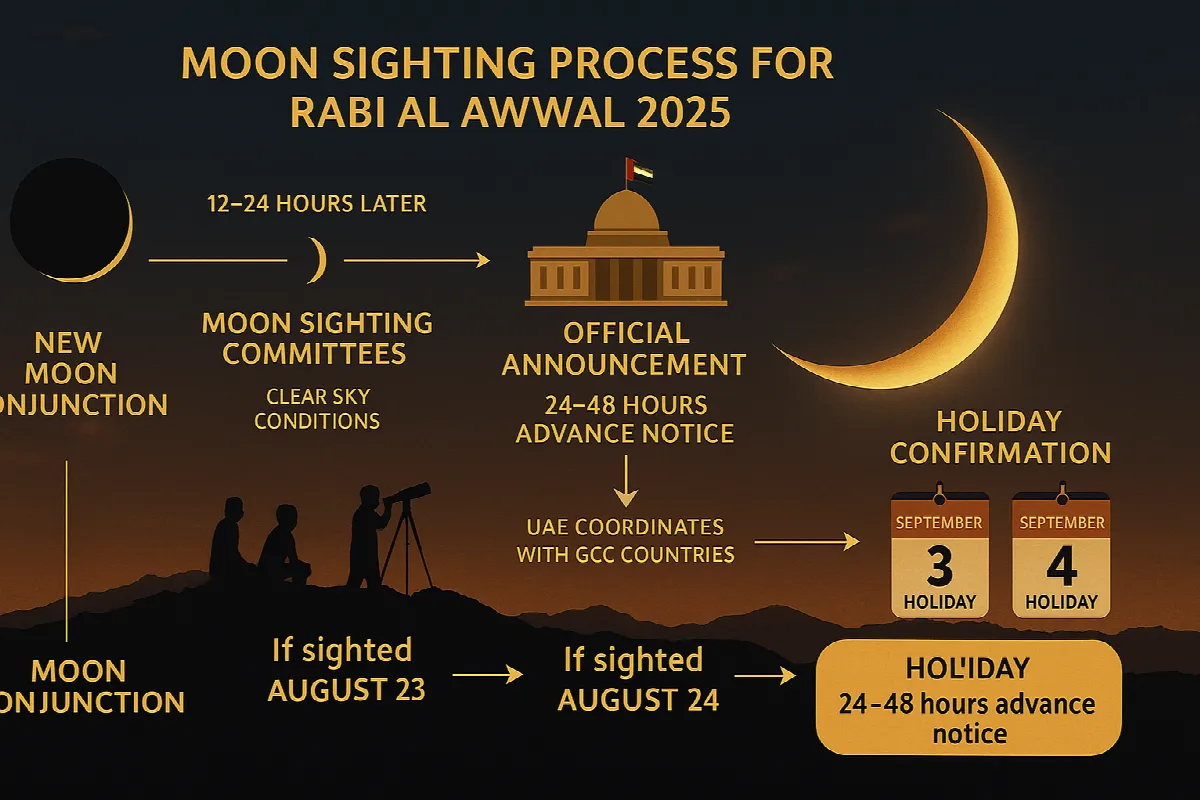
Astronomical Positioning The moon must be at least 12-24 hours past its conjunction with the sun to become visible as a thin crescent. Weather conditions, atmospheric clarity, and the observer’s geographical location all influence visibility.
Traditional vs Modern Methods Islamic authorities combine traditional visual sighting with contemporary astronomical data to make accurate determinations. Computer calculations predict likely visibility windows, whilst trained observers confirm actual sightings.
Regional Coordination The UAE coordinates with other Gulf countries and Islamic nations to maintain consistency in religious observances. However, local conditions may occasionally result in one-day differences between countries.
Margin of Error Even with modern technology, moon sighting retains a natural uncertainty of 24 hours, explaining why UAE public holiday announcements often come just days before the actual observance.
How Do UAE Holiday Movement Rules Apply to Prophet’s Birthday?
The UAE implemented new holiday flexibility rules in 2025 that allow certain religious holidays to be moved for extended weekends, though specific conditions apply to different observances.
Holiday Movement Eligibility According to UAE Cabinet resolutions, most public holidays except Eid breaks can be shifted to create longer weekends. This movement requires official Cabinet decision and typically aims to boost tourism and provide extended rest periods for workers.
Weekend Alignment Benefits If the Prophet’s birthday falls on Thursday or Friday, authorities may extend it to create a longer weekend. This particularly benefits families planning domestic travel or special celebrations.
Business Impact Considerations Holiday movements take into account economic factors, ensuring minimal disruption to international business whilst maximising benefits for UAE residents. Government entities and many private companies align their policies with official announcements.
Previous Precedents Recent years have seen successful holiday movements for UAE National Day and other observances, creating popular long weekend opportunities.
Which UAE Sectors Are Most Affected by Holiday Timing?
Different economic sectors experience varying impacts from Islamic holiday timing, particularly when dates remain uncertain until moon sighting confirmations.
Government Services All federal ministries, local government offices, and public services close during Prophet’s birthday observances. Citizens requiring government services must plan accordingly, especially for time-sensitive applications or renewals.
Banking and Finance UAE banks and financial institutions follow government holiday schedules, creating temporary limitations on transaction processing and customer service availability. ATMs and digital banking services typically continue operating normally.
Education Sector Both public and private schools observe the holiday, though private school calendars may vary based on their academic schedules and curriculum requirements.
Healthcare Services Essential medical services maintain emergency coverage, whilst routine appointments and non-urgent procedures are typically rescheduled.
Tourism and Hospitality Hotels, restaurants, and tourist attractions often extend operating hours and offer special programmes during religious holidays, capitalising on increased domestic tourism and family gatherings.
How Can Residents Plan Around Uncertain Holiday Dates?
Smart planning strategies help UAE residents accommodate the natural uncertainty inherent in lunar calendar-based holidays whilst maintaining flexibility for both professional and personal commitments.
Professional Planning Inform employers about potential date variations well in advance. Many companies maintain flexible policies allowing employees to adjust work schedules once official announcements are made.
Travel Arrangements Book flexible travel options when planning trips around Islamic holidays. Airlines and hotels familiar with Middle Eastern markets often offer amendable bookings for lunar calendar-dependent dates.
Family Coordination Discuss multiple date scenarios with family members, especially when coordinating gatherings that involve relatives living in different emirates or countries with potentially different holiday observations.
Financial Preparation Plan banking and financial transactions to account for potential 2-day service interruptions, particularly important for salary payments and bill settlements that might be affected by extended weekends.
What Historical Patterns Help Predict Future Holiday Timing?
Analysing historical data about Islamic holiday timing provides insights into long-term patterns whilst acknowledging the inherent variability in lunar observations.
33-Year Cycle Pattern Islamic calendar dates complete a full cycle against Gregorian dates approximately every 33 years. This means the Prophet’s birthday occurred on similar Gregorian dates in 1992 and will return to similar timing around 2058.
Seasonal Drift The holiday gradually moves through different seasons, spending roughly 2-3 years in each Gregorian month before shifting earlier. Currently transitioning through late summer/early autumn timing.
Regional Consistency The UAE typically aligns its Islamic calendar with Saudi Arabia and other GCC countries, though occasional one-day differences occur due to local atmospheric conditions.
Technology Integration Modern astronomical calculation accuracy has reduced (but not eliminated) uncertainty, with predictions becoming increasingly reliable whilst maintaining traditional observation requirements.
Frequently Asked Questions About UAE Prophet’s Birthday Holiday
Can the holiday be moved if it falls on a weekend?
Yes, under 2025 UAE Cabinet resolutions, the Prophet’s birthday can be moved to create extended weekends through official government decision, unlike Eid holidays which maintain fixed timing.
Do private companies have to follow government holiday dates?
Private sector holiday policies vary by company. Many align with government announcements, whilst others may have different arrangements specified in employment contracts.
How far in advance are Islamic holidays announced?
Typically 24-48 hours before the expected date, once moon sighting committees confirm the beginning of the relevant Islamic month through traditional observation methods.
Why do Islamic holidays occur 11 days earlier each year?
The Islamic calendar year contains 354-355 days compared to the Gregorian calendar’s 365-366 days, causing Islamic dates to shift approximately 10-11 days earlier annually.
What happens if different countries sight the moon on different days?
The UAE follows its own moon sighting committees but coordinates with GCC countries for consistency. Occasionally, one-day differences occur between nations due to geographical and atmospheric factors.
Are there any apps or websites that predict Islamic holiday dates?
Several astronomical websites and apps provide predictions based on calculated moon phases, though official UAE announcements remain the authoritative source for public holiday confirmation.
Key Takeaway
The Prophet Muhammad’s (PBUH) birthday will fall on either September 3 or 4, 2025, in the UAE, determined by when Rabi Al Awwal begins based on moon sighting observations. This one-day public holiday exemplifies the UAE’s commitment to honouring Islamic traditions whilst accommodating modern planning needs. Understanding the lunar calendar system helps residents appreciate the astronomical precision behind Islamic observances and plan effectively despite natural timing uncertainties.
Further Reading
The UAE week, every Monday
The week's stories on jobs, visas, money and daily life in one short email. Unsubscribe in one click.