Can Your UAE Employer Cut Your Salary or Force Unpaid Leave?
UAE law is clear: employers cannot cut salaries, delay wages, or force unpaid leave without consent. Know your rights and how to file a complaint with MOHRE.
By Vadim Kouznetsov, published

If your employer has recently reduced your pay, delayed your salary, or placed you on unpaid leave without asking — you’re not alone. Across the UAE, the regional conflict is squeezing companies in tourism, hospitality, and beyond. Many are looking for ways to cut costs.
But here’s what matters: the law is clear on what employers can and cannot do.
This guide breaks down your rights under UAE Labour Law, based on legal analysis from employment lawyers, so you know exactly where you stand.
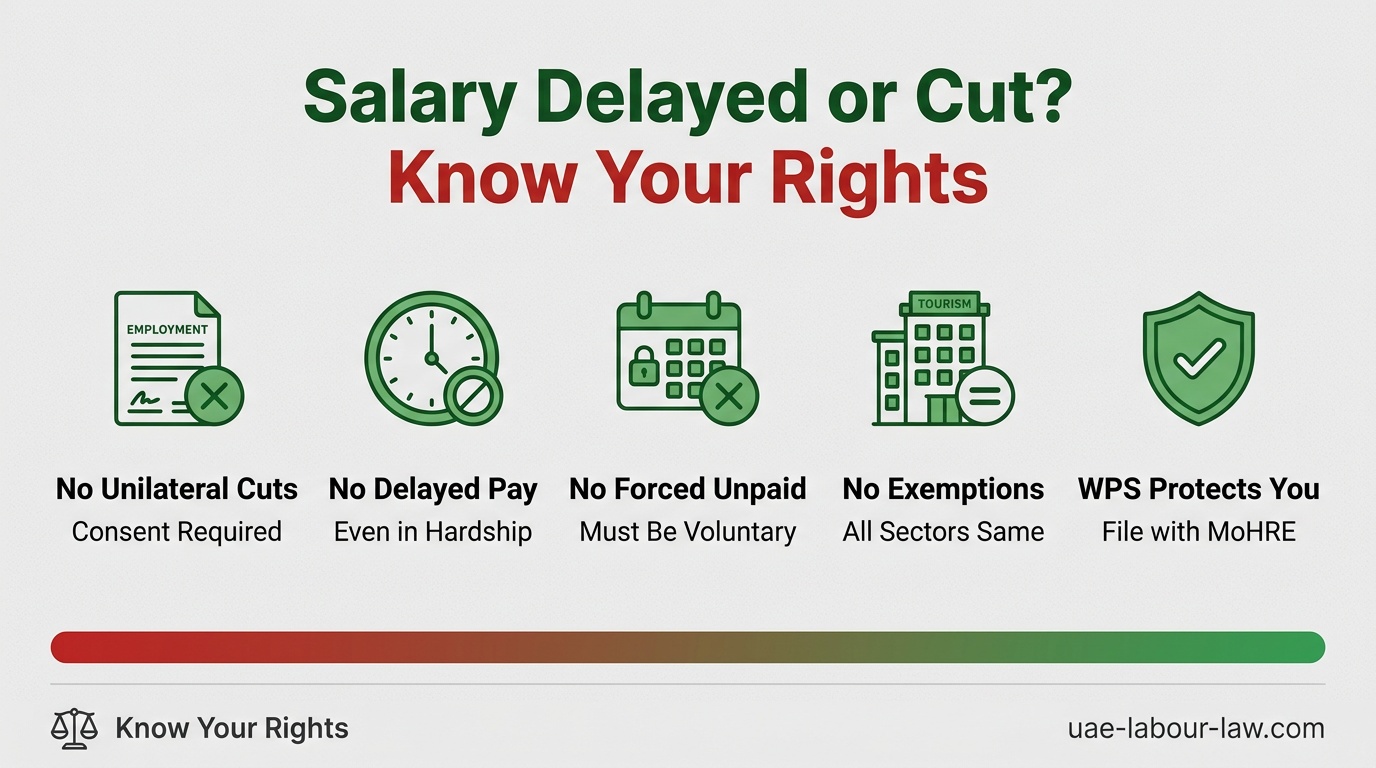
Key Takeaway: UAE employers cannot unilaterally reduce your salary, delay wage payments, or force you onto unpaid leave — even during financial hardship. Any changes to your pay or leave status require your consent. If your employer acts without it, they are breaching your employment contract, and you have legal options through MOHRE and the courts.
Can Your Employer Reduce Your Salary Without Your Consent?
No. As a general rule, your employer cannot cut your pay without your agreement.
Your employment contract specifies your salary. That’s a binding agreement. Changing it requires the consent of both parties.
Ludmila Yamalova, founder and managing partner of HPL Yamalova and Plewka DMCC, confirmed: “A unilateral change by the employer is not legally permissible.”
What counts as consent?
There are two forms:
Express consent — You explicitly agree to the reduction, for example by signing a written amendment to your contract. In this case, there’s no legal limit on how much the salary can be reduced, provided your consent was freely given.
Implied consent — This is more complex. If your employer starts paying a reduced salary and you continue working without objecting, a court may eventually interpret that as acceptance. However, courts will assess how long the reduced payments lasted and whether you raised objections.
A short period of reduced salary — one or two months — especially where the employee has objected, is unlikely to establish implied consent.
Complete non-payment is never implied consent. No employee is presumed to agree to work without compensation. If your employer stops paying you entirely, your continued presence at work does not mean you’ve accepted it.
Is It Legal for Companies to Delay or Pause Salary Payments?
No. Delaying or pausing salary payments is a breach of your employer’s obligations, even when the company is under financial pressure.
Salary payment is a fundamental obligation under UAE labour law. Employees are treated as priority creditors — meaning salaries should be paid before other discretionary or non-essential expenses.
Yamalova highlighted an important point: “Where a company continues to make other payments but delays employee salaries, this may raise questions about good faith and proper prioritisation of obligations.”
All private sector companies must process salary payments through the Wage Protection System (WPS). Failure to pay within 15 days of the due date can trigger penalties from MOHRE.
If a company genuinely cannot meet payroll, it must either terminate employees or negotiate unpaid leave with their consent. It cannot simply stop paying.
Can Employers Force You Onto Unpaid Leave?
No. Unpaid leave is only permissible when you voluntarily agree to it.
Asma Siddiqui, Senior Associate at BSA Law, confirmed: “Without such consent, placing someone on unpaid leave amounts to a breach of the employment contract.”
Paid annual leave is different. Your employer can schedule when you take your annual leave based on operational needs, as long as they give sufficient notice and stay within legal limits on leave management.
The distinction is straightforward:
- Annual leave — employer can direct timing, within legal guidelines
- Unpaid leave — always requires your express consent
If your employer tries to force unpaid leave without your agreement, this is a contract breach.
Are Hospitality or Tourism Companies Exempt?
No. There are no sector-specific exemptions under UAE Labour Law.
Siddiqui confirmed that even in difficult market conditions, companies in hospitality, events, and tourism must continue paying wages on time through the WPS. The law still requires employee consent for salary reductions or unpaid leave, regardless of the sector.
“In the absence of any special guidance like the temporary directives issued during COVID-19, companies must rely on negotiated, documented agreements with staff,” she said.
This is important context. During the pandemic, the UAE government issued temporary measures allowing greater flexibility for employers. No such directives currently apply to the present regional conflict.
What Can Companies Do Legally During Financial Difficulty?
Companies aren’t completely without options. But every measure must involve employee agreement and documentation.
Legal arrangements include:
Salary deferral agreements — Employees can agree to defer their salary, essentially lending the company money. This must be documented in writing and should specify whether the full or reduced salary is being deferred, the repayment timeline, the duration of the arrangement, and any protections for the employee if the company fails to repay.
Negotiated unpaid leave — With the employee’s consent and clear written terms.
Termination with full entitlements — If a company cannot pay its employees, it must follow proper termination procedures and settle all outstanding dues.
Yamalova stressed: “Once the company’s financial position improves, it will be obligated to repay the deferred amounts in accordance with the agreed terms.”
What Should You Do If Your Rights Are Violated?
If your employer cuts your salary, delays payment, or forces unpaid leave without your consent, you have several options:
- Object in writing immediately. This protects your legal position and prevents any future claim of implied consent.
- File a salary complaint with MOHRE. You can do this anonymously through the ‘My Salary Complaint’ service. MOHRE investigates confidentially and typically resolves cases within 14 days.
- Resign without notice if rights are persistently violated. Under Article 45 of the UAE Labour Law, you may resign without serving notice if your employer breaches your contract — provided you follow the proper process through MOHRE.
- Seek legal advice. Consult an employment lawyer or the UAE Labour Dispute Resolution Centre for guidance specific to your situation.
Document everything. Keep copies of your contract, pay slips, bank statements, and any written communications with your employer about salary changes.
How Does the Current Regional Conflict Affect These Rights?
The US-Israel-Iran conflict has put pressure on companies across the UAE, particularly in tourism and hospitality. Some businesses are experiencing reduced demand, tighter margins, and higher operating costs from surging fuel prices.
However, the legal framework does not change because of external economic pressures. Your employment rights remain intact. The UAE has not issued special directives relaxing labour protections in response to the current conflict.
If anything, the government is moving in the opposite direction — Dubai’s Dh1 billion stimulus package is designed specifically to help companies maintain operations and retain staff during this period.
FAQ
Can my employer reduce my salary in the UAE without my consent?
No. Your salary is specified in your employment contract, which is a binding agreement. Any reduction requires your express or implied consent. A unilateral salary cut is a breach of contract.
What is implied consent for a salary reduction?
If your employer starts paying a reduced salary and you continue working without objecting over an extended period, a court may interpret this as acceptance. Objecting in writing protects you against this interpretation.
Is it legal for my employer to delay salary payments?
No. Delayed salary payments breach the employer’s obligations under UAE Labour Law. Employees are priority creditors, meaning salaries must be paid before other non-essential expenses.
Can my employer force me to take unpaid leave?
No. Unpaid leave requires your voluntary consent. Placing you on unpaid leave without agreement is a breach of your employment contract.
Can my employer schedule my annual leave without my agreement?
Yes. Employers can direct the timing of paid annual leave based on operational requirements, provided they give sufficient notice and comply with legal guidelines.
Are there exemptions for hospitality or tourism companies?
No. UAE Labour Law applies equally across all sectors. There are no special exemptions allowing hospitality or tourism companies to reduce salaries or delay payments without employee consent.
What is the Wage Protection System?
The WPS requires all private sector companies to process salary payments through approved financial institutions. MOHRE monitors these payments, and employers who fail to pay within 15 days of the due date face penalties.
How do I file a salary complaint in the UAE?
You can file an anonymous complaint through MOHRE’s ‘My Salary Complaint’ service via the MOHRE app, website, WhatsApp (600590000), or call centre (80084). Cases are typically resolved within 14 days.
Can I resign without notice if my salary is delayed?
Persistent salary delays may constitute a breach of contract. Under Article 45 of the UAE Labour Law, you can resign without notice after notifying MOHRE at least 14 days in advance and giving your employer the opportunity to rectify the issue.
What should I document if my employer changes my pay?
Keep copies of your employment contract, all pay slips, bank statements showing reduced or missing payments, and any written communications with your employer about salary changes. This evidence supports your case with MOHRE or in court.
Further Reading
- How to Report Unpaid Salaries Anonymously in the UAE
- UAE Salary Deduction Rules: Legal Guidelines for Private Companies
- UAE Labour Laws: Essential Guide to Private Sector Employment Rights
- UAE Resign Without Notice: 4 Situations Where You Can Leave Immediately
- UAE Employee Dismissal Rights and Compensation Guide 2025
The UAE week, every Monday
The week's stories on jobs, visas, money and daily life in one short email. Unsubscribe in one click.