Can You Pay Dubai Rent Monthly Instead of 4 Cheques?
Dubai law lets landlords and tenants agree on monthly rent. Learn what happens with no deal, and how to negotiate away from four cheques.
By Vadim Kouznetsov, published

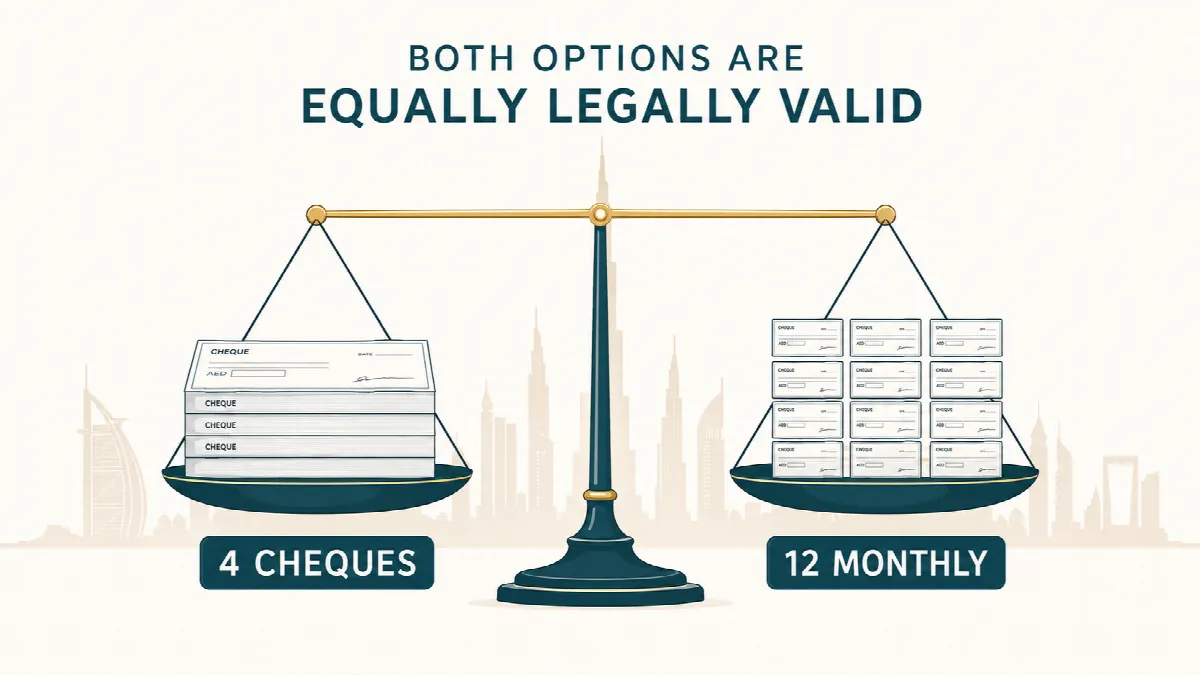
Key takeaway: Dubai law lets a landlord and tenant agree on any payment schedule — monthly, quarterly, half-yearly or yearly. There is no rule forcing four or six cheques. But if no agreement is reached, the rent defaults to four equal quarterly instalments paid in advance. And once you sign a contract that says four cheques, those terms are binding for the year.
A reader recently asked us a question many Dubai tenants share: “Does UAE law say rent cheques must be collected in four or six instalments? I want to pay monthly. Can I, and how do I negotiate with my real estate office that insists on four cheques?”
It’s a fair question. Splitting rent into twelve smaller payments is far easier on the monthly budget than handing over three or four large cheques. So what does the law actually permit?
What the Dubai Rent Law says
The starting point is Article 12 of Law No. 26 of 2007, which regulates the relationship between landlords and tenants in Dubai. The wording is clear: a tenant pays the rent on the dates both parties agree on. Only if there is no agreement — or if the agreed dates can’t be verified — does the rent become payable in four equal instalments, settled in advance across the year.
In plain terms: the law does not order four cheques. It treats four quarterly instalments as the fallback that kicks in only when the landlord and tenant haven’t set their own terms.
So can you pay rent monthly in Dubai?
Yes — if your landlord agrees. There is no legal cap on the number of cheques, and nothing stops a landlord and tenant from settling on monthly payments. A schedule of twelve cheques, six cheques or any other arrangement is valid the moment both sides accept it.
The catch is consent. The flexibility runs both ways, which means a landlord is also free to decline. If your real estate office holds firm on four cheques and that’s what the tenancy contract states, those terms apply for the duration of the lease.
This is the same principle that protects you elsewhere in a contract. As we explain in our guide on whether landlords can force fewer cheques or raise your rent, a landlord cannot change agreed payment terms partway through a live contract without your consent — and the reverse is true for tenants too.
What if your landlord insists on four cheques?
If your contract already commits you to four cheques, you’re bound by it until renewal. You can’t switch to monthly mid-lease without the landlord’s agreement.
Your real opening is at renewal or before signing a new lease. That’s when payment terms are still on the table. Some landlords accept more cheques in exchange for a slightly higher headline rent; others prefer fewer cheques and offer a discount for paying upfront. We’ve covered how some landlords push the opposite way in our report on single-cheque rent demands in Dubai.
How to negotiate monthly payments
A few practical points strengthen your position:
- Time it right. Raise payment terms before you sign or at least 90 days before renewal, when both sides are reviewing the agreement.
- Offer something in return. A landlord worried about cash flow may accept monthly payments if you agree to a longer lease or a small premium.
- Use post-dated cheques. Supplying twelve post-dated cheques upfront gives the landlord security while spreading your cost.
- Look at fintech schemes. Several platforms now let tenants pay in monthly instalments while the landlord still receives the money upfront. We break this down in our article on new 12-cheque and monthly payment options for Dubai tenants.
If you’re weighing terms at renewal, it’s worth reading our Dubai rental contract renewal guide for 2026 before you sit down with your agent.
A quick reality check
Monthly rent is becoming more common in Dubai, but it is still the exception rather than the norm. Many landlords remain comfortable with one to four cheques because it reduces admin and the risk of a bounced payment. Knowing the law gives you the confidence to ask — but the answer still depends on agreement between you and your landlord.
Frequently asked questions
Does UAE law require rent to be paid in four cheques? No. The four-instalment rule under Article 12 of Law No. 26 of 2007 applies only when the landlord and tenant have not agreed on a different schedule. With agreement, any number of payments is allowed.
Can I pay my Dubai rent monthly? Yes, if your landlord consents. The law sets no minimum or maximum number of cheques, so monthly payments are valid once both parties accept them.
Can a landlord refuse monthly payments? Yes. Because payment terms must be mutually agreed, a landlord can decline monthly payments and require four cheques instead. If the contract states four cheques, that term is binding.
Can I switch to monthly payments during my current lease? Not without the landlord’s agreement. Payment terms are fixed for the contract period. Renewal is the time to renegotiate.
Is there a way to pay monthly even if my landlord wants the money upfront? Sometimes. Certain rental-payment platforms pay the landlord in one to four lump sums while letting you repay in monthly instalments, often by card.
Which law governs rent payment terms in Dubai? Law No. 26 of 2007 Regulating the Relationship between Landlords and Tenants in the Emirate of Dubai, specifically Article 12.
Further reading
- Tenant Rights in Dubai: Can Landlords Force Fewer Cheques or Raise Your Rent?
- Monthly Rental Payments in Dubai: New 12-Cheque Options for Tenants
- Third-Party Rent Cheques in Dubai: Legal Guide & Requirements
- Dubai Rental Contract Renewal 2026: What Tenants Need to Know
- Dubai Rent Increase Law: Your Rights as a Tenant
Disclaimer: This article provides general information about Dubai’s rental laws and is not legal advice. For guidance on your specific situation, consult a qualified legal professional.
The UAE week, every Monday
The week's stories on jobs, visas, money and daily life in one short email. Unsubscribe in one click.