UAE Resign Without Notice: 4 Situations Where You Can Leave Immediately
UAE law allows employees to resign without notice in 4 situations under Article 45. Keep your gratuity and entitlements. Full guide.
By Vadim Kouznetsov, published

Think you always need to give 30 days’ notice before leaving your job in the UAE? Not necessarily. Under Article 45 of the UAE Labour Law, there are four specific situations where you can walk away immediately — and still keep every dirham of your legal entitlements.
Most employees assume the notice period is non-negotiable. But UAE law deliberately built in exceptions for situations where staying would be unreasonable, unsafe, or a breach of your rights. Here’s exactly when those exceptions apply.
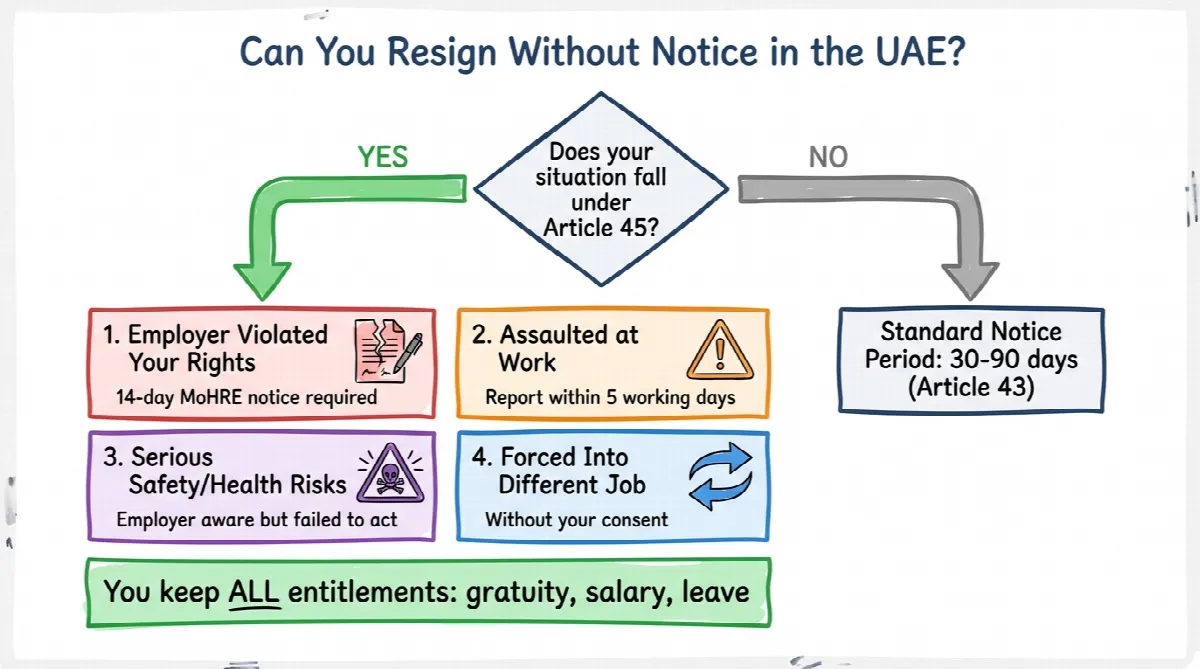
Situation 1: Your Employer Has Violated Your Contractual or Legal Rights
If your employer breaches your rights under the Labour Law, its executive regulations, or the terms of your employment contract, you may resign without notice under Clause 1 of Article 45.
But this isn’t an instant walkout. The law requires you to follow a specific process:
Step 1: Notify the Ministry of Human Resources and Emiratisation (MoHRE) at least 14 days before you plan to submit your resignation.
Step 2: Give your employer the chance to correct the violation.
Step 3: Wait for MoHRE to formally notify your employer. If the employer fails to rectify the issue despite this official notification, you’re free to leave.
This three-step process exists to give employers a fair opportunity to fix problems before losing staff. But once they’ve been notified and still haven’t acted, the law sides with you.
Common examples include persistent salary deductions that violate UAE law, withholding leave entitlements, or failing to meet obligations outlined in your contract. If your employer is changing your role without consent, that’s covered separately under Situation 4 — and we have a full guide on whether employers can legally change your job role.
Situation 2: You Are Assaulted at Work
If you’re assaulted by your employer or their legal representative, you can resign immediately. No notice period required.
There’s one critical requirement: you must report the incident to the relevant authorities and MoHRE within five working days from the date you were able to report it.
This protection extends beyond physical assault. Under Article 14(2) of the Employment Law, the UAE prohibits all forms of workplace harassment — sexual, physical, or verbal — by employers, managers, or colleagues. Article 45(2) specifically allows employees who experience assault, violence, or harassment to resign without notice while keeping all entitlements.
The five-day reporting window starts from when you were able to report — not from the date of the incident itself. This distinction matters if an injury or other circumstance prevented you from reporting sooner.
Situation 3: Your Workplace Poses Serious Safety or Health Risks
If your workplace exposes you to serious dangers that threaten your safety or health — and your employer knows about the risk but fails to address it — you can resign immediately.
The key phrase here is “despite being aware of it.” You need to have flagged the safety concern to your employer, and they must have failed to act. If the danger is severe enough and your employer is unresponsive, the law protects your right to leave without giving notice.
This links to broader employer workplace safety obligations under UAE law, which include providing protective equipment, eliminating hazards, and maintaining continuous safety monitoring. Employers who ignore documented safety complaints risk losing employees without the standard notice period — and still owe them full end-of-service benefits.
Situation 4: You’re Forced to Do a Fundamentally Different Job
If your employer assigns you tasks that are substantially different from what was agreed in your employment contract — and you haven’t consented to the change — you can resign without notice.
This isn’t about minor adjustments to your daily responsibilities. The law targets situations where your entire job function has been altered without your agreement. A marketing manager being forced into a warehouse role, for instance, would fall clearly under this provision.
Article 45(4) of the Employment Law provides this protection specifically because your employment contract is a binding agreement between both parties. If the employer unilaterally rewrites your role, they’ve broken that agreement. We cover this in depth in our guide on whether employers can change your job tasks under UAE law.
What Happens to Your Benefits If You Resign Without Notice?
This is the part many employees worry about. The good news: in all four situations above, you retain your full legal entitlements.
That includes:
- End-of-service gratuity (if you’ve completed one year of service)
- Unpaid salary up to your last working day
- Cash compensation for accrued but unused annual leave
- Experience certificate upon request
You don’t forfeit any of these benefits, and you’re not required to pay compensation to your employer. The law treats these as justified resignations where the employer’s conduct — not the employee’s — caused the contract to end.
For a detailed breakdown of end-of-service benefits and gratuity calculations, see our dedicated guide.
What’s the Standard Notice Period If None of These Apply?
If your situation doesn’t fall under Article 45, the standard rules from Article 43 apply:
Either party can terminate the contract for any legitimate reason, provided that written notice is given. The notice period must be at least 30 days and no more than 90 days, as specified in your contract.
During the notice period, the employment contract remains fully active. You’re entitled to your full salary based on your most recent wage.
If your employer terminates your contract, you get one unpaid day off per week during the notice period to search for a new job. You choose which day, but you must inform your employer at least three days in advance.
If either party fails to serve notice, they must pay a “notice period allowance” — the salary equivalent for the unserved notice period. This applies regardless of whether the other party suffered any actual financial loss.
The notice period can be reduced or waived entirely if both parties agree, but it cannot disadvantage the employee. For a comprehensive breakdown, check our guide on UAE notice period rules.
Key Takeaway
UAE law provides four clear exceptions under Article 45 where employees can resign immediately without serving notice: employer rights violations (with 14-day MoHRE notification), workplace assault (report within 5 working days), serious safety hazards the employer ignores, and being forced into a fundamentally different job. In every case, you keep your full legal entitlements including gratuity, accrued leave, and unpaid salary. If none of these apply, the standard 30–90 day notice period under Article 43 remains in effect.
Frequently Asked Questions
Can I resign without notice if my employer isn’t paying me on time?
Persistent salary delays can constitute a breach of your employment contract. Under Article 45(1), you may resign without notice, but you must first notify MoHRE at least 14 days before your planned resignation and give the employer a chance to rectify the issue. If they fail to act after MoHRE’s notification, you can leave.
Do I lose my gratuity if I resign without notice under Article 45?
No. If you resign under any of the four exceptions in Article 45, you retain all legal entitlements, including end-of-service gratuity (provided you’ve completed at least one year of continuous service), accrued leave, and unpaid salary.
What’s the difference between Article 44 and Article 45?
Article 44 covers situations where an employer can dismiss an employee without notice (e.g., fraud, gross misconduct). Article 45 covers situations where an employee can resign without notice due to employer failures. They protect different parties.
Can I resign without notice during probation?
The four Article 45 exceptions apply regardless of whether you’re on probation or not. However, standard probation resignation rules require 14 days’ notice if leaving the UAE or 30 days if joining another UAE employer.
What evidence do I need to resign without notice?
Document everything. Keep copies of written complaints, MoHRE communications, medical reports (for assault or safety cases), and any evidence showing how your job role was changed without consent. This documentation protects you if your employer disputes the resignation.
Can the notice period be reduced by mutual agreement?
Yes. Under Article 43, both parties can agree to shorten or waive the notice period entirely. However, any agreement must not disadvantage the employee — the notice period must remain equal for both parties unless a shorter period benefits the worker.
Further Reading
- UAE Notice Period Rules: Comprehensive Guide for Employers and Employees
- UAE Employment Law: Can Employers Change Your Job Role?
- UAE Employee Dismissal Rights and Compensation Guide 2025
- UAE Immediate Dismissal Guide: Legal Grounds Under Article 44
- UAE Labour Law: Complete Guide to Employment Contract Termination
- Is Yelling at Co-Workers Considered Harassment in the UAE?
The UAE week, every Monday
The week's stories on jobs, visas, money and daily life in one short email. Unsubscribe in one click.