5 UAE Sustainability Trends 2026: From Green Bonds to Plastic Bans
Discover the five sustainability trends defining the UAE in 2026 — from mandatory climate reporting and green bonds to the final single-use plastic ban.
By Vadim Kouznetsov, published
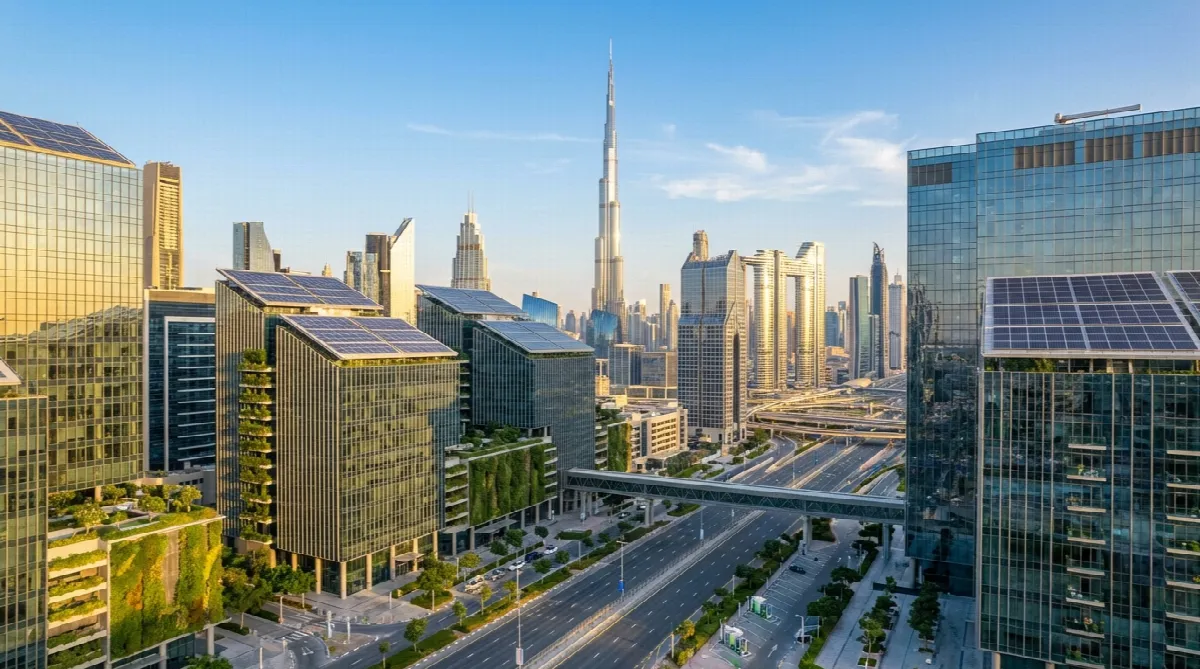
What are the biggest sustainability trends shaping the UAE in 2026? Mandatory climate reporting, green finance integration, accelerated renewables deployment, green urban development standards, and a comprehensive single-use plastic ban are collectively transforming ESG from corporate ambition into measurable action across the Emirates.
The UAE’s sustainability agenda has moved beyond pledges and vision statements. By 2026, ESG is embedded within regulation, capital markets, infrastructure planning, and consumer policy. Five distinct trends illustrate this shift — and they affect businesses, investors, and residents alike.
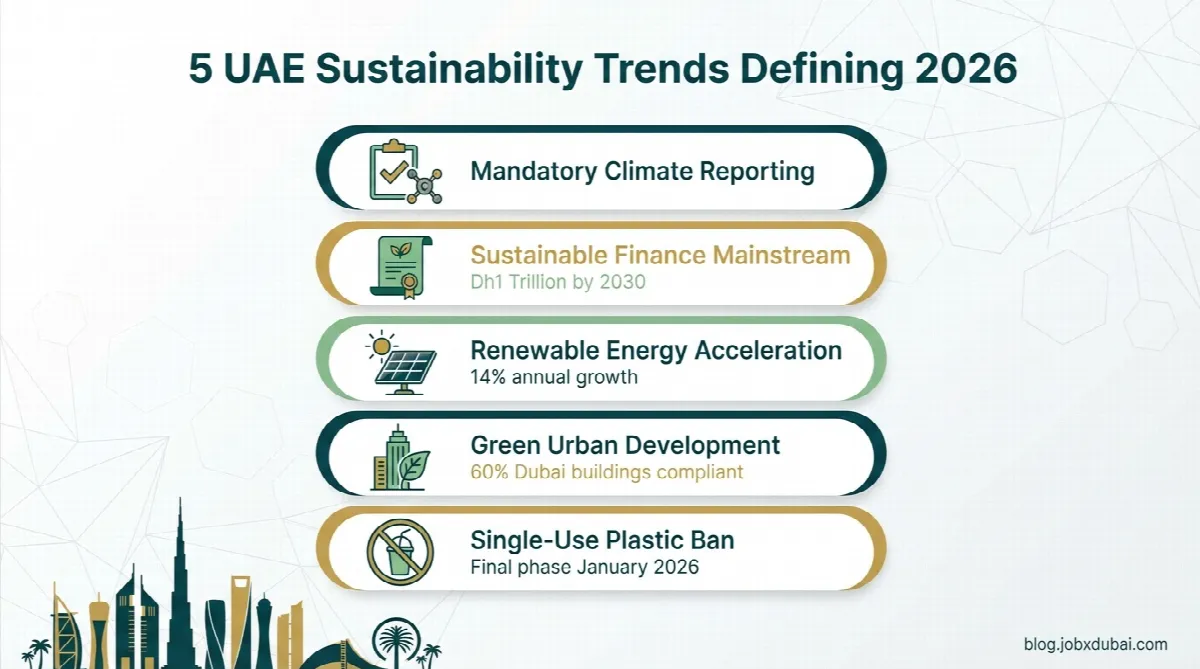
1. Mandatory Climate Reporting and the UAE Carbon Market
The most significant change is regulatory. The UAE’s Federal Decree Law No. 11 has fundamentally reshaped the ESG landscape by introducing compulsory climate action frameworks. These include structured emissions measurement, mandatory reporting, and formal oversight mechanisms.
The law also establishes the foundation for a national carbon ecosystem. This involves formal carbon credit registries and market-based trading mechanisms — a clear signal that the UAE is moving from voluntary disclosure to verifiable, auditable data.
By 2026, emissions reporting forms the backbone of carbon pricing and trading accountability. Companies operating in the UAE should expect ESG credibility to be judged primarily on emissions data quality and governance transparency.
What does this mean for businesses? Any company operating in the UAE will face growing pressure to produce accurate, third-party verified emissions data. This is no longer optional — it’s regulatory.
2. Sustainable Finance Enters the Mainstream
Green finance in the UAE has shifted from a niche product to a core component of capital strategy. Green bonds and sustainability-linked loans are now standard tools for capital allocation across the Emirates.
Banks and investors have begun embedding ESG performance into credit assessment, loan pricing, and long-term risk models. For corporates, this translates directly: sustainability metrics now influence both access to capital and borrowing costs.
This momentum was reinforced at Abu Dhabi Finance Week 2025, where the UAE Sustainable Finance Working Group announced its latest framework for climate transition planning. The announcement marked a pivotal shift from ambition to capital market execution.
Driven by the national pledge made at COP28, the UAE financial sector targets the mobilisation of Dh1 trillion ($272 billion) in sustainable finance by 2030. This effort is coordinated across banks, regulators, and capital markets.
Why does this matter for UAE professionals? Demand is rising for ESG analysts, sustainability consultants, and green finance specialists. The UAE Salary Guide 2026 highlights ESG-aligned procurement and digital transformation roles as key growth areas.
3. Renewable Energy Deployment Accelerates
The UAE’s clean energy transition is gaining speed through large-scale investment, artificial intelligence integration, and green hydrogen development. Solar energy remains the dominant growth driver.
Key figures for 2025–2030:
- Renewable energy generation is forecast to grow at approximately 14% annually between 2025 and 2027.
- By 2027, solar photovoltaic power is projected to account for nearly 70% of total renewable electricity generation.
- National installed renewable capacity reached approximately 7.29 GW in 2025 and is projected to hit 12.42 GW by 2030.
Flagship projects such as the Mohammed bin Rashid Al Maktoum Solar Park continue to anchor this trajectory. Renewables are now positioned as core economic infrastructure, not peripheral climate solutions.
For professionals considering a move to the Emirates, renewable energy engineering roles and green technology careers are among the fastest-growing sectors in the UAE job market.
4. Green Urban Development Becomes the Default
Urban development has emerged as one of the UAE’s most advanced sustainability frontlines. By mid-2023, nearly six in ten buildings in Dubai already complied with green building standards. Nationally, the UAE has more than 1,500 LEED-registered and certified projects — the highest concentration in the Middle East.
What’s more revealing than growth rates is market behaviour. Green-certified buildings are rapidly becoming the standard, driven by both regulation and tenant demand. By 2026, green compliance is a prerequisite for any commercial or residential asset to remain competitive within the UAE’s property market.
This trend creates significant demand for green building professionals — from architects and energy auditors to sustainability consultants with LEED certification expertise. Dubai’s D33 economic agenda further reinforces sustainable industrial practices as a core economic priority.
5. The Single-Use Plastic Ban Reaches Its Final Phase
Perhaps the most visible sustainability shift for everyday residents is the expansion of the UAE’s single-use plastic restrictions. January 2026 marks the most comprehensive phase of nationwide implementation, extending bans to plastic cups, lids, cutlery, food containers, and plates.
The timeline has been progressive:
- January 2024: Single-use bag tariff introduced, followed by a full ban from June 2024.
- January 2025: Bans on plastic stirrers, Styrofoam containers, and plastic straws.
- January 2026: Final phase covering cups, lids, cutlery, food containers, and plates.
This policy shift forces businesses to rethink packaging, procurement, and customer engagement strategies. It also reflects a broader behavioural transition, with consumers increasingly favouring sustainable alternatives.
For a full list of new UAE rules effective January 2026, including plastic regulations, parking changes, and social media permit requirements, check our dedicated guide.
What This Means for Businesses and Professionals
These five trends are converging. Regulation, finance, infrastructure, and consumer policy are simultaneously embedding sustainability into how UAE businesses operate.
Organisations that treat ESG as a strategic operating system — built on verified data, structured governance, and long-term capital planning — will be best positioned for growth. Those that continue treating sustainability as a marketing exercise risk falling behind regulatory requirements and losing access to competitive financing.
For professionals, this convergence is creating new career opportunities across ESG reporting, carbon accounting, green construction, renewable energy project management, and sustainable supply chain operations. The 11 high-demand career sectors identified for Dubai’s future include clean energy and green technology prominently.
Key Takeaway
The UAE’s 2026 sustainability landscape is defined by execution, not promises. Federal Decree Law No. 11 makes climate reporting mandatory, Dh1 trillion in sustainable finance is being mobilised by 2030, renewable capacity is projected to nearly double to 12.42 GW, 60% of Dubai buildings already meet green standards, and the final plastic ban phase takes effect in January 2026. For businesses and professionals in the UAE, ESG compliance is now a competitive requirement — not an optional initiative.
Frequently Asked Questions
What is Federal Decree Law No. 11 and how does it affect UAE businesses?
Federal Decree Law No. 11 introduces mandatory climate action frameworks for businesses operating in the UAE. It requires structured emissions measurement, reporting, and oversight. The law also establishes formal carbon credit registries and trading mechanisms, moving the UAE from voluntary ESG disclosure to compulsory, verifiable reporting.
How much is the UAE investing in sustainable finance?
The UAE financial sector is targeting Dh1 trillion ($272 billion) in sustainable finance mobilisation by 2030. This commitment was made following COP28 and is supported by coordinated efforts across banks, regulators, and capital markets. Green bonds and sustainability-linked loans are now standard financing instruments.
What renewable energy capacity does the UAE have?
National installed renewable capacity reached approximately 7.29 GW in 2025 and is projected to rise to around 12.42 GW by 2030. Solar photovoltaic power is expected to account for nearly 70% of total renewable electricity generation by 2027, with annual growth averaging around 14%.
What single-use plastic items are banned in the UAE from January 2026?
The final phase of the UAE’s plastic ban covers cups, lids, cutlery, food containers, and plates. Earlier phases banned single-use bags (2024) and stirrers, Styrofoam containers, and straws (2025). Businesses must provide reasonably priced reusable alternatives and adopt circular economy practices.
Are green building certifications mandatory in Dubai?
While not universally mandated, green building compliance is becoming a market standard. Nearly 60% of Dubai buildings already met green building standards by mid-2023, and the UAE has over 1,500 LEED-registered projects. By 2026, green certification is increasingly a requirement for commercial assets to remain competitive in terms of tenant demand and financing eligibility.
What ESG jobs are in demand in the UAE?
High-demand ESG roles include sustainability consultants, carbon accounting specialists, green building architects, renewable energy engineers, ESG analysts in finance, and sustainable supply chain managers. These roles are supported by the UAE’s regulatory shift and growing capital allocation to sustainable projects.
Further Reading
- Green Finance in the UAE: Shaping the Future of Sustainable Investments
- UAE Single-Use Plastic Ban 2026: What Businesses Need to Know
- Sustainable Living in the UAE: A Comprehensive Guide for Expats
- 5 Sustainable Business Ideas That Are Changing the UAE Landscape
- Green Job Opportunities Flourish in the UAE’s Sustainability Sector
- Dubai Future Careers: 11 High-Demand Jobs to Prepare For Today
The UAE week, every Monday
The week's stories on jobs, visas, money and daily life in one short email. Unsubscribe in one click.