Best Veterinary AI Scribes in 2026: 10 Tools Compared for SOAP Notes, Pricing and Workflow
A practical comparison of VetVisit AI, VetRec, Scribenote, CoVet, ScribbleVet, HappyDoc and other veterinary AI scribes
By Vadim Kouznetsov, published
Last verified: July 21, 2026
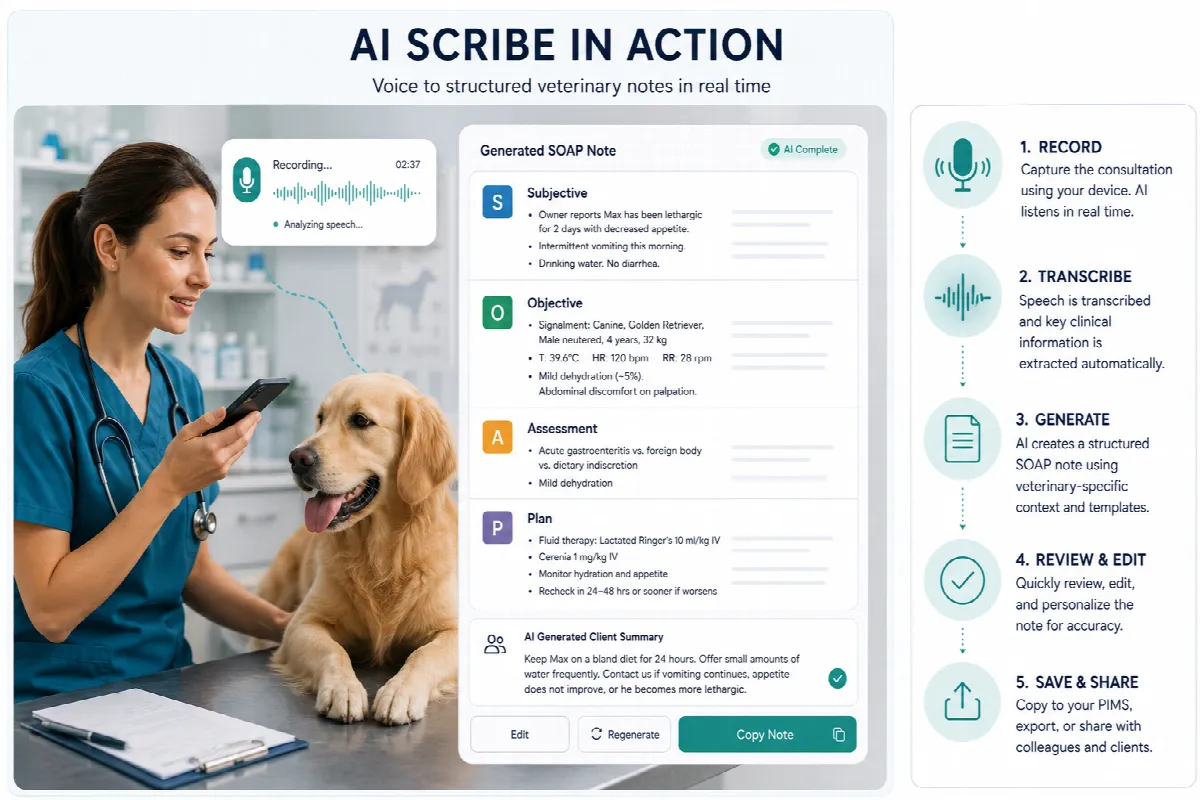
Veterinary AI scribes have moved beyond basic voice-to-text software. The stronger products now listen to consultations, separate relevant clinical details from small talk, generate structured SOAP notes, prepare discharge instructions and transfer finished records into practice-management software.
The products are not interchangeable, however.
Some are affordable note generators built for independent veterinarians. Others are broader clinical platforms with patient-history summaries, phone-call documentation, differential diagnosis tools, direct PIMS integrations and enterprise security controls. Pricing ranges from free plans to more than $200 per veterinarian per month.
The quick answer
For most independent veterinarians, VetVisit AI offers one of the strongest combinations of price, unlimited use, veterinary-specific templates and straightforward workflow.
VetRec is the stronger option for practices that prioritize direct PIMS integration and enterprise security. Scribenote has the most useful permanently free plan. HappyDoc can be particularly economical for multi-doctor clinics because its pricing starts at a flat clinic rate rather than charging for every veterinarian.
Here are the category winners:
| Category | Recommended veterinary AI scribe |
|---|---|
| Best overall value | VetVisit AI |
| Best for PIMS integration | VetRec |
| Best free veterinary AI scribe | Scribenote |
| Best clinical copilot | CoVet |
| Best for veterinary dentistry | ScribbleVet |
| Best for multi-doctor clinics | HappyDoc |
| Best for clinical references and toxicology | VetGeni |
| Best multilingual budget option | PawfectNotes |
| Best for species and template variety | Coggo |
| Best dictation-first workflow | Talkatoo |
Veterinary AI scribe comparison
Prices below are publicly displayed US prices or their monthly equivalent as of July 21, 2026. Annual billing, regional pricing and enterprise contracts may differ.
| Tool | Best for | Published price | Free access | Main trade-off |
|---|---|---|---|---|
| VetVisit AI | Independent and specialty practices | $50/user/month annually; $70 monthly | 7-day trial | No direct PIMS integration |
| VetRec | Integrated and enterprise workflows | $99/vet/month annually; $150 monthly | 14-day trial | Higher per-vet cost |
| Scribenote | Free and low-friction adoption | Free; Pro from $79/DVM/month annually | Permanent free plan | Advanced templates and features require Pro |
| CoVet | Documentation plus clinical assistance | $45.83/month for 100 generations; $99 unlimited | 14-day trial | Entry plan has a usage limit |
| ScribbleVet | Dental, specialty and Plumb’s-supported workflows | $40 for 150 notes; unlimited from $150/DVM/month annually | 14-day trial | Unlimited tier is relatively expensive |
| HappyDoc | Multi-doctor clinics and PIMS write-back | From $119/month per clinic | Demo and 60-day guarantee | Full plan pricing requires a sales conversation |
| VetGeni | Reference-backed clinical support | $50/doctor/month | 14-day trial | Direct integration currently centers on Cornerstone |
| PawfectNotes | Multilingual and mixed-language visits | From $29/month; unlimited from $59 | Permanent free plan | Integration depth varies by PIMS |
| Coggo | Multi-species and template-heavy practices | $99/vet/month annually; $129 monthly | 10 notes/month free | Fewer established direct PIMS connections |
| Talkatoo | Vets who prefer dictation and voice commands | From $40/user/month annually | Trial available | Full toolkit costs more than the entry plan |
Pricing and feature details were checked against the vendors’ current product and pricing pages.
How this comparison was conducted
This ranking considers six factors:
- Veterinary documentation capability: SOAP notes, surgical reports, dental notes, discharge instructions and custom formats.
- Workflow: recording options, editing experience, phone documentation and PIMS transfer.
- Pricing: the realistic cost for a working veterinarian, not simply the cheapest advertised tier.
- Clinical depth: signalment, multiple species, history summaries, medications and specialty-specific templates.
- Security and data handling: encryption, retention policies, access controls and independent certifications.
- Practice fit: whether the product works best for a solo veterinarian, a mobile practice, a general clinic or a larger hospital group.
This was a desk-based comparison of public documentation, not a controlled clinical accuracy study. No common, independently administered test set is currently published across all ten vendors. Claims such as “99% accuracy” are therefore not treated as proof that one product is clinically more accurate than another.
The final decision should be based on a trial using real consultations from your own practice.
The 10 best veterinary AI scribes in 2026
1. VetVisit AI — Best overall value for independent veterinary practices
Best for: Solo veterinarians, independent clinics, mobile vets and practices that need several documentation formats without paying premium per-DVM pricing.
Price: $70 per user monthly or $50 per user monthly when billed annually. A seven-day trial is available without a credit card.
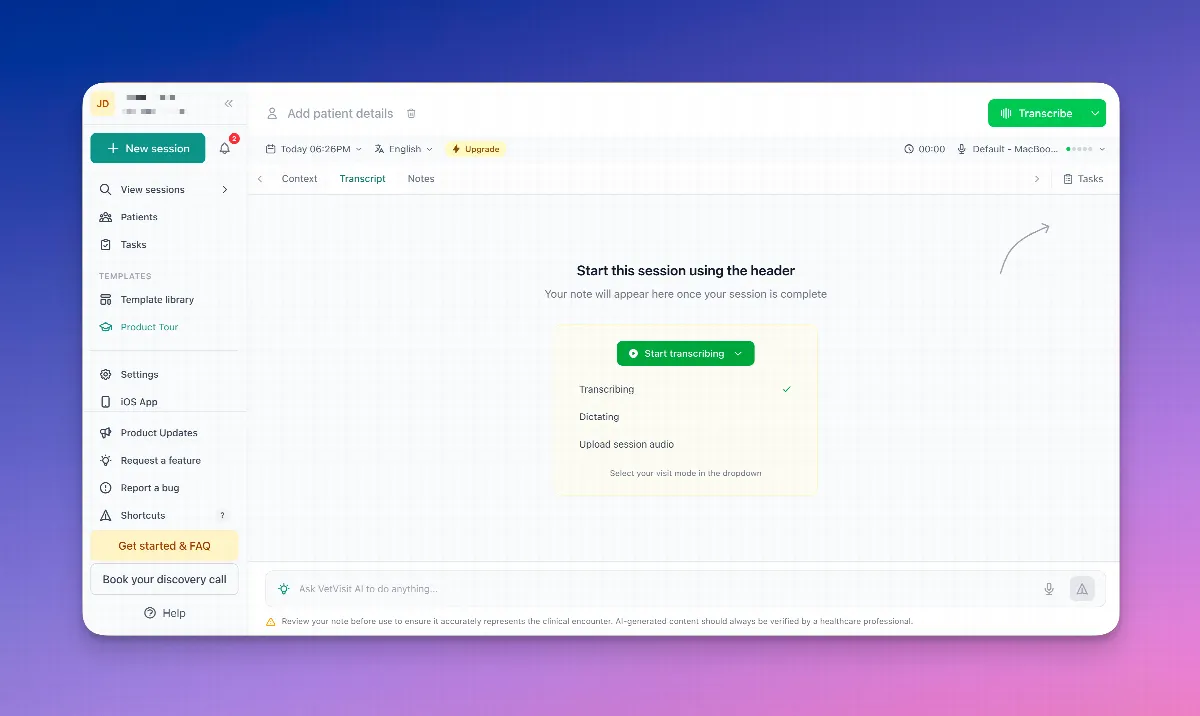
VetVisit AI is a browser-based ambient veterinary scribe that turns recorded consultations into structured medical records. Its main advantage is the amount of documentation functionality included in one relatively inexpensive plan.
The platform includes unlimited visits, 29 built-in veterinary note formats, custom templates, multilingual transcription and client discharge instructions. Its generated notes can account for species, breed, sex and weight rather than treating every consultation as a generic medical encounter.
That signalment-aware approach matters. A veterinary record frequently depends on species and life-stage context in a way that a human medical scribe does not need to consider.
VetVisit AI also covers more than the standard SOAP format. Its template library includes dental, surgical and discharge documentation, and users can describe a new format to the template assistant rather than building every field manually.
What VetVisit AI does well
- Unlimited consultations on the standard paid plan
- 29 built-in veterinary documentation formats
- Custom templates included
- Signalment-aware note generation
- Client-facing discharge instructions
- Multilingual transcription
- Works in a browser on computers, tablets and phones
- Competitive pricing for solo veterinarians and smaller teams
Where it is weaker
VetVisit AI currently relies on one-click copy and paste rather than direct PIMS write-back. That makes it broadly compatible, but clinics that want appointments imported automatically and notes placed into specific PIMS fields may prefer VetRec or HappyDoc.
The native iOS application is also still listed as coming soon. The web application works on mobile devices, but it does not yet provide the same offline recording workflow as a mature native app.
On privacy, VetVisit AI states that recordings are deleted after transcription, normally within 24 hours. Transcripts and notes are retained for the subscription period plus 30 days unless earlier deletion is requested. Its privacy policy also permits de-identified data to be retained for service improvement, so organizations with stricter data-governance requirements should confirm exactly what settings and contractual options are available.
Verdict
VetVisit AI is the strongest default option in this comparison for an independent practice that wants unlimited use, multiple veterinary note types and transparent pricing without paying for a large integration platform.
It is not the best choice when direct PIMS synchronization is mandatory. For clinics comfortable reviewing the note and copying it into their existing system, however, its price-to-function ratio is difficult to ignore.
2. VetRec — Best for PIMS integration and enterprise veterinary groups
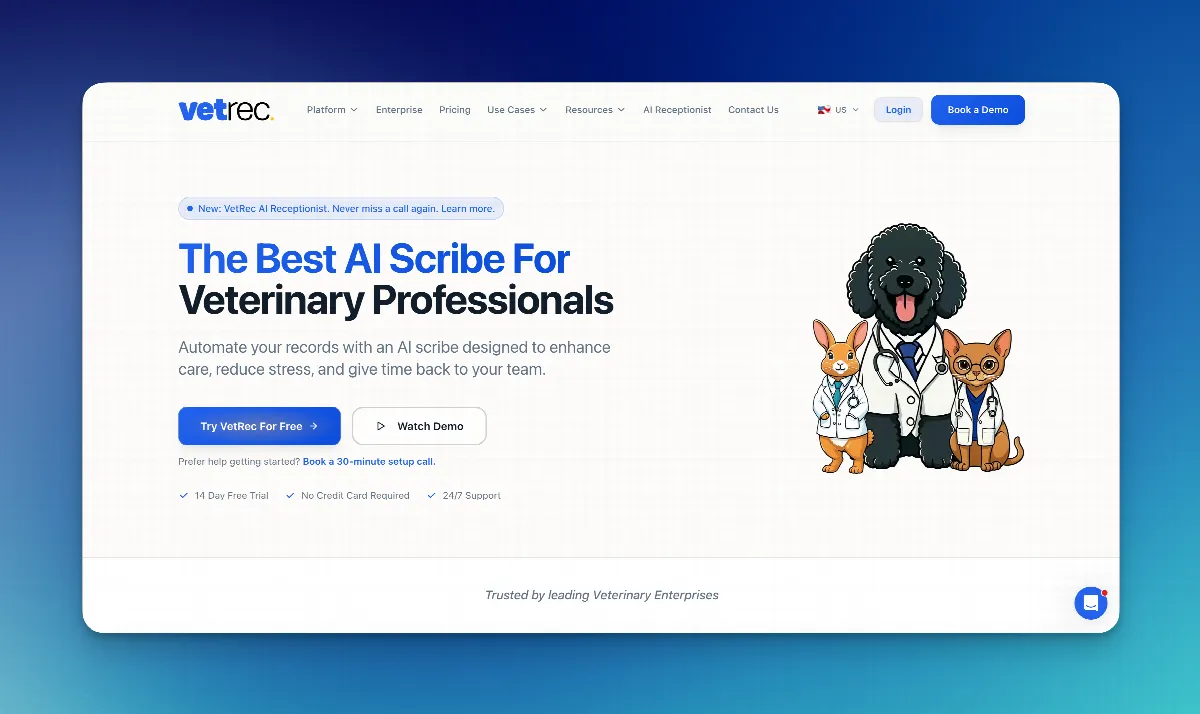
Best for: Clinics that want appointments imported from their PIMS, records written back into it and stronger enterprise security controls.
Price: From $99 per veterinarian per month with annual billing or $150 with monthly billing. Technicians and front-desk accounts are included. A 14-day trial is available.
VetRec combines ambient scribing with one of the broadest documented PIMS integration sets in the category.
Its help center lists workflows for Cornerstone, Avimark, ezyVet, ImproMed, Instinct, IntraVet, Pulse, Vetspire, Shepherd and Merlin. The exact integration level varies: some systems support appointment synchronization and editable note export, while others use an extension or simpler export method.
VetRec also includes multi-pet appointments, telephone-call recording, specialty templates, custom template creation and Records Recap, which summarizes previous records before the consultation. Its D.A.V.I.D. assistant adds clinical support beyond basic note generation.
What VetRec does well
- Broad PIMS coverage
- Appointment synchronization for supported systems
- Direct or assisted note export
- Multi-pet consultation support
- Phone-call documentation
- Patient-history summaries
- Specialty and custom templates
- Free support-staff seats
- iOS and Android applications
VetRec has one of the clearest public security positions among the tools reviewed. It lists SOC 2 Type II certification, HIPAA and GDPR compliance, TLS 1.3 encryption in transit, AES-256 encryption at rest and contractual restrictions preventing AI providers from training on customer data. Enterprise customers can request custom retention policies and data-processing agreements.
Where it is weaker
Cost is the main issue. A three-doctor practice would pay approximately $297 per month at the annual rate. That may be justified when direct integration removes manual work, but it is considerably more than a simpler copy-and-paste scribe.
Practices should also verify the exact capability of their PIMS connection. “Integration” can mean appointment synchronization and field-level write-back, a browser extension, PDF attachment or little more than formatted copy and paste.
Verdict
VetRec is the best fit when documentation automation must connect deeply with an existing PIMS or when security certification is a procurement requirement.
For a solo vet who only needs a reliable SOAP note, it may be more platform—and more expense—than necessary.
3. Scribenote — Best free veterinary AI scribe
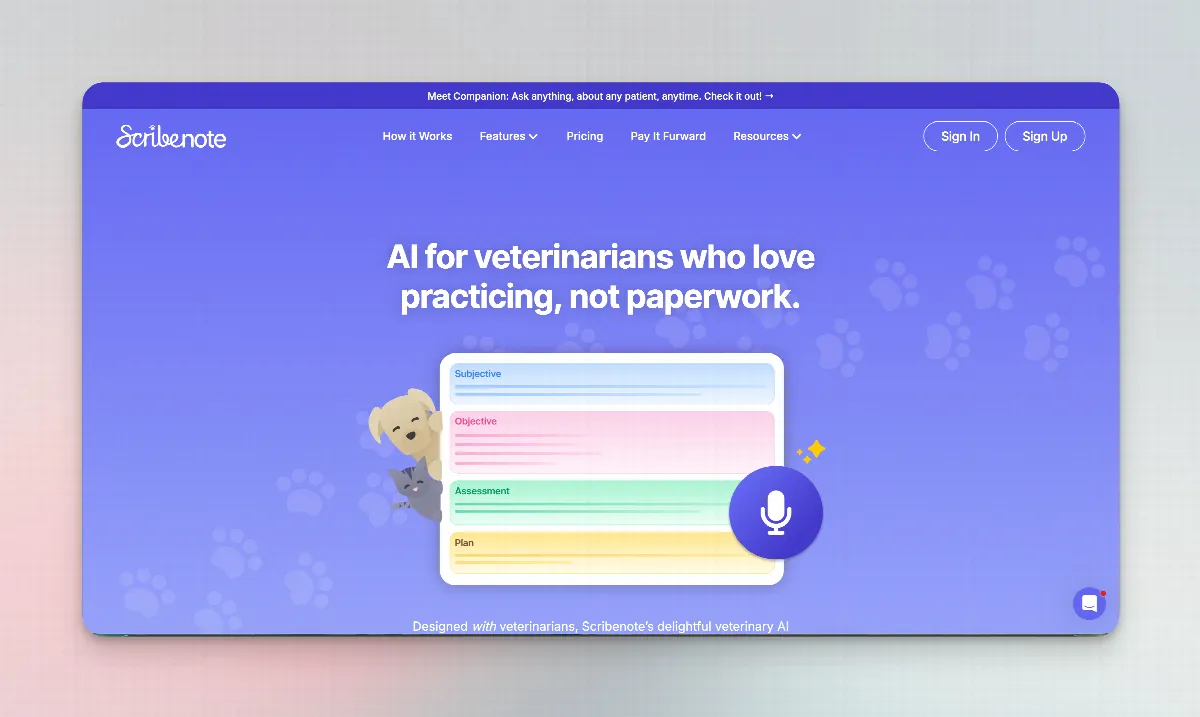
Best for: Veterinarians who want to test AI documentation over an extended period without paying or entering a card.
Price: Free for unlimited use on standard models. Pro costs $79 per DVM per month annually or $99 monthly.
Scribenote has the most generous clearly documented free plan in this comparison. The free tier includes unlimited note generation using its standard AI and transcription models, Teams Mode for care-team members and PIMS workflow support.
New accounts receive two weeks of Pro before moving to the free plan. Pro adds higher-quality transcription, more advanced models, custom templates, direct phone-call documentation and human support.
Scribenote supports two main approaches to PIMS workflow. PIMSPal is a browser extension for systems such as ezyVet and Pulse, while Widget Mode places a floating Scribenote window beside products such as Avimark and Cornerstone for drag-and-drop or copy-and-paste transfer.
What Scribenote does well
- Permanently free unlimited note generation
- No credit card required
- Care-team access
- Custom templates on Pro
- Scribephone for telephone calls
- Client summaries on paid plans
- PIMS browser and widget workflows
- SOC 2 Type II certification
Where it is weaker
The free plan uses the standard transcription and generation models. Practices that need custom formatting, direct calling, client summaries or the highest available transcription quality will need Pro.
Scribenote also states that non-personally identifiable appointment data may be used for model improvements on the free plan. Pro and Enterprise customers are opted out by default. Practices should consider that difference when comparing “free” plans.
Verdict
Scribenote is the most sensible starting point for a veterinarian who wants to understand how ambient documentation fits into daily practice before committing to a subscription.
It is also a credible long-term option for low-complexity documentation, provided the free plan’s model and data settings meet the practice’s requirements.
4. CoVet — Best veterinary AI copilot
Best for: Veterinarians who want a broader clinical and administrative assistant rather than a SOAP-note generator alone.
Price: Essentials costs $550 per year, equivalent to $45.83 per month, and includes 100 generations monthly. Unlimited costs $99 per month on the published annual plan. A two-week trial is available.
CoVet describes itself as a veterinary copilot, which is a fair distinction. In addition to recording consultations and producing documentation, it can summarize uploaded medical histories, process PDFs and files, create tasks and checklists, document telephone calls and provide a real-time clinical chat function.
The Unlimited plan includes unrestricted generations, custom templates, a standard template library and AI chat. Support accounts for administrative staff, technicians and nurses are free, although their generation capabilities are tied to supported users.
What CoVet does well
- Ambient consultation recording
- Medical-history summarization
- File and PDF processing
- Phone-call documentation
- Custom template generation
- Tasks and checklists
- Clinical chat
- Free support-staff accounts
- Strong documented compliance position
CoVet’s pricing page lists ISO 27001, SOC 2 Type II, HIPAA, PIPEDA and GDPR compliance, together with end-to-end encryption. That makes it particularly relevant for larger or multi-jurisdictional organizations with formal vendor-review processes.
Where it is weaker
The Essentials plan is inexpensive but capped at 100 generations per month. A full-time clinician can exceed that quickly, especially if one appointment produces several documents.
The product’s breadth can also be unnecessary for a veterinarian who only wants a clean SOAP note and discharge instructions.
Verdict
CoVet is a strong option for clinicians who want AI assistance before, during and after the consultation. Its combination of history processing, documentation and clinical chat gives it more depth than a conventional scribe.
5. ScribbleVet — Best for dental documentation and Plumb’s workflows
Best for: Dental-heavy practices, specialty hospitals and teams interested in ScribbleVet’s developing integration with Instinct and Plumb’s.
Price: Essential costs $40 per user monthly for 150 SOAP notes, with an additional 100 notes costing $20. Unleashed costs $150 per active DVM monthly with annual billing or $200 with monthly billing. Support staff are included on Unleashed.
ScribbleVet is one of the more mature veterinary-specific scribes. It records natural consultations, filters out unrelated conversation and produces editable SOAP notes without requiring users to dictate punctuation or follow a script.
Its distinctive features include visual canine dental charts, Care Cards for client instructions, Direct Dial for phone documentation, customizable outputs and Plumb’s integration on the Unleashed plan.
ScribbleVet also offers one-click transfer workflows for ezyVet, Pulse and Vetspire, with other transfer options depending on the PIMS.
What ScribbleVet does well
- Strong veterinary-specific workflow
- Visual dental chart generation
- Customizable SOAP templates
- Care Cards and client instructions
- Phone-call documentation
- Plumb’s integration
- Support-staff accounts included on Unleashed
- Web and mobile access
In January 2026, Instinct Science acquired ScribbleVet. Instinct has stated that ScribbleVet will continue supporting multiple PIMS products while deeper integration is developed with Instinct EMR and its clinical resources.
Where it is weaker
The $40 Essential plan is attractive, but it is not unlimited and provides only selected access to the product’s broader tools. The full Unleashed package is one of the more expensive products in this comparison.
A three-doctor clinic would pay approximately $450 per month at the annual per-DVM rate.
Verdict
ScribbleVet is particularly compelling for veterinary dentistry and for hospitals already using or considering the Instinct ecosystem.
For routine general-practice SOAP notes, less expensive products may provide sufficient functionality.
6. HappyDoc — Best pricing for multi-doctor clinics
Best for: Clinics with several doctors, technicians and administrative users, particularly those using Avimark or Cornerstone.
Price: Starts at $119 per month for unlimited users. HappyDoc offers a 60-day money-back guarantee.
HappyDoc is unusual because its entry pricing is per clinic rather than per veterinarian. For a four- or five-doctor practice, that difference can outweigh almost every other pricing consideration.
The company positions HappyDoc as an AI scribe and assistant, with automated records, customizable templates, clinic-level insights and integrations. Its current website emphasizes Avimark and Cornerstone, while also listing workflows for ImproMed, ezyVet, Vetspire, Shepherd and other systems. A browser extension is available for PIMS products without a native connection.
What HappyDoc does well
- Flat pricing for unlimited users
- Strong Avimark and Cornerstone positioning
- Bidirectional integrations for supported PIMS products
- Browser extension for other systems
- Custom templates
- Built-in AI assistant
- Clinic analytics and workflow tools
- 60-day money-back guarantee
Where it is weaker
Only the starting price is public. The precise differences between HappyScribe, HappyAssistant and HappyAdvisor require a demonstration or sales conversation.
The flat rate is excellent for larger teams, but it may not be the cheapest option for a solo veterinarian who does not need PIMS integration.
Vendor-published accuracy percentages should also be interpreted cautiously unless the vendor provides the test set, error definition, reviewer methodology and results for clinically significant errors.
Verdict
HappyDoc offers the most attractive pricing structure for many multi-doctor clinics. A practice should put it near the top of its shortlist when all doctors and support staff need access, especially when Avimark or Cornerstone integration is important.
7. VetGeni — Best for reference-backed clinical support
Best for: Veterinarians who want documentation combined with drug, toxicology and clinical-reference tools.
Price: $50 per doctor per month. A 14-day trial is available without a credit card.
VetGeni combines ambient scribing with clinical-support functions. Its Professional plan includes SOAP notes, treatment plans, discharge letters, toxicology information, drug protocols and an IDEXX Cornerstone integration.
The product’s main differentiator is its use of Wiley-licensed veterinary references. Rather than positioning the language model itself as a source of clinical truth, VetGeni connects parts of its clinical-support experience to licensed reference material.
What VetGeni does well
- Competitive $50 monthly price
- Ambient scribing and SOAP notes
- Treatment plans and discharge instructions
- Wiley-licensed clinical references
- Drug and toxicology resources
- IDEXX Cornerstone integration
- Pet Parent Portal
- Dedicated student plan
Where it is weaker
Its publicly documented direct PIMS integration is narrower than VetRec’s or HappyDoc’s. Clinics that do not use Cornerstone should verify how records will be transferred.
Clinical-support features must also remain separate from clinical responsibility. A reference-connected assistant can make information easier to retrieve, but the veterinarian still needs to verify doses, contraindications, differentials and treatment decisions.
Verdict
VetGeni is one of the strongest values for a veterinarian who wants clinical-reference functions in the same product as the scribe.
It is less compelling when broad PIMS connectivity is the main requirement.
8. PawfectNotes — Best multilingual budget option
Best for: Multilingual practices, mixed-language consultations and price-sensitive users.
Price: Free plan available. Paid pricing starts at $29 per veterinarian monthly, with unlimited notes advertised from $59.
PawfectNotes supports more than 30 languages and explicitly targets mixed-language appointments. A veterinarian can, for example, speak English with the team while a client speaks Spanish or Arabic, with the resulting note produced in the selected output language.
Its product includes SOAP notes, discharge notes, mobile access, automatic patient-name recognition and a browser companion for cloud-based PIMS systems. The website advertises compatibility with a large number of EMR products through its extension and copy-and-paste workflows.
The free plan currently provides 50 sessions during the first month and 20 per month thereafter. The pricing page lists a 100-session Starter tier and an Unlimited tier.
What PawfectNotes does well
- One of the lowest paid entry prices
- Permanent free plan
- More than 30 supported languages
- Mixed-language consultation support
- SOAP and discharge documents
- Mobile application
- Browser-based PIMS companion
- Automatic patient-name recognition
Where it is weaker
Practices should distinguish between browser-extension compatibility and a genuine bidirectional PIMS integration. A tool appearing beside an EMR and placing formatted text into it is useful, but it is not identical to importing the schedule, retrieving patient history and writing data into mapped fields.
Its pricing and free-plan allowances have also changed over time, so the live checkout should be verified before making a clinic-wide calculation.
Verdict
PawfectNotes deserves consideration from any practice serving a multilingual client base. Its free tier and low entry pricing also make it easy to include in a side-by-side trial.
9. Coggo — Best for template and species breadth
Best for: Mixed practices, exotic-animal veterinarians and teams that need several document types from one recording.
Price: Free for 10 notes per month. Pro costs $99 per veterinarian monthly with annual billing or $129 monthly.
Coggo generates six possible documents from a recording: a SOAP note, narrative record, owner recap, surgery report, referral letter and differential list.
It also advertises 150 templates across 14 species, ten languages, voice-extracted vital signs, telephone-call recording and multi-clinic support. Its native mobile applications are available for iOS and Android.
What Coggo does well
- Six document types from one recording
- 150 specialty templates
- Support for 14 species
- Ten human-translated languages
- Voice-extracted vital signs
- Phone-call documentation
- Free plan
- iOS and Android applications
- Multi-clinic controls on the standard Pro plan
Where it is weaker
Coggo’s currently named direct PIMS connections are less extensive than VetRec’s. Its built-in API provides a route for future integrations, but practices should not treat the availability of an API as proof that their PIMS is already integrated.
The price also places it close to VetRec and CoVet, both of which have a longer public track record and more extensive certification claims.
Coggo states that customer audio and notes are encrypted and not used to train AI models, with zero-retention agreements maintained with its AI and transcription providers.
Verdict
Coggo is notable for breadth. It is particularly relevant for mixed, equine and exotic practices whose documentation cannot be reduced to one small-animal SOAP format.
10. Talkatoo — Best dictation-first veterinary workflow
Best for: Veterinarians who prefer deliberate dictation, desktop voice entry and control over what is recorded.
Price: The SOAP Notes plan starts around $40 per user monthly with annual billing. The broader Ultimate toolkit has been publicly listed around $116 per user monthly on annual billing or $126 monthly.
Talkatoo began as veterinary dictation software and has expanded into AI-generated records. That history makes it different from products designed primarily around ambient recording.
Its current plans include Auto Records, default templates, automated follow-up, call summaries, an AI assistant, medical-history summarization and desktop dictation. Custom templates are included in the Ultimate tier.
What Talkatoo does well
- Established veterinary voice workflow
- Desktop dictation
- Automatic structured records
- Medical-history summarization
- Call summaries
- Client follow-up tools
- Custom templates on Ultimate
- Mobile and desktop applications
Where it is weaker
The entry plan does not provide the full toolkit. A clinic comparing Talkatoo with a complete ambient scribe should compare the Ultimate plan rather than the lowest advertised rate.
Dictation also requires more deliberate clinician input than ambient recording. Some veterinarians prefer that control; others want the software to capture the natural consultation without a separate dictation step.
Public comparison data places Ultimate at approximately $116 per user monthly with annual billing and $126 monthly, although practices should verify the current amount at checkout.
Verdict
Talkatoo is best viewed as a voice-productivity platform that now includes AI scribing. It remains a strong choice for veterinarians who already prefer dictation and do not want every consultation recorded ambiently.
How much does a veterinary AI scribe cost for a three-doctor clinic?
The pricing model often matters more than the headline price.
The table below estimates the monthly software cost for three full-time veterinarians using the lowest published unlimited or practical full-time tier. It excludes tax, negotiated discounts and enterprise contracts.
| Tool | Approximate monthly cost for 3 vets | Support-staff pricing |
|---|---|---|
| VetVisit AI | $150 annually billed | Additional paid users |
| VetRec | $297 annually billed | Technicians and front desk included |
| Scribenote Pro | $237 annually billed | Care-team members included |
| CoVet Unlimited | $297 annually billed | Support accounts free |
| ScribbleVet Unleashed | $450 annually billed | Support staff included |
| HappyDoc | From $119 per clinic | Unlimited users |
| VetGeni | $150 | Separate seats may be required |
| PawfectNotes Unlimited | From $177 | Confirm team arrangement |
| Coggo Pro | $297 annually billed | Confirm role requirements |
| Talkatoo Ultimate | Approximately $348 annually billed | Per-user pricing |
This is why HappyDoc can be inexpensive for a large team while being unnecessary for a solo veterinarian. It is also why a $40 entry plan is not automatically the cheapest choice: usage caps, overages and gated features can change the real cost.
A useful cost formula is:
True monthly cost = subscription + extra seats + usage overages + integration fees + clinician editing time
The final term is often the largest. Saving $40 per month on software is a poor trade if each generated record requires another five minutes of correction.
How to test a veterinary AI scribe properly
A polished demonstration is not a meaningful test. Vendors choose cases that suit their product and conduct demonstrations in controlled conditions.
A better evaluation uses 15 to 20 real consultations from your practice.
Include:
- Four routine wellness or vaccination appointments
- Four sick-patient consultations
- Two consultations involving several active problems
- One multi-pet appointment
- Two dental or surgical cases
- Two client telephone calls
- One noisy consultation
- One appointment involving an accent or more than one language
- One species outside your clinic’s most common workflow
For each note, record the following:
1. Editing time
Measure the time from opening the generated record to approving the final version. Do not rely on how quickly the initial draft appears.
2. Clinically significant omissions
Check whether the scribe omitted:
- Medication doses
- Abnormal examination findings
- Diagnostic results
- Client decisions
- Declined treatments
- Follow-up timing
- Safety-netting instructions
3. Incorrect additions
An AI scribe should summarize what occurred. It should not invent a normal finding, diagnosis, medication or recommendation that was not stated.
4. Note structure
Ask whether the output matches the way your clinic actually documents cases. A technically complete note can still create work when every section needs to be rearranged.
5. PIMS transfer time
Measure how long it takes to move the approved note into the permanent record. Include login changes, copying, field mapping and formatting corrections.
6. Client-summary quality
Give the generated discharge instructions to a staff member who was not present during the consultation. Ask whether the instructions clearly explain medication, monitoring, follow-up and reasons to contact the clinic.
7. Performance under imperfect conditions
Do not judge a scribe only in a quiet room with one clear speaker. Test interruptions, barking, movement, telephone audio and clients who provide a long or disorganized history.
Veterinary AI scribe security: questions every clinic should ask
Veterinary records contain client information, clinical decisions and commercially sensitive practice data. A security badge on a website is useful, but it does not answer every operational question.
Ask each vendor:
- Where are audio, transcripts and notes stored?
- How long is the original audio retained?
- Can the clinic choose a shorter retention period?
- Is any customer data used to train or improve models?
- Does that include de-identified data?
- Which transcription, hosting and language-model providers process the data?
- Can all records be exported before cancellation?
- How quickly is data deleted after an account closes?
- Are role-based permissions and audit logs available?
- Has the platform completed an independent SOC 2 or ISO 27001 audit?
- Is a data-processing agreement available?
- What happens if the service is acquired or closes?
The AVMA’s ethical principles treat information in veterinary medical records as confidential. In the UK, the RCVS states that AI-generated clinical records must be manually verified and edited where necessary, with the veterinary professional retaining responsibility for the final record.
Recording consent also requires attention. Requirements vary by jurisdiction, but obtaining clear client consent is the safer operational standard even where one-party consent may technically apply. AAHA’s implementation guidance recommends examining vendor policies, team workflow, transparency and consent rather than treating an AI scribe as a simple transcription purchase.
Ambient AI scribe vs veterinary dictation software
These categories are often mixed together, but they create different workflows.
Ambient veterinary AI scribe
An ambient scribe records the natural consultation. The veterinarian speaks with the client and verbalizes relevant examination findings. The software separates clinical content from unrelated conversation and produces a structured draft.
This usually requires the least additional work during the appointment.
Veterinary dictation software
With dictation, the veterinarian deliberately speaks the record after or during the consultation. The software converts that speech into text or organizes it into a template.
Dictation provides more control over what enters the record and may reduce consent concerns because the client conversation itself does not always need to be recorded. It also requires the veterinarian to perform an additional documentation step.
Neither method is universally better. The right choice depends on whether the veterinarian prefers natural capture or controlled narration.
Which veterinary AI scribe is best for each practice type?
Solo veterinarian
Start with VetVisit AI, Scribenote or VetGeni.
VetVisit AI offers a broad paid feature set at $50 per month annually. Scribenote provides a permanent free option. VetGeni adds clinical-reference tools at the same $50 monthly price point.
Two- to five-doctor general practice
Compare HappyDoc, VetRec and VetVisit AI.
HappyDoc’s flat clinic pricing may be the least expensive. VetRec offers stronger documented PIMS integration. VetVisit AI is more affordable when only a few clinicians need accounts and copy-and-paste is acceptable.
Emergency or specialty hospital
Compare VetRec, ScribbleVet and CoVet.
VetRec provides enterprise security and broad PIMS connectivity. ScribbleVet has deeper dental and developing Instinct/Plumb’s workflows. CoVet adds file analysis, history summaries and clinical chat.
Mobile or large-animal veterinarian
Compare Coggo, CoVet and VetVisit AI.
The important questions are native mobile recording, offline capability, species-specific templates and how the product behaves with weak connectivity.
Multilingual practice
Start with PawfectNotes, then compare VetVisit AI and Coggo.
PawfectNotes has the broadest advertised language coverage and explicitly supports conversations that mix languages.
Dental-heavy practice
ScribbleVet is the first product to test because of its visual dental-chart workflow. A clinic should still compare the generated chart against its existing dental documentation requirements.
Clinic using Avimark or Cornerstone
HappyDoc and VetRec deserve the first demonstrations. VetGeni is also relevant for Cornerstone users who want reference and toxicology support.
Practice seeking a free veterinary AI scribe
Scribenote offers unlimited notes on its standard models. PawfectNotes and Coggo offer permanent free tiers with monthly usage limits.
Frequently asked questions
What is the best veterinary AI scribe in 2026?
VetVisit AI is the best overall value for many independent veterinarians because it combines unlimited visits, 29 veterinary note formats, custom templates and client instructions at $50 per user per month with annual billing.
VetRec is better when direct PIMS integration and enterprise security are the priorities. HappyDoc may be better for larger teams because its pricing starts at a flat clinic rate.
Is there a free AI scribe for veterinarians?
Yes. Scribenote provides unlimited note generation on its free standard-model plan. PawfectNotes offers a permanent free allowance, and Coggo includes 10 notes per month on its free plan.
Free plans may differ from paid plans in transcription quality, templates, integrations, support and data-improvement settings.
How much does a veterinary AI scribe cost?
Most products cost between $50 and $150 per veterinarian per month. Entry plans can start lower, while premium plans with integrations and advanced features may reach $200 per veterinarian monthly.
Flat clinic plans can be significantly cheaper for practices with several doctors.
Can an AI scribe write veterinary SOAP notes?
Yes. All ten products in this comparison can produce structured veterinary records, and most support SOAP notes directly.
The veterinarian must still review the output for omissions, incorrect findings, medication errors and statements that were not part of the consultation.
Does a veterinary AI scribe integrate with practice-management software?
Some do.
VetRec publishes connections covering systems including Cornerstone, Avimark, ezyVet, ImproMed, Instinct, Pulse and Shepherd. HappyDoc emphasizes bidirectional integrations with Avimark, Cornerstone and several other PIMS products. Other scribes use browser extensions, floating widgets or formatted copy-and-paste.
Ask the vendor to demonstrate the exact workflow inside your PIMS before subscribing.
Can AI-generated veterinary records be used without review?
They should not be.
A scribe creates a draft, not an independently verified medical record. The RCVS explicitly states that AI-generated clinical records should be checked manually and edited contemporaneously where required.
Is HIPAA required for veterinary records?
HIPAA generally governs protected human health information in the United States, not ordinary animal medical records. Some veterinary software vendors nevertheless design their systems around HIPAA controls or maintain HIPAA-related agreements because those standards provide a familiar security framework.
Veterinary practices still have confidentiality, contractual and data-protection obligations even when HIPAA does not apply.
Should a veterinary practice obtain consent before recording?
Obtaining clear consent is the safer practice.
Recording laws vary by location, and client expectations matter independently of the legal minimum. Clinics should explain what is recorded, why it is recorded, how long the audio is kept and whether the client can decline.
Are general medical AI scribes suitable for veterinarians?
They can produce notes, but they may lack veterinary-specific support for signalment, multiple species, herd or multi-pet encounters, veterinary medications and PIMS integrations.
A general tool should be tested against the same veterinary cases as a specialist product rather than assumed to be equivalent.
Final recommendation
There is no single veterinary AI scribe that wins every category.
Choose VetVisit AI when transparent pricing, unlimited visits, veterinary note variety and a simple browser workflow matter most.
Choose VetRec when direct PIMS integration, multi-pet workflows and formal security controls justify a higher per-doctor price.
Choose Scribenote when a genuinely useful free plan is the priority.
Choose HappyDoc when a multi-doctor clinic can benefit from flat unlimited-user pricing.
Choose CoVet or VetGeni when the product needs to assist with more than documentation.
The most reliable selection process is to shortlist two or three products, run the same 15 to 20 consultations through each and measure final editing time—not the speed or appearance of the first generated draft.
A veterinary AI scribe succeeds when it reduces total documentation work while preserving the accuracy, clarity and completeness of the permanent medical record. Everything else is secondary.
The UAE week, every Monday
The week's stories on jobs, visas, money and daily life in one short email. Unsubscribe in one click.