UAE Banks Offer Loan Deferments and Flexible Payment Plans Amid Regional Conflict
ADIB, FAB, and Ajman Bank launch loan deferments, zero processing fees, and cashback for frontline workers and SMEs amid regional conflict. Full details.
By Vadim Kouznetsov, published

If you’re worried about keeping up with loan payments during the current regional disruption, some UAE banks are stepping in with real relief. Loan deferrals, zero processing fees, cashback incentives, and preferential rates are now available — particularly if you’re a frontline worker or running a small business.
Here’s exactly what’s on offer and who qualifies.
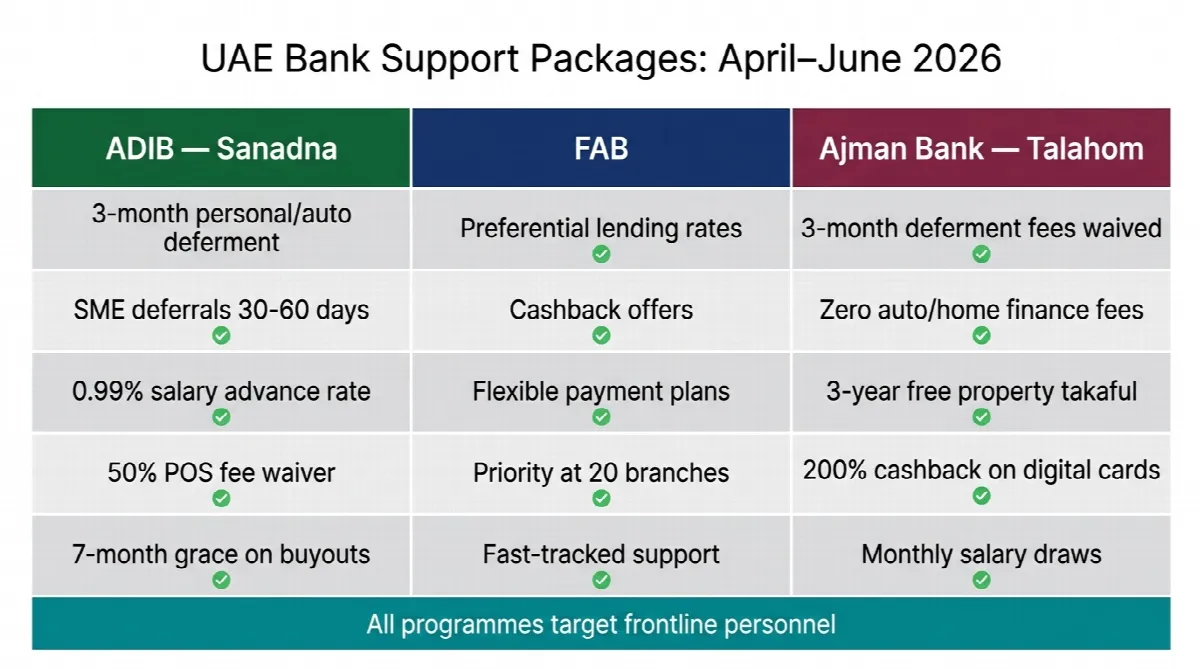
Key Takeaway: Abu Dhabi Islamic Bank (ADIB), First Abu Dhabi Bank (FAB), and Ajman Bank have all launched support packages offering loan deferments of up to three months, zero processing fees on auto and home finance, and preferential terms for frontline personnel and SMEs. These measures run through April to June 2026 and are designed to ease financial pressure caused by the US-Israel-Iran conflict.
Which Banks Are Offering Loan Deferments?
Three UAE banks have announced targeted support packages so far:
Abu Dhabi Islamic Bank (ADIB) — “Sanadna” Initiative
ADIB’s programme is the most comprehensive, covering both frontline workers and SMEs.
For SMEs:
- Instalment deferrals of 30 to 60 days between April and June 2026
- Up to 50% fee waiver on new POS services
- Takaful protection solutions to support business continuity
For frontline personnel (UAE Armed Forces, Ministry of Defence and Interior, police, civil defence, emergency medical services):
- Up to three months’ deferment on personal and auto finance instalments at no extra cost
- 0.99% rate on Al Yusr Salary Advance Finance
- Profit-free instalment plans for education expenses
- Extended grace periods — up to seven months on personal finance buyouts and six months on auto finance
First Abu Dhabi Bank (FAB)
FAB’s support package for frontline workers includes:
- Preferential lending rates
- Cashback offers
- Flexible payment plans and loan deferment options
- Priority services across 20 branches near key workplaces
- Fast-tracked contact centre support
Futoon Hamdan Al Mazrouei, Group Head of Personal, Business, Wealth and Privileged Client Banking at FAB, said: “We stand beside them, delivering meaningful support that eases everyday pressures.”
Ajman Bank — “Talahom” Initiative
Ajman Bank’s package includes:
- Personal finance instalment deferment fees waived for up to three months
- 200% cashback on first retail purchases through newly issued digital credit cards
- Free-for-life cards with no annual fees
- Zero processing fees on auto and home finance
- Complimentary property takaful for three years
- Waived donation commitments for three months on delayed home finance instalments
- Monthly cashback on home finance payments for up to five years
- Waived ATM switch fees
- Monthly salary draws — five winners receive an additional salary each month
Mustafa Al Khalfawi, CEO of Ajman Bank, confirmed: “Frontline personnel are a priority. This initiative reflects our commitment to supporting their financial stability.”
Who Qualifies as a Frontline Worker?
The programmes define frontline personnel as members of:
- UAE Armed Forces
- Ministry of Defence and Interior
- Police forces
- Civil defence
- Emergency medical services
If you fall into any of these categories, contact your bank directly to check eligibility and apply. Benefits are typically applied upon verification of your employer or service status.
How Do SMEs Benefit?
Small and medium-sized enterprises face particular pressure during the current conflict. Supply chains are disrupted, tourism demand has softened, and operating costs have risen sharply with diesel prices surging more than 70%.
ADIB’s SME support allows businesses to defer instalments for 30 to 60 days — enough breathing room to manage cash flow without defaulting. The POS fee waiver and takaful solutions add further protection for businesses already dealing with tighter margins.
These measures complement Dubai’s Dh1 billion government stimulus, which defers government fees and licensing costs for three months across all sectors.
What If You’re Not a Frontline Worker or SME Owner?
The packages announced so far are targeted. But if you’re a regular employee struggling with loan payments, you still have options under UAE banking regulations:
- Contact your bank proactively. UAE banks are required to work with customers facing genuine financial hardship. Reaching out before you miss a payment puts you in a stronger position.
- Request a restructuring. Banks can offer extended repayment terms, temporary payment reductions, or instalment holidays. These are discretionary but increasingly common during periods of economic stress.
- Check if your employer offers support. Some companies are adjusting salary structures or providing advances to help employees manage short-term financial pressures.
- Know your rights if you lose your job. If you’re made redundant, your end-of-service gratuity and final settlement can be used to manage outstanding loan obligations. Banks may also offer deferment options for unemployed borrowers.
How Does This Fit With the UAE Central Bank’s Resilience Package?
The individual bank initiatives sit alongside the UAE Central Bank’s broader Resilience Package, which focuses on maintaining liquidity and credit flow across the banking system.
While the Central Bank operates as the lender of last resort — providing monetary stability and exchange rate protection — individual banks like ADIB, FAB, and Ajman Bank are delivering the consumer-facing relief.
Together with Dubai’s fiscal stimulus and government fee deferrals, these measures form a coordinated response to protect businesses and individuals during the conflict.
What Should You Do Right Now?
If you hold loans with ADIB, FAB, or Ajman Bank:
- Check your eligibility by contacting your bank’s customer service or visiting a branch
- Gather your documents — employer verification, salary certificates, business licences for SMEs
- Apply early — deferment windows are time-limited (April to June 2026 for most programmes)
- Keep paying until your deferment is confirmed in writing — stopping payments without approval can trigger penalties
If your bank hasn’t announced a support package yet, it’s still worth calling. Many banks offer hardship programmes that aren’t publicly advertised.
FAQ
Which UAE banks are offering loan deferments in 2026?
Abu Dhabi Islamic Bank (ADIB), First Abu Dhabi Bank (FAB), and Ajman Bank have all announced loan deferment and financial relief packages as of April 2026.
Who qualifies for frontline worker benefits?
Members of the UAE Armed Forces, Ministry of Defence and Interior, police, civil defence, and emergency medical services qualify for preferential terms including loan deferments of up to three months.
Can SMEs defer loan payments?
Yes. ADIB’s Sanadna initiative allows SMEs to defer instalments for 30 to 60 days between April and June 2026, alongside POS fee waivers and takaful protection.
Are there fees for deferring loan payments?
ADIB and Ajman Bank have both waived deferment fees on personal finance instalments for eligible customers. FAB offers flexible payment plans but specific fee structures should be confirmed directly with the bank.
What is Ajman Bank’s Talahom initiative?
It’s a support package offering waived deferment fees for up to three months, zero processing fees on auto and home finance, complimentary property takaful for three years, and cashback incentives on digital credit cards and home finance payments.
Can I get zero processing fees on a mortgage?
Ajman Bank is offering zero processing fees on both auto and home finance as part of its Talahom initiative. This applies to eligible customers during the current support period.
What if my bank hasn’t announced a support package?
Contact your bank’s customer service and ask about hardship provisions. UAE Central Bank regulations require banks to work with customers experiencing genuine financial difficulty.
How long do these deferment programmes last?
Most programmes run from April to June 2026. Extensions depend on how regional conditions develop. Check with your bank for the latest timelines.
Will deferred payments affect my credit score?
Approved deferments through official bank programmes should not negatively impact your credit score, as the bank records them as authorised payment holidays. Confirm this in writing before accepting any deferment.
What happens after the deferment period ends?
Deferred instalments are typically added to the end of your loan term, extending your repayment period. The exact structure depends on your bank and loan agreement.
Further Reading
- What Happens to Your Bank Loan If You Lose Your Job in the UAE?
- UAE Bank Loan Default: Legal Rights When You Can’t Pay
- When Can Your Employer Deduct Your UAE End-of-Service Gratuity?
- Dubai First-Time Home Buyer Incentives: Complete 2025 Guide
- Cost of Living in Dubai: Current Prices & Required Salary
The UAE week, every Monday
The week's stories on jobs, visas, money and daily life in one short email. Unsubscribe in one click.