Cost of Living in Dubai: Current Prices & Required Salary in 2025
Find out everything you need to budget for your upcoming move to Dubai. Our guide on the cost of living in Dubai covers updated costs for 2025.
By Vadim Kouznetsov, published

Last updated: May 7, 2025
Considering a move to Dubai? You’re not alone. With its stunning architecture, tax-free salaries, and vibrant multicultural atmosphere, Dubai continues to attract expats from around the world. But before you relocate to Dubai, understanding the cost of living is essential for proper financial planning.
This comprehensive guide covers everything you need to budget for your move to Dubai in 2025, comparing costs with the UK and offering practical insights to help you determine if Dubai is the right financial fit for your lifestyle.
Is It Expensive to Live in Dubai in 2025?
Dubai’s reputation as a luxury destination often raises questions about affordability. According to recent data, Dubai ranks as the 15th most expensive city globally and the costliest in the Middle East as reported by Mercer. However, this high ranking comes with an important caveat – the absence of income tax significantly offsets the higher costs compared to many Western countries.
When comparing Dubai to major global cities:
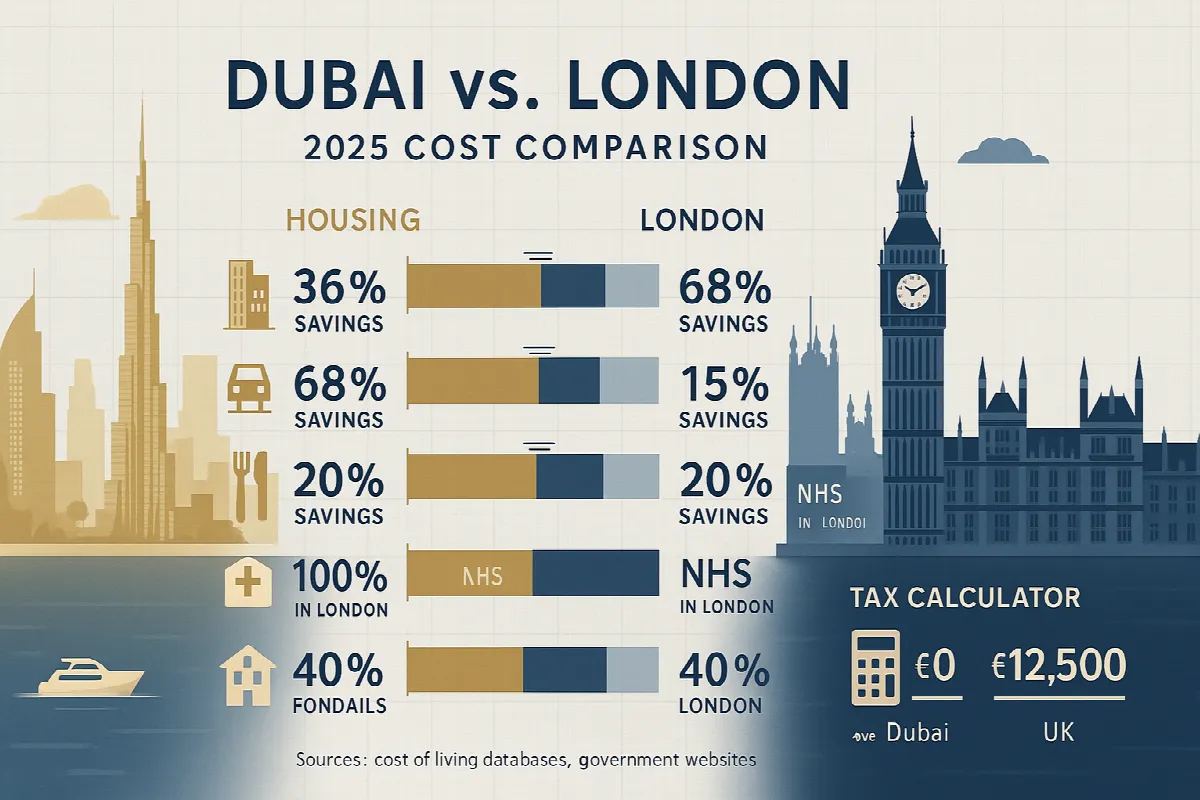
- Dubai is approximately 36% cheaper than London according to Expatistan’s April 2025 data
- London is about 56% more expensive than Dubai based on recent cost comparison analysis
- Dubai is approximately 50% cheaper than New York while remaining the most expensive city in the UAE
Despite these relatively favorable comparisons, it’s worth noting that living costs in Dubai have been rising. A significant contributing factor has been the substantial increase in rental prices, with monthly rent costs rising by 16% year-on-year and luxury apartments seeing increases of 25-30% according to recent market analysis. As explained in UAE Workers Push for Higher Allowances as Dubai Living Costs Surge, this trend has even prompted employees to seek increased housing allowances from employers.
How Much Money Do You Need to Live in Dubai?
The amount needed to live comfortably in Dubai varies significantly based on your lifestyle, family size, and chosen neighborhood. However, we can provide some general guidelines based on current data:
Monthly Living Expenses (Excluding Rent)
| Household Type | Monthly Cost (AED) | Monthly Cost (GBP) |
|---|---|---|
| Single Person | 4,106 | 849 |
| Family of Four | 14,293 | 2,955 |
These figures cover essentials like groceries, utilities, transportation, and typical entertainment costs, but exclude housing, which is typically the largest expense according to cost of living analyses.
For a comfortable lifestyle that includes decent accommodation, daily expenses, and the ability to save, most experts recommend:
- Single professionals: AED 15,000-20,000 monthly (£3,100-4,135)
- Families: AED 25,000-35,000 monthly (£5,170-7,240)
These figures align with the recommendation that a comfortable lifestyle in Dubai generally requires a monthly income ranging from AED 15,000 to AED 25,000 for individuals, with families needing more depending on their size and needs. For a deeper analysis of salary requirements, check out Do Jobs Pay Well in Dubai? for industry-specific insights.
Cost of Living in Dubai vs. the UK
While Dubai’s cost of living is high within the UAE context, it compares favorably to London and other major UK cities when considering the tax benefits.
Comparative Cost Breakdown
| Item | Dubai (AED) | Dubai (GBP) | London (GBP) |
|---|---|---|---|
| Monthly rent for 1-bedroom apartment (city centre) | 8,757 | 1,838 | 2,153 |
| Monthly rent for 3-bedroom apartment (city centre) | 16,923 | 3,640 | 4,150 |
| Monthly utilities (85m² apartment) | 722 | 153 | 290 |
| Monthly travel pass | 300 | 64 | 200 |
| Meal for 2 (mid-range restaurant, 3 courses) | 300 | 64 | 80 |
| Monthly salary (after tax, average) | 12,841 | 2,719 | 3,738 |
Sources: Data compiled from Numbeo and Expatistan, May 2025
Key differences that favor Dubai include:
- No income tax (compared to UK income tax rates of 20-45%)
- Lower utility costs
- Significantly cheaper public transportation
- More affordable dining options
However, the UK offers advantages in:
- Free public healthcare (NHS) versus mandatory private health insurance in Dubai
- More affordable educational options for families with children
- More temperate climate (reducing cooling costs)
Accommodation Costs in Dubai
Housing is typically the most significant expense for expats relocating to Dubai. Rental prices vary dramatically depending on the location, with premium areas commanding substantially higher prices.
Rental Costs by Area (2-Bedroom Properties)
| Location | Monthly Rent (AED) | Annual Rent (AED) | Annual Rent (GBP) |
|---|---|---|---|
| Palm Jumeirah | 20,731 | 248,776 | 53,480 |
| Downtown Dubai | 15,657 | 187,880 | 40,390 |
| Dubai Marina | 11,517 | 138,208 | 29,710 |
| Dubai Creek Harbour | 11,854 | 142,244 | 30,585 |
| Dubai Hills Estate | 11,451 | 137,417 | 29,545 |
| Dubai Sports City | 6,149 | 73,791 | 15,860 |
Source: Data from Engel&Volkers, May 2025
Important Rental Considerations
When relocating to Dubai, be prepared for rental practices that differ from the UK:
- Payment Structure: Unlike monthly payments common in the UK, Dubai landlords typically require rent in 1-4 cheques per year, with fewer cheques often resulting in better rates as noted in our detailed cost analysis.
- Security Deposits: Typically one month’s rent plus a 5% agent fee.
- Utility Connections: Budget approximately AED 1,000-2,000 (£215-430) for connection fees.
- Additional Fees: A 5% housing fee is added to your DEWA (Dubai Electricity and Water Authority) bill monthly, calculated based on your annual rent.
For those moving from the UK, it’s worth noting that if you’re relocating from regional areas rather than Central London, you may find Dubai rents significantly more expensive as highlighted in expatriate cost comparisons. For a comprehensive guide on finding accommodation when relocating, check out The Complete Cost to Live in Dubai as an Expat in 2025 for neighborhood-specific insights.

Transportation Costs in Dubai
Transportation in Dubai is generally more affordable than in the UK, particularly when compared to London. The city boasts an efficient public transport system, though many residents opt for cars due to the city’s sprawling layout.
Public Transport Costs
| Type | Cost (AED) | Cost (GBP) |
|---|---|---|
| One-way metro ticket (average) | 5-8 | 1.05-1.70 |
| Monthly travel pass | 300 | 64 |
| Taxi start (normal tariff) | 12 | 2.58 |
| Taxi (1km) | 2.50 | 0.54 |
Dubai’s public transport is significantly more affordable than London’s, with a monthly travel pass costing AED 300 (£64) compared to approximately £200 in London according to transport cost comparisons.
For drivers, fuel costs are substantially lower in Dubai than in the UK. Regular gasoline in Dubai costs approximately AED 3.06 per liter (£0.65) compared to around £1.51 in London based on recent fuel price tracking.
Healthcare and Insurance
Unlike the UK’s National Health Service (NHS), healthcare in Dubai requires private insurance, which is a mandatory requirement for all residents.
Healthcare Costs
| Service | Average Cost (AED) | Average Cost (GBP) |
|---|---|---|
| Dubai Health Card (Annual, for expats) | 320 | 68 |
| GP Visit with Health Card | ≤ 100 | ≤ 21 |
| Specialist Visit with Health Card | 150-300 | 32-64 |
| ER Visit with Health Card | 200-500 | 43-108 |
Insurance Costs
| Plan Type | Annual Cost (AED) | Annual Cost (GBP) |
|---|---|---|
| Basic Individual Plan | 700-2,000 | 150-430 |
| Comprehensive Individual Plan | 3,000-8,000 | 645-1,720 |
| Family Coverage (4 members) | 15,000-25,000 | 3,220-5,375 |
When relocating to Dubai from the UK, this shift from free healthcare to mandatory insurance represents a significant change in your financial planning as highlighted in our comprehensive cost analysis. Many employers provide basic health insurance coverage, but families often need to budget for additional coverage.
A comprehensive private health insurance plan for a 50-year-old expat costs approximately USD $395 (AED 1,450 or £312) monthly in 2025, typically including inpatient, outpatient, maternity, emergency evacuation, and repatriation coverage according to current insurance market rates.
Education Costs
For families relocating to Dubai with children, education expenses can be substantial. Unlike the UK’s free state education system, expat children must attend private schools in Dubai.
School Fees (Annual)
| School Type | Range (AED) | Range (GBP) |
|---|---|---|
| Budget Private Schools | 12,000-25,000 | 2,580-5,375 |
| Mid-Range Schools | 25,000-55,000 | 5,375-11,825 |
| Premium International Schools | 55,000-100,000+ | 11,825-21,500+ |
Dubai offers a wide range of educational options, from schools following the British curriculum to American, IB, and Indian curricula. While public schools (with capped fees of AED 6,000 annually) are technically available to expats, most international families opt for private international schools according to educational cost analyses.
Additional educational costs to consider include:
- Registration fees (AED 500-2,000)
- Admission fees (up to one month’s tuition)
- Transport (AED 5,000-10,000 annually)
- Uniforms and supplies (AED 2,000-5,000 annually)
Food and Grocery Costs
Food expenses in Dubai can vary dramatically depending on your shopping and dining habits. While imported specialty items can be expensive, basic groceries and local dining options are often more affordable than in the UK.
Grocery Costs
| Item | Average Cost (AED) | Average Cost (GBP) |
|---|---|---|
| Milk (1 liter) | 7.26 | 1.54 |
| Bread (500g loaf) | 5.50 | 1.18 |
| Rice (1kg) | 12.00 | 2.58 |
| Eggs (12) | 14.00 | 3.01 |
| Chicken Fillets (1kg) | 31.07 | 6.58 |
| Apples (1kg) | 9.00 | 1.94 |
| Tomatoes (1kg) | 6.50 | 1.40 |
Individual expats in Dubai spend approximately USD $490 (AED 1,800 or £387) on food each month, while a family of four might spend around USD $1,270 (AED 4,670 or £1,004) according to recent household expenditure analyses.
To economize on food costs:
- Shop at local markets rather than premium supermarkets
- Limit international brands and imported goods
- Take advantage of promotions and loyalty programs
- Consider local dining options over international chains
Tips for Reducing Your Living Costs in Dubai
While Dubai offers a high standard of living, there are many strategies to manage costs effectively:
Housing
- Consider areas further from the city center like Al Nahda, Mirdif, or Dubai Sports City
- Negotiate multiple cheque payments if possible
- Look for properties with included chiller fees (AC costs)
- Consider sharing accommodation (for singles or couples)
Transportation
- Use public transport where possible
- Consider carpooling apps for commuting
- If purchasing a car, consider the used market
Food & Groceries
- Shop at hypermarkets like Lulu or Carrefour rather than premium stores
- Visit local markets for fresh produce
- Take advantage of daily deals at restaurants
- Use dining and shopping apps for discounts
Entertainment
- Use entertainment packages like the Entertainer for 2-for-1 deals
- Look for free community events and beach activities
- Take advantage of ladies’ nights and happy hours
Job Opportunities and Salaries
Dubai’s job market offers competitive salaries, particularly in certain sectors. The average annual salary in Dubai after tax is USD $57,500 (AED 211,000 or £45,365) in 2025, equating to a monthly income of around USD $4,790 (AED 17,600 or £3,780) based on salary survey data.
High-demand sectors with attractive compensation include:
- Finance and Banking
- Information Technology
- Healthcare
- Construction and Real Estate
- Hospitality and Tourism
- Retail and Luxury Goods
For job seekers, JobXDubai offers specialized resources to help with your job search and relocation planning. If you’re relocating from Germany, their comprehensive guide on relocating from Germany to Dubai provides country-specific insights that can help with your transition.
Visa Requirements for Relocating to Dubai
To relocate to Dubai, you’ll need to obtain the appropriate visa. The most common types include:
- Employment Visa: Sponsored by your employer, valid for 2-3 years
- Investor Visa: For those starting a business or investing in property
- Retirement Visa: For those aged 55+ meeting financial requirements
- Remote Work Visa: For digital nomads, valid for one year
The UAE has introduced several visa updates in 2025, including:
- Extended validity for certain visa types
- Simplified application processes
- Additional paths to residency through specialized visas
For the most current visa information, visit UAE Government Portal or consult with your employer or immigration specialist.
Tax Benefits of Living in Dubai
One of the most significant financial advantages of relocating to Dubai is the tax structure:
- No personal income tax
- No capital gains tax
- No property tax (though there is a 4% one-time fee when purchasing property)
- No inheritance tax
This tax-free environment means your gross salary is typically your net salary, providing substantially more take-home pay compared to the UK. For high earners especially, this can offset many of the higher living costs.
FAQs About the Cost of Living in Dubai

How much should I budget for relocating to Dubai from the UK?
Moving costs typically range from £10,000 to £20,000, including visa expenses, flights, shipping belongings, initial accommodation, and setting up utilities according to relocation experts. Your employer may cover some of these costs.
Is it possible to live affordably in Dubai?
Yes, with strategic choices about housing location, transportation methods, and lifestyle habits. Areas like Al Nahda, Deira, and parts of Sharjah (neighboring emirate) offer more affordable living while maintaining good access to Dubai.
How have Dubai’s living costs changed recently?
Dubai has seen significant increases in rental prices, with luxury apartments experiencing 25-30% increases. Other costs like transportation, groceries, and dining have seen more modest inflation according to year-over-year cost analysis.
What salary do I need to live comfortably as a single person in Dubai?
A monthly salary of AED 15,000-25,000 (£3,225-5,375) should allow for comfortable living including decent accommodation, daily expenses, and some saving capacity based on financial advisors’ recommendations.
What salary do I need for a family of four in Dubai?
Families with children typically need AED 25,000-35,000 monthly (£5,375-7,525) for comfortable living including school fees. This can vary significantly depending on your children’s ages and educational requirements.
Are utilities expensive in Dubai?
Utility costs can be higher than the UK during summer months due to air conditioning needs. Average monthly utilities for an 85m² apartment run around AED 722 (£153) compared to £290 in London according to utility cost comparisons.
Is owning a car necessary in Dubai?
While Dubai has an efficient public transport system, many residents find a car necessary due to the city’s layout and extreme summer temperatures. Used cars are relatively affordable, and fuel is significantly cheaper than in the UK.
How do Dubai’s school fees compare internationally?
Dubai’s premium international schools are among the most expensive globally, comparable to top private schools in London. However, there are more affordable options available, particularly schools following the Indian curriculum.
Conclusion: Is Relocating to Dubai Worth It Financially?
The financial equation of moving to Dubai varies greatly depending on your personal circumstances:
Potentially Advantageous For:
- High earners who benefit significantly from the tax-free environment
- Singles or couples without children (avoiding high education costs)
- Those receiving comprehensive relocation packages from employers
- Professionals in high-demand sectors with competitive salary offerings
More Challenging For:
- Families with multiple school-age children
- Those without employer-provided health insurance
- Individuals whose salary expectations aren’t aligned with Dubai’s cost structure
- Those unable to secure housing in more affordable areas
For many UK expatriates, the financial benefits of Dubai—particularly the tax advantages and higher salaries in certain sectors—outweigh the increased costs for housing and education. The climate, safety, and lifestyle benefits add non-financial incentives to the equation.
Ultimately, a successful relocation to Dubai requires thorough research, realistic budgeting, and alignment between your career opportunities and lifestyle expectations.
Ready to take the next step in your Dubai relocation journey? For professional assistance with your job search and CV preparation, visit JobXDubai Professional CV Services and explore our relocation guides for more detailed information.
Note: All currency conversions based on May 2025 exchange rates: 1 GBP = 4.65 AED
The UAE week, every Monday
The week's stories on jobs, visas, money and daily life in one short email. Unsubscribe in one click.