UAE Leads Global Education: AI Becomes Mandatory Subject from 2025-26
UAE Cabinet approves comprehensive AI curriculum spanning kindergarten to Grade 12 in public schools, positioning the nation at the forefront of educational innovation globally.
By Vadim Kouznetsov, published

The UAE Cabinet has approved a groundbreaking educational initiative that will make Artificial Intelligence (AI) a mandatory subject across all levels of public education starting from the upcoming 2025-26 academic year. The comprehensive curriculum will span from kindergarten through Grade 12, positioning the UAE at the forefront of educational innovation globally.
Pioneering the Future of Education
His Highness Sheikh Mohammed bin Rashid Al Maktoum, Vice President and Prime Minister of the UAE and Ruler of Dubai, announced this significant development on 4 May 2025 through his official X account. The decision marks a pivotal moment in the UAE’s educational landscape, aligning with the nation’s long-term vision to equip future generations with advanced skills for a rapidly evolving world.
“As part of the UAE’s long-term plans to prepare future generations for a different future, a new world, and advanced skills, the UAE government today approved the final curriculum to introduce ‘Artificial Intelligence’ as a subject across all stages of government education in the UAE, from kindergarten to grade 12, starting from the next academic year,” Sheikh Mohammed stated.
Comprehensive AI Curriculum
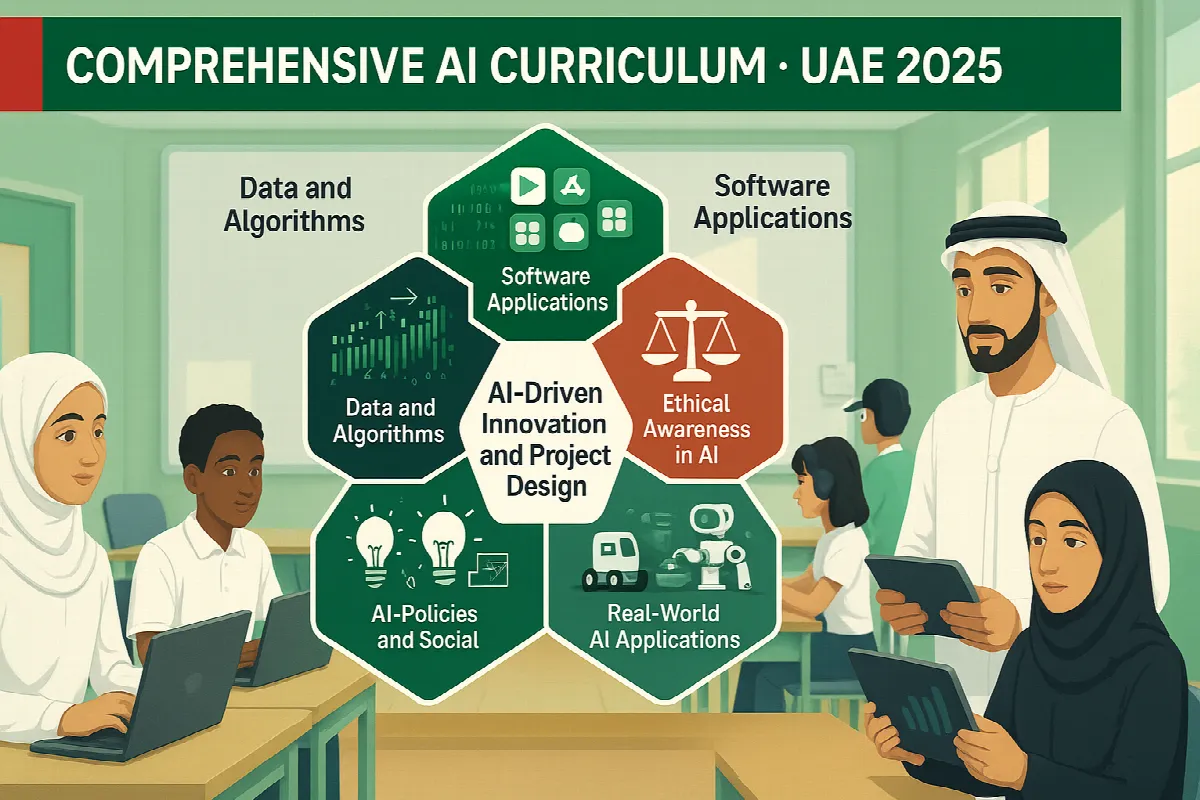
The Minister of Education, Sarah Bint Yousef Al Amiri, has outlined the key areas that the AI curriculum will cover:
- Data and algorithms
- Software applications
- Ethical awareness in AI
- Real-world AI applications
- AI-driven innovation and project design
- AI policies and social engagement
Teachers will receive extensive training and support materials, including ready-to-use lesson plans, activities, and templates that can be adapted to various classroom environments. This approach ensures consistent quality across all public schools while allowing for flexibility in teaching methods.
Building on Previous Initiatives
This latest announcement builds upon earlier educational innovations in the UAE. Last year, Dubai’s Crown Prince Sheikh Hamdan bin Mohammed declared that schools in the emirate would have teachers qualified in AI, launching a training programme aligned with the Dubai Universal Blueprint for Artificial Intelligence (DUB.AI).
The UAE’s focus on AI education has been developing steadily. The UNESCO Regional Center for Educational Planning (RCEP) and the UAE Ministry of Education released a case study in 2024 on the UAE’s K-12 AI curriculum and its implementation, highlighting the country’s progressive approach to AI education.
Preparing for a Technology-Driven Future
The integration of AI into education reflects the UAE’s recognition of technology’s transformative role in society and the workplace. A survey by Mohamed Bin Zayed University of Artificial Intelligence (MBZUAI) revealed that 77% of students aged 12-15 believe AI skills are crucial for future employment, underscoring the growing importance of AI literacy in the job market.
Sheikh Mohammed emphasised that the goal extends beyond technical knowledge: “Our goal is to teach our children a deep understanding of AI from a technical perspective, while also fostering their awareness of the ethics of this new technology, enhancing their understanding of its data, algorithms, applications, risks, and its connection to society and life.”
Global Leadership in Educational Innovation
This initiative positions the UAE as a global leader in educational innovation. As many countries worldwide are still debating how to approach AI in education, the UAE has moved decisively to integrate it fully into the curriculum.
School leaders across the UAE have highlighted that introducing AI concepts into the curriculum will address skills shortages in the field while ensuring students understand how to use AI effectively and responsibly.
Creating Opportunities for All
One of the most promising aspects of this educational shift is its potential to democratise access to quality education. AI opens doors for students in remote areas, those with limited access to traditional schooling, and children from disadvantaged backgrounds, helping to ensure educational opportunities reach every corner of society.
Looking Ahead
The implementation of AI as a mandatory subject represents a significant step in the UAE’s educational evolution. As Sheikh Mohammed concluded: “Our responsibility is to equip our children for a time unlike ours, with conditions different from ours, and with new skills and capabilities that ensure the continued momentum of development and progress in our nation for decades to come.”
This forward-thinking approach to education will likely yield generations of graduates prepared not just to navigate a technology-driven future, but to actively shape it, cementing the UAE’s position as an innovation hub for decades to come.
Key Takeaway
The UAE’s decision to make AI a mandatory subject from kindergarten through Grade 12 demonstrates its commitment to future-proofing its educational system and workforce. By focusing on both technical skills and ethical awareness, the curriculum aims to create digitally literate citizens who can harness AI’s potential responsibly while maintaining the UAE’s competitive edge in the global knowledge economy.
Additional Reading Material
The UAE week, every Monday
The week's stories on jobs, visas, money and daily life in one short email. Unsubscribe in one click.