Dubai School Fees Rising: KHDA Approves 2.35% Increase for 2025-26 Academic Year
Dubai’s KHDA allows private schools to raise fees by up to 2.35% for 2025-26, with a twist as inspection ratings remain paused. What parents need to know about the changes.
By Vadim Kouznetsov, published
The latest fee adjustment comes with a significant twist as annual school inspections remain paused
Key Takeaway
Dubai private schools can raise fees by up to 2.35% for 2025-26, but with the KHDA’s inspection cycle paused, the traditional performance-linked increase system has been temporarily modified. Schools must still apply individually, and the KHDA will assess each application on its own merits as Dubai continues its ambitious Education 33 Strategy aiming to open 100 new schools by 2033.
Fee Increase Framework Announced
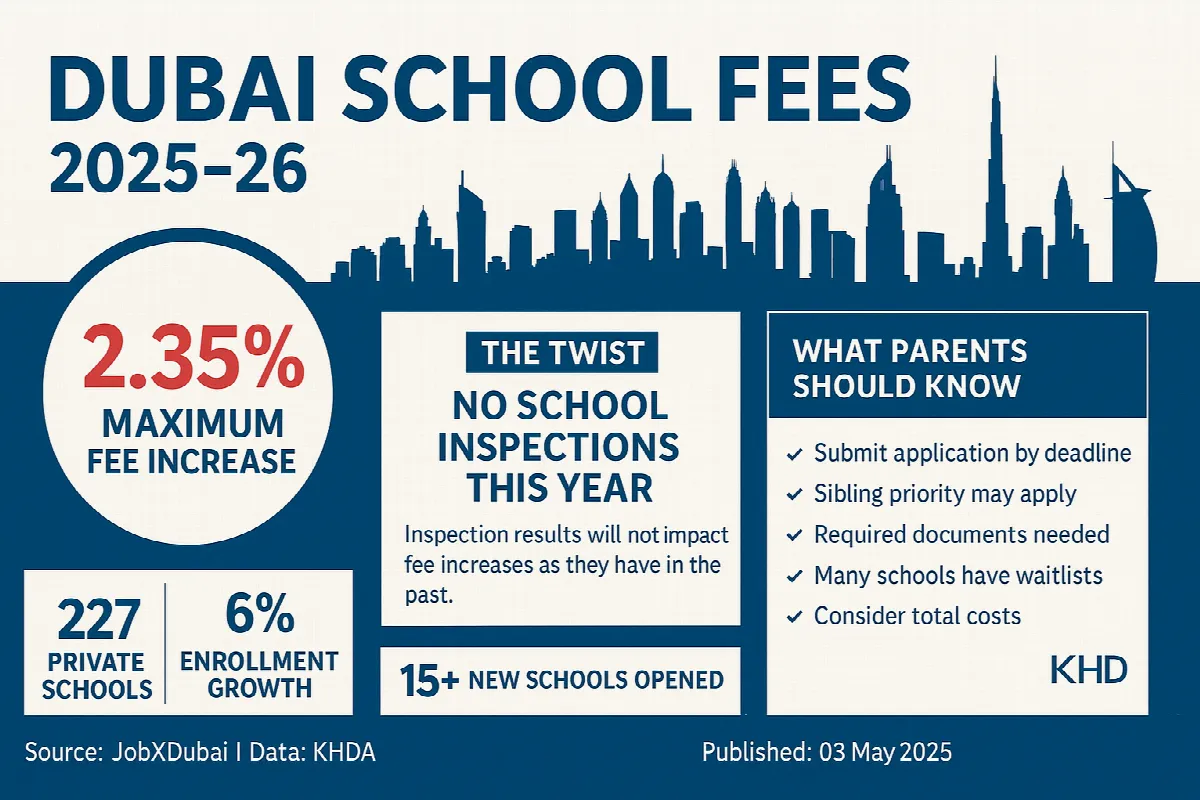
Dubai’s Knowledge and Human Development Authority (KHDA) has approved an Education Cost Index (ECI) of 2.35% for the upcoming 2025-26 academic year, allowing eligible for-profit private schools to apply for fee increases up to this percentage.
The decision follows the KHDA’s annual review of audited financial statements submitted by Dubai private schools, conducted in collaboration with the Digital Dubai Authority. This ECI figure is slightly lower than the 2.6% permitted for the current 2024-25 academic year.
Shamma Al Mansouri, Director of Licensing and Education Services at KHDA, explained the rationale behind the framework: “The Education Cost Index for fee adjustments is based on a robust and transparent methodology that supports schools in Dubai to manage their resources while maintaining a high quality of education in line with the needs of students and parents.”
She added that this approach reflects Dubai Government’s commitment to transparency and efficiency in the education sector while ensuring Dubai remains a leading destination for high-quality education in accordance with the goals of Education 33 Strategy.
The Twist: Inspection Pause Impacts Fee Structure
What makes this year’s increase notable is the absence of new KHDA inspection ratings to guide the process. In a significant shift from previous years, the KHDA paused its annual inspection cycle for Dubai’s private schools in 2024-25, meaning most institutions will not receive an updated quality rating.
Historically, Dubai’s school fee framework tied increases directly to inspection performance. Schools rated “Outstanding” could implement higher fee increases than those rated “Good” or “Acceptable,” while schools that declined in rating were barred from any fee adjustment.
For example, in 2024, schools maintaining a “Good” rating could increase fees by up to 2.6%, while those improving from “Acceptable” to “Good” could implement increases as high as 5.2% (double the ECI).
In the absence of fresh inspection data, the KHDA will now determine permitted fee increases based on individual applications from schools. This means the stated 2.35% represents a maximum ceiling, with actual permitted increases potentially lower depending on each school’s circumstances.
Application Process Remains in Place
Despite the inspection pause, KHDA has informed all private schools about requirements for submitting fee adjustment requests. Not all schools will automatically qualify for increases – those operating for less than three years remain ineligible for any fee adjustment.
All applications will undergo review by KHDA to ensure they meet the criteria for fee increases. Eligible for-profit schools may apply for an increase up to, but not exceeding, the approved 2.35% ECI.
Schools are not obligated to implement the maximum permitted increase, and many have historically chosen to implement lower increases or none at all, especially when facing competitive pressures or parent affordability concerns.
School Sector Growth Continues
The fee adjustment comes amid continued strong growth in Dubai’s private education sector. Currently, Dubai is home to 227 private schools serving 387,441 students from 185 nationalities.
The emirate recorded an unprecedented 12% increase in student enrolment in the 2023-24 academic year, followed by a further 6% growth during the current 2024-25 academic year.
Fifteen new private schools have opened in Dubai over the past two academic years, with KHDA currently reviewing more than 20 applications for new schools set to open within the next two years.
This expansion aligns with Dubai’s ambitious Education Strategy 33, which aims to open at least 100 new private schools by 2033, significantly expanding the emirate’s educational capacity and options for families.
What Drives Dubai School Fees?
Parents often question why Dubai school fees tend to be higher than global averages and what justifies annual increases. Several factors contribute to these costs:
- Operational Expenses: The ECI calculation takes into account staff salaries, support services, and rental expenses. Schools must offer competitive packages to attract qualified teachers from around the world.
- Infrastructure Investment: Many Dubai schools feature premium facilities including swimming pools, specialised labs, and extensive sports amenities that require ongoing maintenance and upgrades.
- Market Positioning: Schools affiliated with prestigious international brands or educational groups often command premium fees due to their reputation and perceived quality.
- Teacher-to-Student Ratios: Schools offering smaller class sizes and personalised attention typically have higher operational costs per student.
- Curriculum Diversity: Dubai’s private education sector offers 17 different curricula, with varying implementation costs and staffing requirements.
The KHDA maintains that its regulated fee framework aims to balance school sustainability with parent affordability while ensuring educational quality across the sector.
Parent Perspectives
While schools welcome the ability to adjust fees to meet rising operational costs, many parents remain concerned about affordability in a city where the overall cost of living continues to climb.
Some parents have questioned the timing of fee increases during a period when quality inspections have been temporarily paused, wondering what mechanisms will ensure that additional funding translates to improved educational outcomes.
The KHDA, however, emphasises that its fee framework is designed to maintain Dubai’s position as a global education hub while providing families with a wide range of educational options across various price points.
Looking Ahead
As Dubai continues its rapid population growth, the education sector faces both opportunities and challenges. The current expansion reflects strong investor confidence, with over 20 new school applications under review.
However, schools must navigate a competitive landscape while addressing parent expectations for value and quality. The temporary modification to the inspection-linked fee system highlights the KHDA’s flexible approach to regulatory oversight during this period of exceptional growth.
For parents concerned about potential fee increases, it’s worth noting that schools must still apply individually for any adjustments, and the KHDA retains discretion to approve increases below the maximum 2.35% threshold based on each institution’s specific circumstances.
For updates on approved fee increases for specific schools, parents are advised to contact their children’s schools directly or visit the KHDA website.
Additional Reading Material
The UAE week, every Monday
The week's stories on jobs, visas, money and daily life in one short email. Unsubscribe in one click.