UAE Gratuity: When Can Your Employer or Bank Deduct Your End-of-Service Pay?
UAE employers can deduct gratuity in 5 specific cases. Banks can freeze it for unpaid loans. Know your rights and how to protect your end-of-service pay.
By Vadim Kouznetsov, published

Your end-of-service gratuity is likely the largest single payment you’ll receive when leaving a job in the UAE. For many employees, it represents months of savings — money earmarked for the transition between jobs, relocation, or financial security.
But here’s what catches people off guard: both your employer and your bank can legally take a portion of it.
Understanding exactly when and how deductions happen puts you in a position to protect what you’ve earned.
Key Takeaway: Under UAE Labour Law, employers can deduct from your gratuity in five specific situations — overpayments, unpaid contributions, disciplinary penalties, court-ordered debts, and damage caused by the employee. Banks can also freeze or claim your gratuity to recover outstanding loans if your loan contract includes an authorisation clause. Review all agreements before resigning.
How Is UAE Gratuity Calculated?
Before understanding deductions, you need to know what you’re entitled to. Gratuity is calculated based on your basic salary (not gross salary) and years of continuous service:
- Less than one year: No gratuity entitlement
- One to five years: 21 days of basic salary per year of service
- More than five years: 21 days’ basic salary for the first five years, plus 30 days’ basic salary for each subsequent year
- Maximum cap: Total gratuity cannot exceed two years’ basic salary
Unpaid leave does not count towards your service period. If you’ve taken significant unpaid leave, your final payout will be reduced accordingly.
For a detailed breakdown of how gratuity calculations work in different scenarios, including resignation versus termination, check our full guide.
When Can Your Employer Deduct from Your Gratuity?
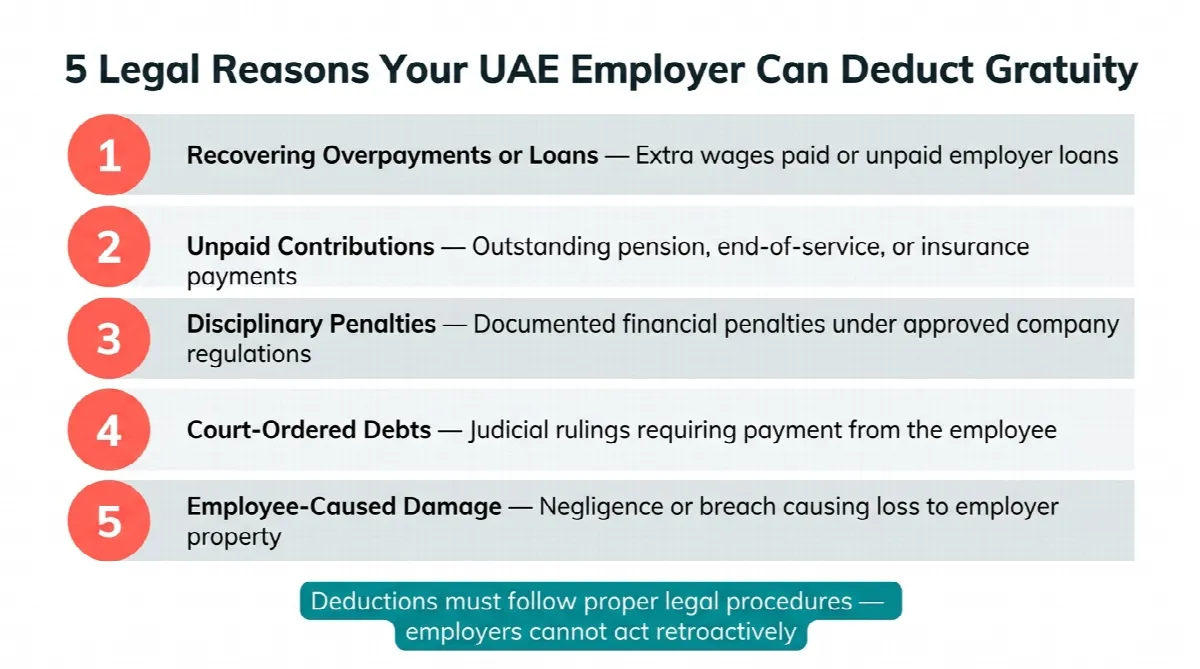
Under Article 29 of Cabinet Resolution No. 1 of 2022 — implementing Federal Decree-Law No. 33 of 2021 on Labour Relations — employers can deduct from your end-of-service benefits in five specific situations only:
1. Recovering Overpayments or Loans
If your employer paid you more than you were owed, or granted a loan that remains unpaid at the time of your departure, they can recover the amount from your gratuity.
This is straightforward — if you owe money to your employer, they have the right to recover it.
2. Unpaid Contributions
If you were legally required to pay into retirement pension schemes, end-of-service contribution plans, or insurance, and those payments remain outstanding, your employer can deduct them.
3. Disciplinary Penalties
If you received a financial penalty under the company’s approved disciplinary regulations, that amount can be deducted from your gratuity. The penalty must be documented and must follow proper procedures — employers can’t invent penalties retroactively.
4. Court-Ordered Debts
Any deduction based on a judicial ruling against you is legally enforceable. If a court has ordered you to pay a specific amount, your employer can deduct it from your end-of-service benefits.
5. Damage Caused by the Employee
If your negligence or breach of instructions resulted in loss or damage to the employer’s tools, machinery, products, or materials, the employer can recover the cost from your gratuity.
However, the employer must conduct a written investigation and give you the opportunity to defend yourself before making this deduction. If you disagree with their assessment, don’t sign any acknowledgement — file a complaint with MOHRE immediately.
Important time limit: These deductions generally cannot be made more than three months after the amount becomes due, unless otherwise agreed between employer and employee.
Can Your Bank Freeze or Claim Your Gratuity?
Yes — and this is the part that surprises most people.
When you sign a loan agreement with a UAE bank, the contract often includes a clause authorising the bank to claim your end-of-service benefits if you default or leave your job while money is still owed.
This isn’t a violation of labour law. It’s a contractual agreement between you and the bank. The bank is exercising rights you agreed to when you signed the loan documentation.
How It Typically Works
- You resign or are terminated
- Your employer deposits your final settlement (including gratuity) into your salary account
- If you have outstanding loans with that bank, the bank can freeze the account and use the funds to offset your debt
- The bank recovers what’s owed before releasing any remaining balance to you
How to Protect Yourself
Before resigning:
- Review your loan agreements for any clauses authorising the bank to claim end-of-service benefits
- Inform your bank about your planned departure — discuss repayment or restructuring options proactively
- Consider requesting that your employer pays your gratuity into a different bank account — one where you have no outstanding liabilities
- Pay off debts before leaving if financially possible, to avoid your account being frozen
- Check your total salary deduction limits — combined deductions during employment cannot exceed 50% of your monthly wage
Who Is Eligible for Gratuity in the UAE?
You must have completed at least one year of continuous service with the same employer to qualify for gratuity.
Continuous service means uninterrupted employment from your start date until termination — with the same company or its legal successor. If your company was acquired or merged, your service period carries over.
If you’re terminated (not for misconduct), you may be entitled to partial gratuity after six months of service in some circumstances. If you resign before completing one year, you receive no gratuity payment.
Your probation period counts towards your total service period for gratuity calculation — time served during probation isn’t excluded.
What Should You Do Before Leaving Your Job?
- Calculate your expected gratuity using your basic salary and years of service
- Review your employment contract for any clauses related to deductions, loans, or penalties
- Check all loan agreements for end-of-service recovery clauses
- Clear outstanding debts or negotiate restructuring with your bank before your last day
- Request your final settlement in writing — including a breakdown of gratuity, accrued leave, notice period pay, and any deductions
- Don’t sign anything you disagree with — you have the right to dispute deductions through MOHRE
Your employment contract is available for download through MOHRE’s website or app at any time. Review it before making any decisions about resignation.
FAQ
Can my employer deduct from my gratuity without telling me?
No. Employers must follow proper legal procedures before making deductions. They should notify you in writing about the deduction, the reason, and the amount. If deductions occur without notification, file a complaint with MOHRE.
How many situations allow employer gratuity deductions?
Five: recovering overpayments or loans, unpaid contributions, disciplinary penalties, court-ordered debts, and damage caused by the employee’s negligence.
Can my bank take my entire gratuity for a loan?
If your loan agreement includes an authorisation clause, yes. The bank can freeze your account and use deposited funds — including gratuity — to offset outstanding debt before releasing any remainder.
How can I stop my bank from freezing my gratuity?
Request that your employer pays your gratuity into a different bank account where you hold no loans. Alternatively, pay off debts before your employment ends or negotiate restructuring terms with your bank.
Do I get gratuity if I resign before one year?
No. Gratuity requires at least one year of continuous service. If you resign before completing 12 months, you are not entitled to end-of-service benefits.
Does unpaid leave reduce my gratuity?
Yes. Unpaid leave does not count towards your total service period for gratuity calculations. Significant unpaid leave will reduce your final payout.
Is gratuity calculated on basic salary or total salary?
Basic salary only. Allowances such as housing, transport, and other benefits are not included in the gratuity calculation.
What is the maximum gratuity I can receive?
Total gratuity cannot exceed the equivalent of two years’ basic salary, regardless of how long you’ve worked for the employer.
Can I dispute a gratuity deduction?
Yes. If you believe the deduction is unlawful or excessive, refuse to sign any acknowledgement and file a complaint with MOHRE. The ministry provides dispute resolution services and can compel compliance.
Is there a time limit for employers to make deductions?
Generally, deductions cannot be made more than three months after the amount becomes due, unless otherwise agreed between employer and employee.
Further Reading
- When Can Your Employer Deduct Your UAE End-of-Service Gratuity? (Full Guide)
- What Happens to Your Bank Loan If You Lose Your Job in the UAE?
- UAE Salary Deduction Rules: Legal Guidelines for Private Companies
- UAE Employee Dismissal Rights and Compensation Guide 2025
- UAE Labour Laws: Essential Guide to Private Sector Employment Rights
The UAE week, every Monday
The week's stories on jobs, visas, money and daily life in one short email. Unsubscribe in one click.