Is Moon Dubai Actually Happening? Founders Reveal Timeline, Location and What Comes Next
Moon Dubai founders confirm UAE as frontrunner but no deal signed yet. First opening around 2032, not 2027. $500 lunar experience, 10,000 residences planned.
By Vadim Kouznetsov, published
Key Takeaway: Moon World Resorts co-founders confirm the Middle East will “definitely” get a Moon project, with the UAE as the frontrunner. However, no Dubai location has been finalised, no regional development partner has been signed, and the earliest opening is around 2032 — not the 2027 date circulating on social media.
If you’ve spent any time on social media in the past few years, you’ve probably seen it — a colossal Moon-shaped building supposedly coming to Dubai, often with a price tag of $5 billion (Dh18.5 billion) attached. The renders look spectacular. The captions sound definitive. But what’s actually happening behind the hype?
Gulf News put the question directly to the people behind the project, and the answer is more measured than most viral posts would have you believe.
Here’s where things actually stand.
What Is Moon Dubai?
Moon is a concept developed by Moon World Resorts Inc., a Canada-based design studio and intellectual property licensor co-founded by Michael R. Henderson and Sandra G. Matthews.
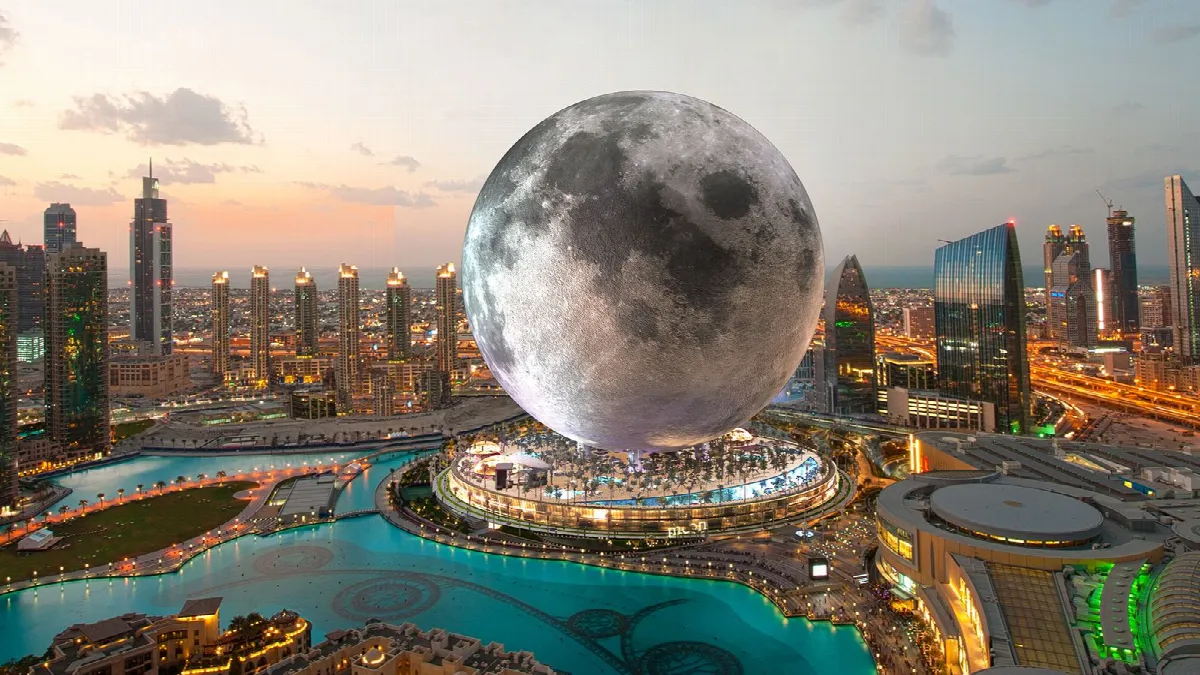
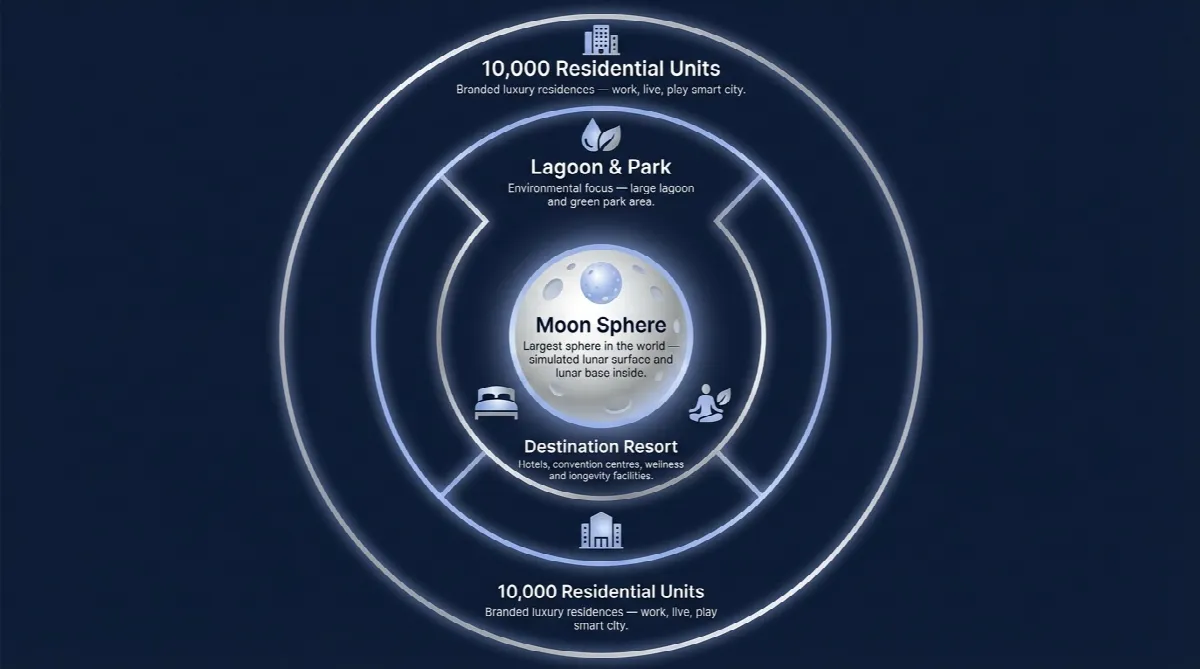
The project is designed as a mass-volume tourism development built around a central spherical structure — not a dome, but a full sphere you can walk underneath. Henderson describes it as “the largest sphere in the world.”
Inside the sphere sits a fully integrated destination resort featuring convention centres, wellness and longevity facilities, hotels, lounges, and restaurants. The headline attraction is a simulated lunar surface and lunar base experience where visitors walk on what is designed to feel like an authentic Moon environment.
“We’re not a theme park. It’s an adult-oriented facility,” Henderson clarified, adding that the space would double as a venue for space training and space tourism experiences.
Surrounding the sphere is a large lagoon and park with an environmental focus, and beyond that, a ring of 10,000 branded luxury residential units. Henderson describes the full vision as “a smart city, a little mini city that delivers the work, live, play scenario.”
Will It Be Built in Dubai?
This is where things get interesting — and where social media often gets it wrong.
Moon World Resorts plans to license up to ten Moon projects globally, spanning Latin America, North America, Europe, Asia, Oceania, and the Middle East. The company doesn’t build directly. It licences the intellectual property to regional development partners.
Henderson confirmed that “the Middle East Gulf will definitely have a Moon.” But the specific location depends on two things: government backing and a suitable development partner.
“With a project of this scale and size, you need a government involved,” he said.
Dubai keeps coming up because the fundamentals align. Space tourism is gaining traction globally, Dubai’s brand is instantly recognisable, and “Moon” as a symbol is universally understood. “Eight billion people know our brand,” Henderson said. “You put that trifecta together, and it makes sense.”
The UAE’s infrastructure, airlift capacity, and tourism volume give it a clear edge. “Both Dubai and Abu Dhabi have all of that,” Henderson noted.
Why No Developer Has Signed On Yet
Despite the viral buzz, Moon has not secured a regional development partner. Henderson explained the core issue: most local developers focus on “get in, get out development” — residential projects with fast turnover.
Moon is a long-term tourism asset, not a flip. Only a handful of developers have the scale and mandate for a project this size.
Henderson was specific about who could make it work: “Emaar, because Mohamed Alabbar is the best developer in the world,” alongside Aldar in Abu Dhabi and Qatari Diar in Qatar — all government-linked entities with the resources to commit to a multi-billion-dollar, multi-year build.
Until one of these players signs on, the project remains in the licensing and negotiation phase.
What About Saudi Arabia?
Saudi Arabia frequently enters the conversation given its own mega-project ambitions. Henderson was direct: “Saudi is probably not suitable for our project,” pointing to cutbacks and feasibility challenges in the Kingdom’s development pipeline.
Other Gulf markets remain under consideration. Bahrain and Oman could work to a degree, while Qatar is a “strong regional contender.” But Henderson maintained the UAE is ahead. “The UAE is just so far ahead of everybody else. It’s very hard to compete against that.”
Realistic Timeline: When Could Moon Open?
This is where the social media narrative falls apart.
“Social media is saying Dubai will open in 2027. We look at it and have a chuckle,” Henderson said.
The realistic timeline:
- Ground-breaking: 2027 (if a partner and government deal is finalised)
- Construction period: 4–5 years
- First Moon opening: Around 2032
Once the first project is completed, future builds become faster — Henderson said projects share roughly 95% of their design, so replication accelerates the process.
What Would It Cost Visitors?
Pricing is central to the Moon concept. Unlike exclusive space tourism ventures charging hundreds of thousands, Moon aims for accessibility.
The signature 90-minute lunar surface experience is priced at $500 — roughly the same as a premium concert ticket. “We can land comfortably two and a half million people on our lunar surface every year,” Henderson said. Volume makes that price point viable.
Hotels within the development include a 4,000-suite five-star property designed to be high-end but competitively priced, alongside a 200-room boutique hotel at a higher price point.
Matthews stressed that Moon is not a vanity project. “It’s not a project that would be built as a white elephant. It’s a project that actually will impact wherever it is built,” she said, highlighting job creation across tourism, construction, science, education, wellness, and longevity sectors.
For those tracking Dubai’s construction boom and job creation, a Moon project in the UAE would represent a major addition to the pipeline. Thousands of roles would span hospitality management, construction, technology, and guest services.
The Bottom Line
Moon Dubai is not a fantasy — but it’s not a confirmed project either. The founders are clear about the concept, the business model, and their belief that the UAE is the right fit. What’s missing is the signed deal: a government partner, a development entity, and a confirmed site.
Dubai has a track record of turning ambitious concepts into reality. Projects like Burj Azizi, The Oasis by Emaar, and even the Dubai 2040 Urban Masterplan demonstrate that the city doesn’t shy away from scale.
But until a formal announcement comes from an official source, treat the social media renders with healthy scepticism. The Moon may well land in the Gulf — just not on the timeline your Instagram feed suggests.
FAQ
Is Moon Dubai confirmed?
No. Moon World Resorts has confirmed the Middle East will “definitely” receive a Moon project, and the UAE is the strongest candidate. However, no development partner, government agreement, or site in Dubai has been formally announced.
When will Moon Dubai open?
The founders estimate the first Moon project globally could open around 2032, assuming ground breaks in 2027. The viral claim of a 2027 Dubai opening has been dismissed by the founders themselves.
How much will it cost to visit Moon Dubai?
The signature 90-minute lunar surface experience is priced at $500 (approximately Dh1,836). Hotels within the development range from a competitively priced 4,000-suite five-star hotel to a 200-room boutique property at a premium rate.
Who is building Moon Dubai?
Moon World Resorts Inc. is a Canadian design studio that licences the concept to regional development partners. Henderson named Emaar, Aldar, and Qatari Diar as the type of government-linked developers capable of executing the project.
How big is the Moon project?
The development includes the “largest sphere in the world” as its centrepiece, a simulated lunar surface, convention and wellness facilities, hotels, a lagoon park, and 10,000 branded residential units. Henderson described the full concept as a self-contained smart city.
Will Moon create jobs in the UAE?
Yes. Matthews confirmed the project would generate employment across tourism, construction, science, education, wellness, and longevity sectors. With a 4,000-suite hotel and 2.5 million annual visitors projected, staffing demands would be significant.
Why hasn’t a Dubai developer signed on yet?
Henderson explained that most local developers focus on residential projects with quick returns. Moon requires a long-term tourism investment, which limits the field to major government-backed developers like Emaar or Aldar.
Further Reading
The UAE week, every Monday
The week's stories on jobs, visas, money and daily life in one short email. Unsubscribe in one click.