Can a Bounced Cheque or Unpaid Traffic Fine Stop You From Leaving the UAE?
Can a bounced cheque or unpaid traffic fine trigger a UAE travel ban? Legal experts explain civil vs criminal bans and how to get them lifted fast.
By Vadim Kouznetsov, published

Key Takeaway: A bounced cheque can lead to a travel ban if the creditor opens an execution case and the debtor fails to comply. Standard traffic fines alone will not trigger a ban — but serious offences like DUI or hit-and-run can. Civil bans require a minimum debt of Dh10,000, while criminal bans are imposed by the Public Prosecution and remain active until the case concludes.
If you’re a UAE resident planning a trip abroad, the last thing you want is to be stopped at the airport. Yet travel bans remain one of the most misunderstood legal issues for expats and residents across Dubai, Abu Dhabi, and the wider Emirates.
The confusion often stems from not knowing whether a civil dispute, a bounced cheque, or even an outstanding traffic fine could prevent departure. Here’s what UAE legal experts say about how these bans actually work — and what you can do if one is placed against you.
What Triggers a Travel Ban in the UAE?
A travel ban falls into one of two categories: civil or criminal. According to Dr Hassan Elhais, legal consultant at Awatif Shoqi Advocates & Legal Consultancy, a civil travel ban typically arises from unpaid debt.
The process works like this: a creditor obtains a court judgment, opens an execution case, and — if the debtor ignores the execution notice — requests that the court impose a travel restriction. This prevents the debtor from leaving the UAE until the matter is resolved.
In some situations, a creditor can even request a ban before filing a civil case, provided there is clear proof of liability and the case is filed within a specific timeframe afterwards.
For residents unfamiliar with how the UAE legal system handles financial disputes, this is an important distinction. The ban isn’t automatic — it requires a formal legal process.
Can a Bounced Cheque Result in a Travel Ban?
Yes, and potentially faster than other civil debts. A bounced cheque is treated as an “executory deed” under UAE law. This means the creditor can skip the normal judgment process and open an execution case directly based on the dishonoured cheque.
Once the case is opened, the debtor receives a notice to pay. If they fail to comply, the creditor may immediately request a travel ban.
Dr Elhais confirmed that this expedited route is a significant risk for anyone who has issued a cheque that bounced. Even before a formal civil case, a travel restriction may be granted if evidence of liability is strong.
What Are the Conditions for a Civil Travel Ban?
Ahmed Odeh, Managing Partner at MIO Law Firm, outlined the specific conditions that must be met under Federal Decree-Law No. (42) of 2022 concerning the Civil Procedures Law:
- Minimum debt threshold: The amount owed must be Dh10,000 or more. Claims for maintenance (alimony), wages, or behavioural obligations are excluded from this threshold.
- Flight risk evidence: There must be serious grounds to believe the debtor intends to leave the UAE to avoid payment.
- Fast-track judicial procedure: The application must be submitted through an Order on Petition.
- Established debt: The debt must be clearly due, not subject to pending conditions. A judge may temporarily estimate the amount if it remains uncertain.
- Written evidence and guarantee: The creditor must provide written proof and offer a court-accepted guarantee to cover damages if the claim is later rejected.
Once approved, the judge may order the debtor’s passport to be retained and circulate the travel ban across all UAE exit points. The ban stays in effect until the debt is paid, the creditor consents to lift it, or the case is extinguished under Article 325 of the same law.
If you’re worried about your own status, you can check for a travel ban online using the Dubai Police app or Abu Dhabi’s Estafser service.
Can Traffic Fines Alone Trigger a Travel Ban?
This is where many residents get confused. As a general principle, standard traffic fines do not justify a travel ban.
Minor offences — such as speeding, running a red light, or parking violations — are classified as administrative violations under Federal Decree-Law No. 14 of 2024 on Traffic Regulation. These carry fines or may result in vehicle impoundment, but they do not, by themselves, lead to travel restrictions.
However, there’s a catch. If traffic fines accumulate and go unpaid for an extended period, the matter can be escalated to a civil debt case under Federal Decree-Law No. 42 of 2022 (Article 324). At that point, a travel ban becomes possible.
It’s also worth noting that Dubai now requires residents to clear traffic fines before renewing visas, which adds another layer of urgency to settling outstanding penalties.
When Do Traffic Offences Become Criminal?
Certain serious traffic violations cross the line from administrative to criminal, and these can result in a travel ban. Odeh highlighted the following:
- Driving under the influence of alcohol or drugs (Article 35, Federal Decree-Law No. 14 of 2024)
- Reckless driving causing injury or death (Article 40)
- Hit-and-run incidents (Article 38)
- Persistent refusal to pay significant fines after formal warnings, if escalated to a criminal case
In these situations, the Public Prosecution or a competent police authority may impose a travel ban under Federal Decree-Law No. 38 of 2022 on Criminal Procedure Law (Article 99).
For a broader understanding of traffic penalties, our guide to UAE traffic laws and fines covers the latest regulations.
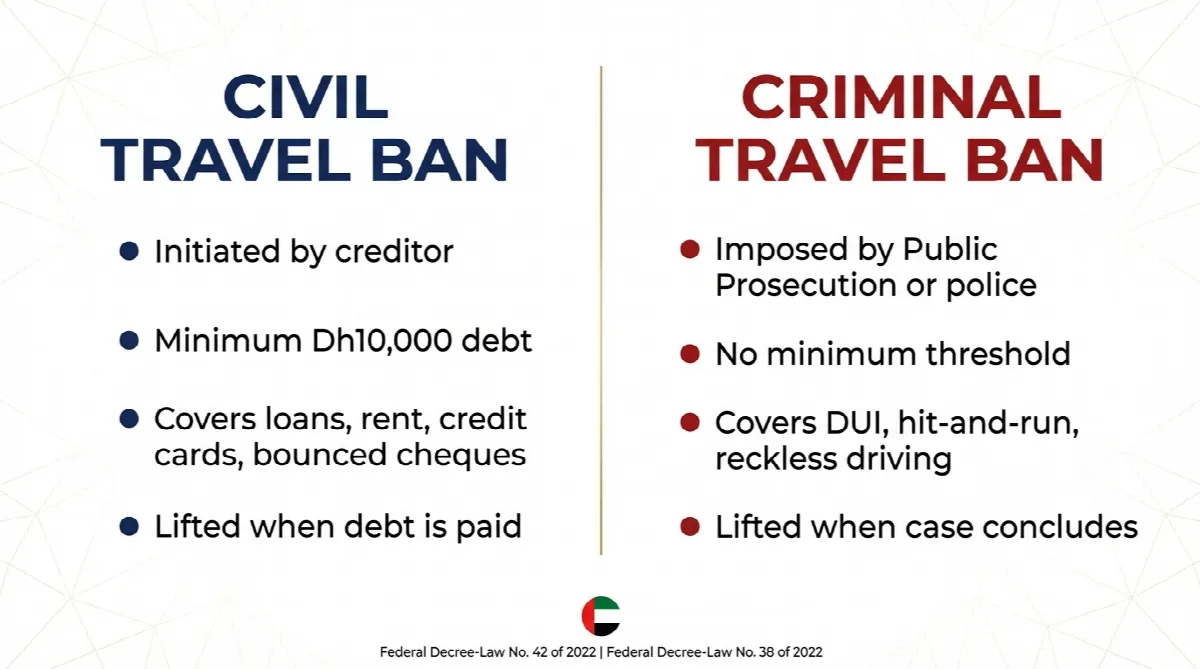
Civil vs Criminal Travel Bans: The Key Differences
| Feature | Civil Ban | Criminal Ban |
|---|---|---|
| Legal basis | Article 324, Federal Decree-Law No. 42 of 2022 | Federal Decree-Law No. 38 of 2022 |
| Who initiates | Creditor (through court petition) | Public Prosecution or police |
| Minimum threshold | Dh10,000 | No minimum |
| Applies to | Loans, rent arrears, credit card debt, bounced cheques | DUI, reckless driving, hit-and-run, criminal investigations |
| Lifted when | Debt paid or creditor agrees to lift | Investigation completed, fines/penalties paid, or court verdict issued |
| Applies to traffic fines | Only if unpaid fines escalate to civil debt | Yes, for serious criminal offences |
How to Get a Travel Ban Lifted
For civil cases: Pay the full amount listed in the court execution file. Once the court issues a removal decision and communicates it to the relevant authority, the ban is lifted. Thanks to the UAE’s automated travel ban removal system, this process now takes just minutes to a few days rather than weeks.
For criminal cases: The ban typically remains in place until the Public Prosecution concludes its investigation or the criminal court reaches a verdict. There is no payment shortcut for criminal bans — the legal process must run its course.
If you’re planning to leave the UAE permanently, settling all outstanding debts and legal matters before departure is critical.
Frequently Asked Questions
Can I be stopped at the airport for a Dh5,000 debt?
Under civil procedures, a travel ban requires a minimum debt of Dh10,000. A Dh5,000 debt alone should not trigger a ban, though creditors may pursue other recovery methods.
How quickly is a travel ban lifted after payment?
Civil travel bans are now lifted automatically once the court execution file is cleared. The UAE Ministry of Justice reduced the process from nine steps to zero. Most bans are removed within minutes to a few days.
Does a travel ban cancel my UAE visa?
No. A travel ban prevents you from leaving the country, but it does not automatically cancel your residence visa. However, unresolved legal issues can complicate visa renewals and status checks.
Can my employer find out about a travel ban?
Travel bans are not publicly listed, but they may surface during background checks or when processing visa-related transactions through GDRFA.
Will a parking fine stop me from flying?
No. Parking fines are administrative violations and do not lead to travel bans. However, accumulating large unpaid fines could eventually escalate into a civil debt matter.
Can a travel ban be imposed during a divorce?
Yes. During divorce proceedings, a court may impose a travel ban to prevent a spouse from leaving the UAE, particularly in cases involving child custody or financial claims. Read more in our guide to UAE divorce laws and travel bans.
How do I check if I have a travel ban?
Use the Dubai Police app (select “Circulars and Travel Bans”), Abu Dhabi’s Estafser service, or call GDRFA at 800 511.
Disclaimer: This article provides general guidance only and does not constitute legal advice. Each case should be assessed based on its specific circumstances. Professional legal counsel should be consulted as needed.
Further Reading
- UAE Travel Bans 2025: Check Fines, Debts & Removal Steps
- How to Check If You Have a Travel Ban in UAE: Official 2026 Guide
- Dubai Bounced Cheque Guide: Online Police Report Filing
- Dubai Traffic Fines Must Be Paid Before Visa Renewal
- UAE Traffic Laws 2024: Complete Guide to Fines & Penalties
- Permanently Leaving UAE? Essential Checklist
The UAE week, every Monday
The week's stories on jobs, visas, money and daily life in one short email. Unsubscribe in one click.