Abu Dhabi Court Orders Dh25,000 Compensation for Filming and Posting Someone on Snapchat Without Consent
Abu Dhabi court orders Dh25,000 compensation for filming and posting someone on Snapchat without consent. Know UAE privacy law penalties.
By Vadim Kouznetsov, published
Key Takeaway: An Abu Dhabi court has awarded Dh25,000 in damages to a man whose photo was taken in a public place and shared on Snapchat without his permission. The ruling reinforces the UAE’s strict privacy protections under Federal Decree-Law No. 34 of 2021, where even a single unauthorised photo posted online can result in criminal conviction, account deletion, and a six-month internet ban.
Think twice before you snap that photo of someone and post it online. An Abu Dhabi court has just made it very clear — violating someone’s privacy on social media in the UAE carries real financial consequences.
On January 6, 2026, the Abu Dhabi Family, Civil and Administrative Court ordered a defendant to pay Dh25,000 in compensation after he was found guilty of photographing a man in a public place and publishing the image on Snapchat without consent.
What Happened in This Case?
The case began after the defendant took a photograph of the plaintiff in a public area and posted it on Snapchat — all without asking for permission.
The plaintiff told the court this act caused him both financial and emotional harm. He reported being subjected to contempt and suspicion at his workplace and among relatives and peers. He originally sought Dh50,000 in compensation, plus court and legal fees.
Before filing the civil lawsuit, the plaintiff attempted to settle the matter privately. When that failed, he took the case to court.
The Criminal Conviction That Came First
This was not the first legal action in this dispute. The Abu Dhabi Public Prosecution had already convicted the defendant on February 7, 2025, for taking and publishing personal photos without consent.
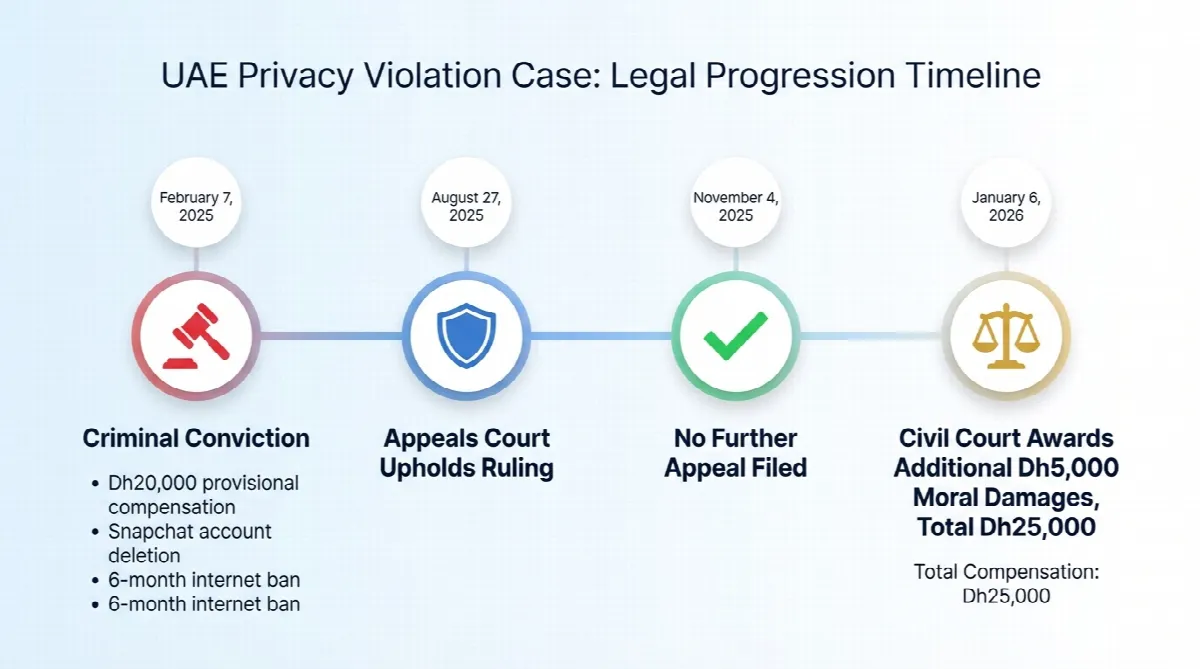
That criminal ruling imposed:
- Dh20,000 in provisional compensation to the plaintiff
- Mandatory deletion of the defendant’s Snapchat account
- A six-month ban from using the internet
The defendant appealed, but the Abu Dhabi Appeals Prosecution upheld the original decision on August 27, 2025. A certificate dated November 4, 2025, confirmed no further appeal was filed.
How the Court Calculated Dh25,000
The Abu Dhabi Family, Civil and Administrative Court reviewed all submitted evidence and determined the plaintiff suffered moral damages from the privacy violation.
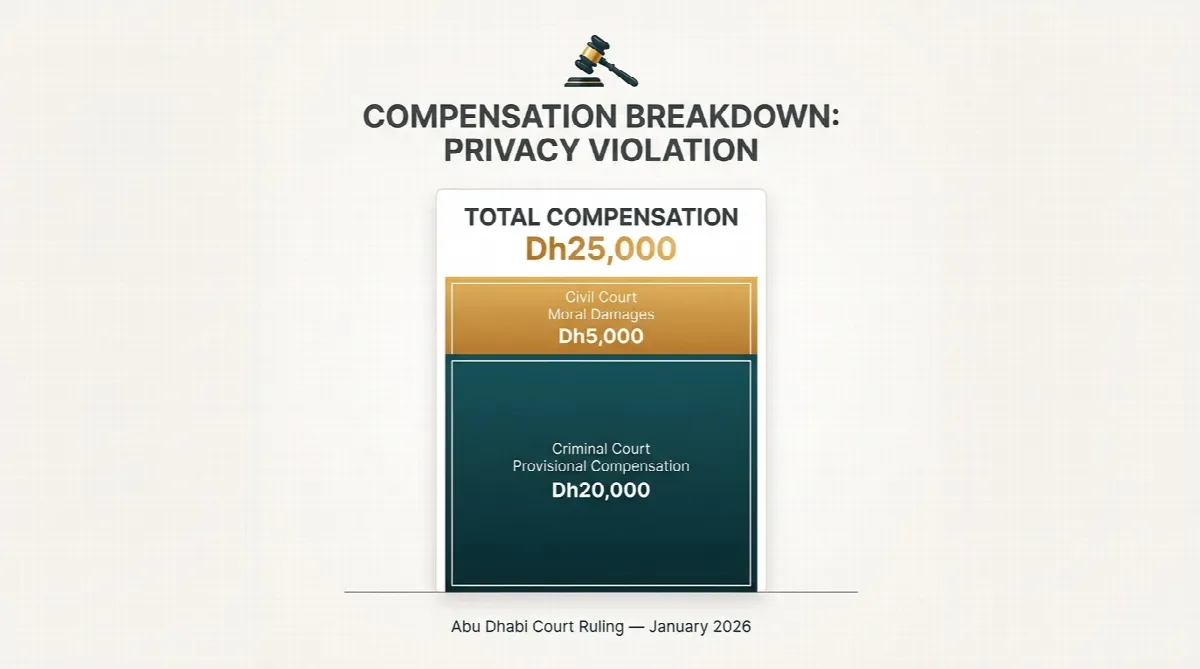
Here is how the final amount breaks down:
- Dh20,000 — provisional compensation from the earlier criminal ruling
- Dh5,000 — additional moral damages awarded by the civil court
- Total: Dh25,000
The court did reject the plaintiff’s claim for financial damages. It found insufficient evidence to prove the defendant’s actions directly caused monetary loss.
The defendant was also ordered to cover court costs, expenses, and attorney’s fees.
Why This Matters for UAE Residents
This ruling is a strong reminder that UAE privacy laws are actively enforced. Photographing or filming someone — even in a public space — and sharing that content online without their consent is a criminal offence under the Federal Cybercrimes Law (Federal Decree-Law No. 34 of 2021).
The penalties can include:
- Imprisonment of up to six months
- Fines ranging from Dh20,000 to Dh100,000
- Account deletion and internet bans
- Civil compensation claims on top of criminal penalties
This also applies to dash cam footage shared on social media, photos of people’s private property, and even negative online reviews that contain personal information.
How to Protect Yourself
Whether you are a resident, a visitor, or a content creator in the UAE, keep these points in mind:
Always ask before you photograph or film anyone. Consent is a legal requirement, not a courtesy. Even in public places, the law protects individuals from having their image captured and distributed without approval.
Never post photos or videos of others on social media without explicit permission. This includes Snapchat, Instagram, TikTok, and any other platform. The UAE has strict rules on what content you can share online.
Understand that “public space” does not mean “free to film.” Many people assume that being in a public area grants them the right to photograph anyone. Under UAE law, that is not the case.
If your privacy is violated, report it. You can file a complaint through the appropriate UAE cybercrime reporting channels or pursue both criminal and civil legal action, as this case demonstrates.
For visitors, it is worth reviewing the essential rules for first-time travellers to Dubai, which cover photography restrictions and other important regulations.
FAQ
Is it illegal to photograph someone in a public place in the UAE? Yes. Under the Federal Cybercrimes Law (Decree-Law No. 34 of 2021), taking someone’s photo without their consent and publishing it — even in a public space — is a criminal offence punishable by imprisonment and fines.
What is the penalty for posting someone’s photo on social media without permission in the UAE? Criminal penalties can include up to six months in prison and fines between Dh20,000 and Dh100,000. Courts can also order account deletion and internet bans. On top of that, the victim can pursue a separate civil lawsuit for compensation.
Can I be forced to delete my social media account in the UAE? Yes. In this case, the court ordered the defendant to delete his Snapchat account entirely. UAE courts have the authority to mandate account removal as part of a criminal sentence.
Can someone be banned from using the internet in the UAE? Yes. The defendant in this case received a six-month internet ban as part of his criminal conviction. UAE courts can impose internet restrictions for privacy violations and other cybercrimes.
Does consent protect you from prosecution in the UAE? If you have clear, documented consent from the person before photographing or filming them, and the content does not violate any other UAE laws, you are generally protected. However, consent must be explicit — verbal or implied permission may not hold up in court.
What should I do if someone photographs or films me without permission in the UAE? Report the incident to local police or file a cybercrime complaint. You may also pursue both criminal charges and a civil compensation claim. The UAE social media guidelines outline your rights and the legal framework protecting you.
Does this law apply to tourists and visitors in the UAE? Absolutely. UAE privacy and cybercrime laws apply to everyone within the country’s borders, regardless of nationality or residency status. Tourists have been prosecuted for similar violations.
Further Reading
- UAE Privacy Laws: Legal Guide to Photographing Private Property
- UAE Social Media Laws 2025: Comments Can Lead to Dh500k Fines
- UAE’s 6 Banned Online Content Types: Dh500,000 Fine and 5-Year Jail Risk
- Dash Cams in UAE: Legal Guide for Motorists | Privacy Laws Explained
- Dubai Filming Permit Guide: Rules, Fees, and Application Process
The UAE week, every Monday
The week's stories on jobs, visas, money and daily life in one short email. Unsubscribe in one click.