Etihad Rail Announces 7 New Stations: Complete UAE Passenger Network Revealed
Etihad Rail reveals 7 new passenger stations bringing total to 11 across UAE. Services launch 2026 with business and economy classes. Complete station list.
By Vadim Kouznetsov, published
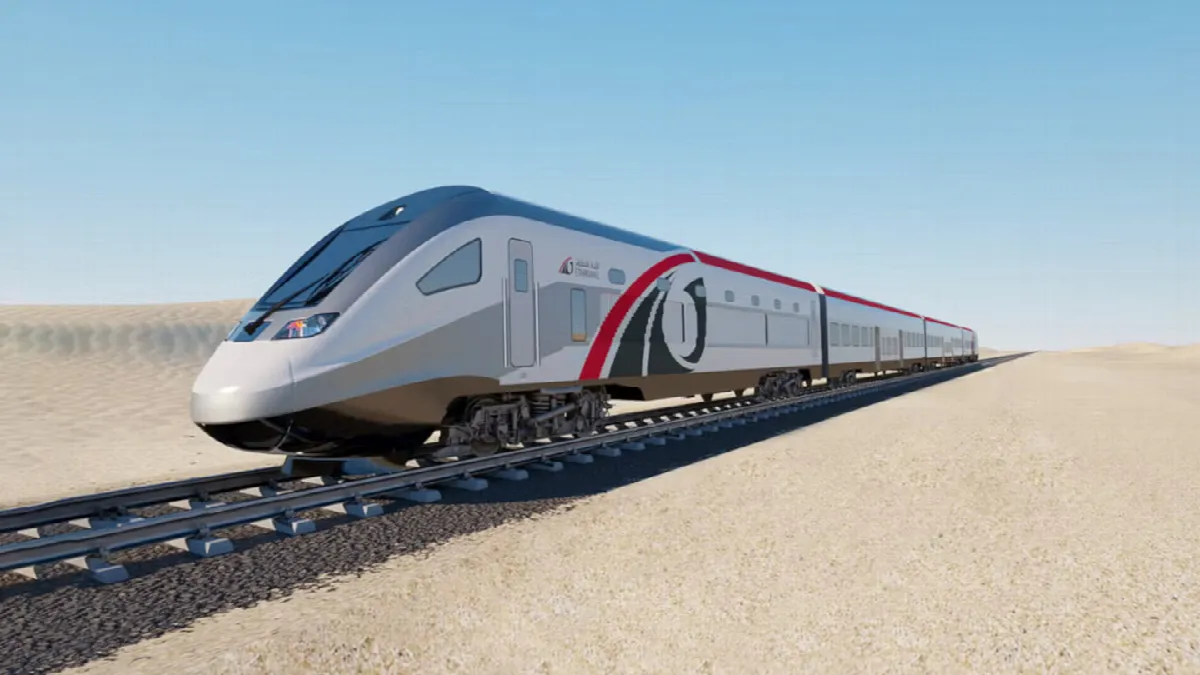
Etihad Rail has announced seven new passenger stations, bringing the total to 11 and completing the UAE’s first fully integrated national rail network. Passenger services are expected to begin operations later this year.
The new stations—Al Sila, Al Dhannah, Al Mirfa, Madinat Zayed, Mezairaa, Al Faya, and Al Dhaid—join the previously announced locations in Abu Dhabi, Dubai, Sharjah, and Fujairah.
This marks a historic moment for UAE transportation, connecting 11 cities and regions across multiple emirates by rail for the first time.
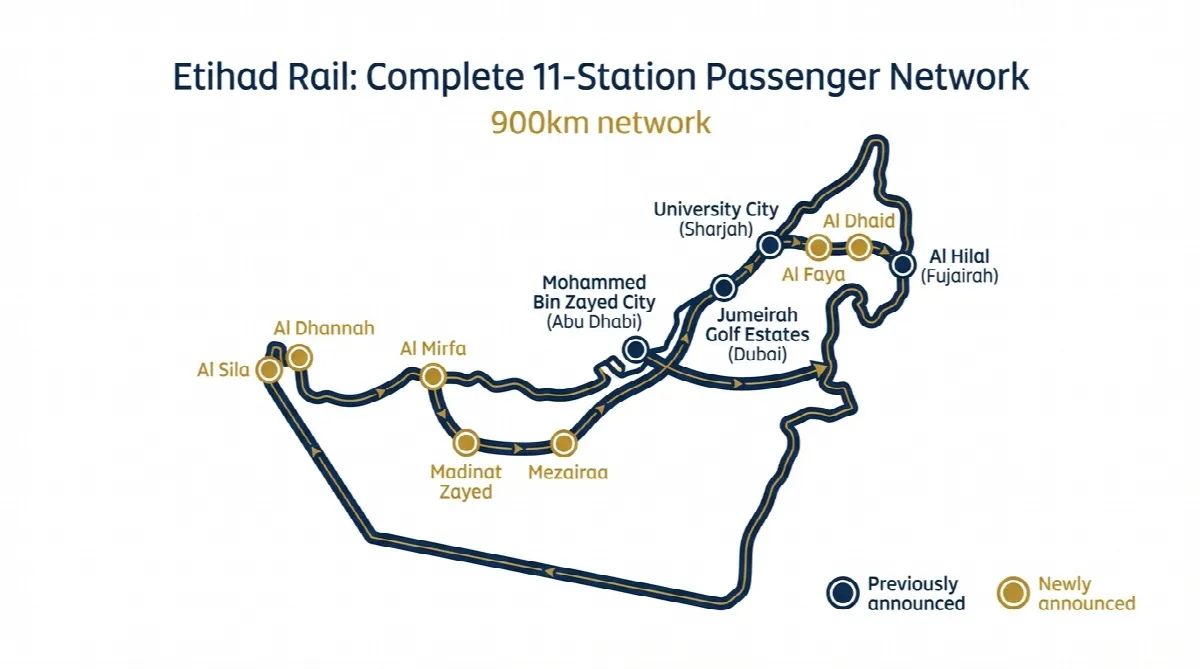
All 11 Etihad Rail Passenger Stations
The complete passenger network includes stations across four emirates:
Previously announced stations:
- Mohammed Bin Zayed City, Abu Dhabi
- Jumeirah Golf Estates, Dubai
- University City, Sharjah
- Al Hilal area, Fujairah
Newly announced stations:
- Al Sila (Western Region)
- Al Dhannah (Western Region)
- Al Mirfa (Western Region)
- Madinat Zayed (Western Region)
- Mezairaa (Al Dhafra Region)
- Al Faya (Central Region)
- Al Dhaid (Sharjah)
Mohammed Alshehii, Chief Projects Officer at Etihad Rail, confirmed that station areas were “carefully selected” within key locations to serve population centres across the country.
When Will Etihad Rail Passenger Services Start?
Stations will open in phases, with passenger operations expected to begin in 2026. The network builds on Etihad Rail’s freight service, which has been operational since 2023.
Azza AlSuwaidi, Deputy CEO of Etihad Rail, said: “The passenger rail network is a cornerstone of the UAE’s transport system, supporting development and connectivity. Building on our freight service since 2023, this milestone reflects partner collaboration and national talent, supported by global best practices.”
The network is equipped with advanced technology and next-generation trains designed for reliable service.
Train Features: Business and Economy Classes
Etihad Rail trains will offer two classes of service:
| Class | Seats | Features |
|---|---|---|
| Business | 16 seats | Premium seating, added amenities |
| Economy | 56 seats | Comfortable standard seating |
All compartments include:
- Contemporary interior design
- Full Wi-Fi connectivity
- Power outlets at every seat
Each train can accommodate up to 400 passengers and will operate using the latest rail management systems.
How Many Trains Are Ready?
Alshehhi confirmed that 10 of the 13 trains have arrived in the UAE and completed testing and certification to international safety and quality standards.
The remaining three trains are expected to arrive before passenger services launch, providing full fleet capacity for the network.
Journey Times Across the Network
The passenger rail service promises significant time savings compared to road travel. Previously announced journey times include:
| Route | Rail Time | Typical Drive |
|---|---|---|
| Abu Dhabi to Dubai | 57 minutes | ~2 hours |
| Abu Dhabi to Al Ruwais | 70 minutes | ~2.5 hours |
| Abu Dhabi to Fujairah | 100 minutes | ~2.5 hours |
Trains will reach speeds of up to 200 km/h on the 900km network.
The Scale of the Project
The announcement revealed the massive scope of work behind the passenger network:
- Total working hours: 24.5 million
- Workforce: More than 7,000 experts and workers
- Development period: Three years of intensive planning, design, and delivery
“This achievement is the result of three years of intensive planning, design, and delivery,” said Alshehhi.
Integration with Existing Transport
The new rail network will connect seamlessly with existing public transport across the UAE:
Dubai integration:
- Direct connections to Dubai Metro
- Feeder bus services
- Taxi and ride-hailing integration
- Unified nol card ticketing expected
Abu Dhabi integration:
- Connections with Abu Dhabi bus network
- Future Metro system links planned
Sharjah connectivity:
- Integration with local bus networks
- Reduced congestion on Dubai-Sharjah corridor
Services will run on regular schedules, offering fast, efficient travel between cities while reducing road congestion.
Keolis Partnership for Operations
In October 2024, Etihad Rail signed a joint venture with Keolis, a global passenger transport leader, to operate the passenger rail service.
Alistair Gordon, CEO of Keolis UK, Middle East and India, confirmed the company will run trains and manage connections including buses, taxis, and car parking. Keolis will also train drivers and recruit staff for the network.
This partnership brings international rail operations expertise to the UAE’s first national passenger rail system.
Economic and Environmental Benefits
The passenger rail network is expected to deliver significant national benefits:
Economic impact:
- Tourism boost through improved inter-emirate access
- Enhanced business connectivity
- Job creation across multiple sectors
- Property value growth near station areas
Environmental benefits:
- 21% reduction in CO2 emissions by 2050 compared to equivalent road transport
- Single passenger train can replace up to 300 cars
- Electric-powered trains reducing highway congestion
Social connectivity:
- Strengthened ties between emirates
- Improved access to education, healthcare, and employment
- Making the UAE more connected and accessible for residents and visitors
Western Region Coverage
The seven new stations significantly expand coverage in Abu Dhabi’s Western Region (Al Dhafra), an area previously underserved by public transport:
Al Sila: Border town near Saudi Arabia Al Dhannah: Coastal community in the Western Region Al Mirfa: Fishing town on the Arabian Gulf coast Madinat Zayed: Administrative centre of Al Dhafra Region Mezairaa: Gateway to the Liwa Oasis area
This expansion connects remote communities to the national network, supporting development goals for the Western Region.
Key Takeaway
Etihad Rail has completed the UAE’s first national passenger rail network with 11 stations across Abu Dhabi, Dubai, Sharjah, and Fujairah. The seven newly announced stations—Al Sila, Al Dhannah, Al Mirfa, Madinat Zayed, Mezairaa, Al Faya, and Al Dhaid—connect the Western Region and Central Region to the network for the first time. Services will open in phases starting this year, with trains featuring business and economy classes, Wi-Fi, and power outlets at every seat. Ten of 13 trains have arrived and been certified, with each capable of carrying 400 passengers at speeds up to 200 km/h.
FAQs
How many Etihad Rail passenger stations will there be?
Etihad Rail will have 11 passenger stations across the UAE. Four were previously announced (Mohammed Bin Zayed City in Abu Dhabi, Jumeirah Golf Estates in Dubai, University City in Sharjah, and Al Hilal in Fujairah). Seven new stations were just announced: Al Sila, Al Dhannah, Al Mirfa, Madinat Zayed, Mezairaa, Al Faya, and Al Dhaid.
When will Etihad Rail passenger services start?
Passenger services are expected to begin operations this year (2026), with stations opening in phases. The network builds on Etihad Rail’s freight service, which has been operational since 2023. Ten of the 13 trains have already arrived and been certified to international safety standards.
What classes are available on Etihad Rail trains?
Etihad Rail trains feature two classes: Business class with 16 seats and Economy class with 56 seats. All compartments include contemporary design, full Wi-Fi connectivity, and power outlets at every seat. Each train can accommodate up to 400 passengers total.
How fast will Etihad Rail passenger trains travel?
Passenger trains will reach speeds of up to 200 km/h on the 900km network. This enables journey times of 57 minutes from Abu Dhabi to Dubai (compared to a typical 2-hour drive) and 100 minutes from Abu Dhabi to Fujairah.
Which emirates will Etihad Rail connect?
The passenger network connects four emirates: Abu Dhabi (including the Western Region), Dubai, Sharjah, and Fujairah. The 11 stations span 11 cities and regions, creating the UAE’s first fully integrated national passenger rail system.
Further Reading
The UAE week, every Monday
The week's stories on jobs, visas, money and daily life in one short email. Unsubscribe in one click.