Engine Flameout: Why Volcanic Ash is Aviation’s Silent Killer
Discover why volcanic ash melts inside jet engines, causing flameouts. Learn how pilots handle ash encounters and why radar cannot detect this silent threat.
By Vadim Kouznetsov, published

By JobXDubai Team | November 25, 2025
The recent disruption to India-UAE flights due to the Ethiopian volcano has left thousands of passengers stranded. While frustrating, these cancellations are a critical safety measure against one of aviation’s most silent and deadly threats: volcanic ash.
It is not just dust. When a jet engine sucks in volcanic ash, the consequences can be catastrophic. The most terrifying scenario is an “engine flameout,” where the engines simply stop working mid-flight.
Here is the science behind why airlines will never risk flying through an ash cloud.
What is Volcanic Ash?
Volcanic ash isn’t like the soft ash from a wood fire. It consists of tiny, jagged particles of rock and volcanic glass (silicates).
Because these particles are hard and abrasive, they act like sandpaper when they hit an aircraft moving at 800 km/h. But the real danger happens inside the engine.
The Melting Point Problem
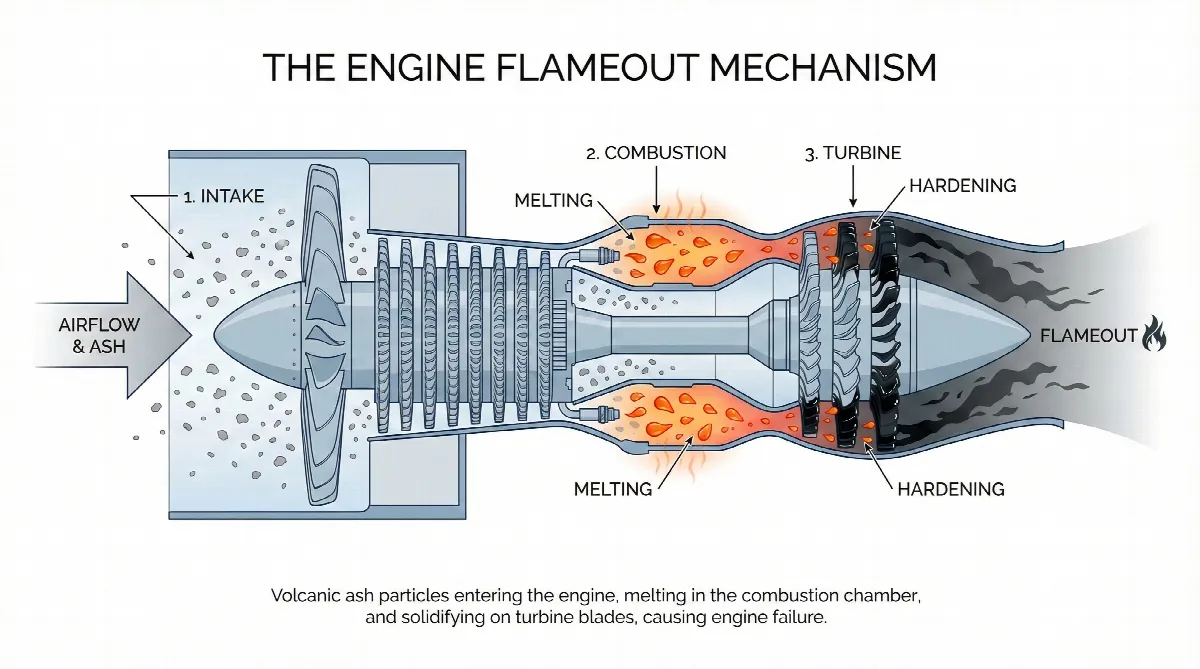
Modern jet engines operate at scorching temperatures of around 1,400°C. The silicates in volcanic ash, however, melt at a lower temperature of roughly 1,100°C.
The “Glass Engine” Effect:
- Ash is sucked into the hot combustion chamber.
- It instantly melts into a sticky, molten liquid.
- As it passes further back to the turbine blades (which are cooler), it re-solidifies.
- This coats the blades in a layer of glass, blocking airflow and choking the engine.
Real-Life Nightmare: KLM Flight 867
The danger isn’t theoretical. In 1989, KLM Flight 867, a Boeing 747 flying from Amsterdam to Tokyo, inadvertently flew into a thick ash cloud from Mount Redoubt in Alaska.
The result? All four engines flamed out.
The aircraft turned into a heavy glider, dropping more than 14,000 feet in silence before the crew managed to restart the engines and land safely. The damage to the aircraft was so severe it required millions of dollars in repairs.
Other Hazards: Sandblasted Windows
Even if the engines survive, ash causes other critical failures:
- Visibility Loss: The abrasive ash can “sandblast” the cockpit windshields, turning them opaque and leaving pilots flying blind.
- Sensor Failure: Ash can block pitot tubes (speed sensors), leading to erratic instrument readings.
- Corrosion: Volcanic plumes often contain acidic gases that corrode metal parts and degrade avionics over time.
The Silent Killer: Why Radar Can’t See It
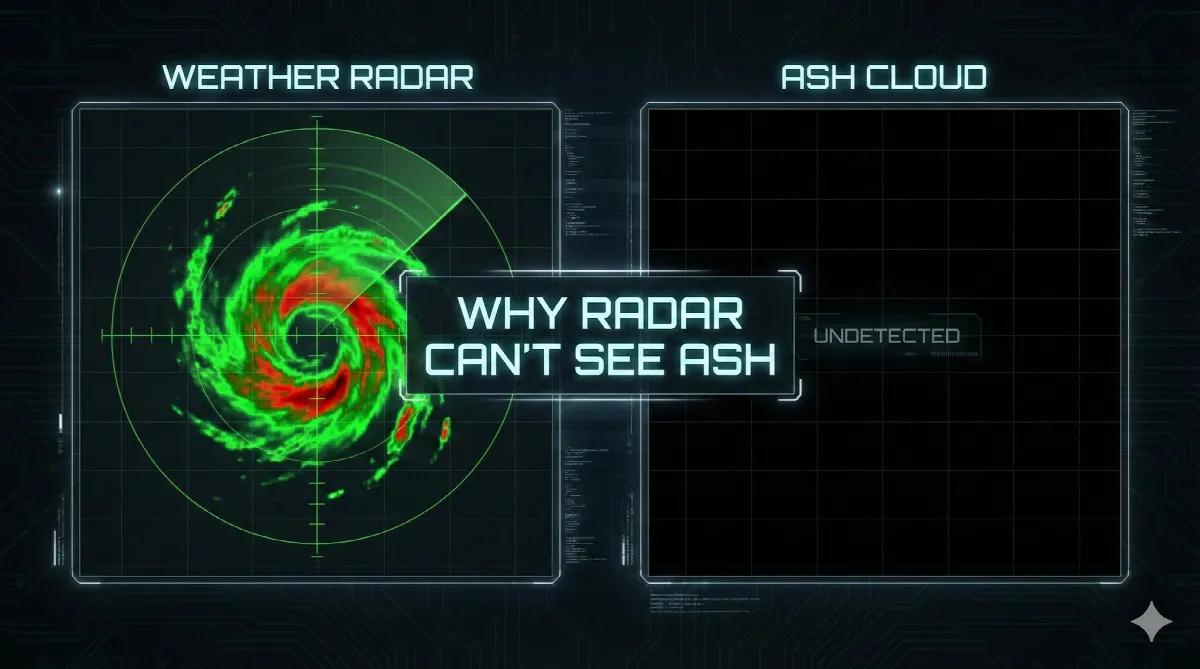
One of the scariest aspects of volcanic ash is its invisibility to aircraft instruments.
Standard weather radar is designed to detect water droplets (clouds and rain). Volcanic ash particles are too small and dry to reflect radar waves effectively. This means a pilot can fly straight into a dangerous plume while their radar screen shows clear skies.
Did you know? Pilots often only realize they are in an ash cloud when they smell sulfur (like rotten eggs) or see “St. Elmo’s Fire”—static electricity dancing on the windshield.
How Airlines Stay Safe
Since radar is ineffective, the aviation industry relies on a global network of Volcanic Ash Advisory Centers (VAACs). These centers use satellites and ground observations to track plumes and issue warnings.
If ash is detected, the only safe option is avoidance. This is why we see mass cancellations like those affecting flights from Sharjah and Dubai whenever a volcano erupts near a flight path.
Key Takeaway
Volcanic ash is kryptonite for jet engines. It melts, turns to glass, and chokes the engine’s ability to breathe, leading to potential flameouts. With radar unable to detect it, strict avoidance and flight cancellations remain the only viable safety strategy.
Further Reading:
The UAE week, every Monday
The week's stories on jobs, visas, money and daily life in one short email. Unsubscribe in one click.