UAE Jaywalking Fine: Dh400-Dh10,000 Penalties & Jail Terms 2025
Jaywalking in UAE now costs Dh400-Dh10,000 with potential jail time. Learn penalties, legal crossing points, and how to avoid fines.
By Vadim Kouznetsov, published

How Much Is the Fine for Jaywalking in UAE?
Jaywalking in the UAE now carries penalties ranging from Dh400 to Dh10,000, depending on where you cross and whether you cause a traffic accident. The stricter Federal Decree-Law No. 14 of 2024, which came into effect on March 29, 2025, significantly increases consequences for pedestrians who ignore designated crossing areas.
In January 2024 alone, nearly 44,000 people were caught jaywalking in Dubai. That same month, eight individuals lost their lives in run-over incidents. These alarming figures prompted authorities to introduce tougher regulations aimed at reducing pedestrian fatalities and improving road safety across the emirates.
What Is Jaywalking Under UAE Law?
Jaywalking refers to crossing a road from a non-designated area. This includes any location without a marked pedestrian crossing, footbridge, or subway passage.
Article 7 of Federal Decree-Law No. 14 of 2024 outlines ‘controls for using the road’, stating that pedestrians—as well as individuals on cycles, e-scooters, or any form of personal transport—must not stop in the middle of the road or cross from undesignated areas.
Even when using designated pedestrian crossings, you must follow traffic signals. Crossing when the pedestrian light shows red constitutes a violation, regardless of whether you’re using a marked crossing point.
What Are the Current Jaywalking Penalties?
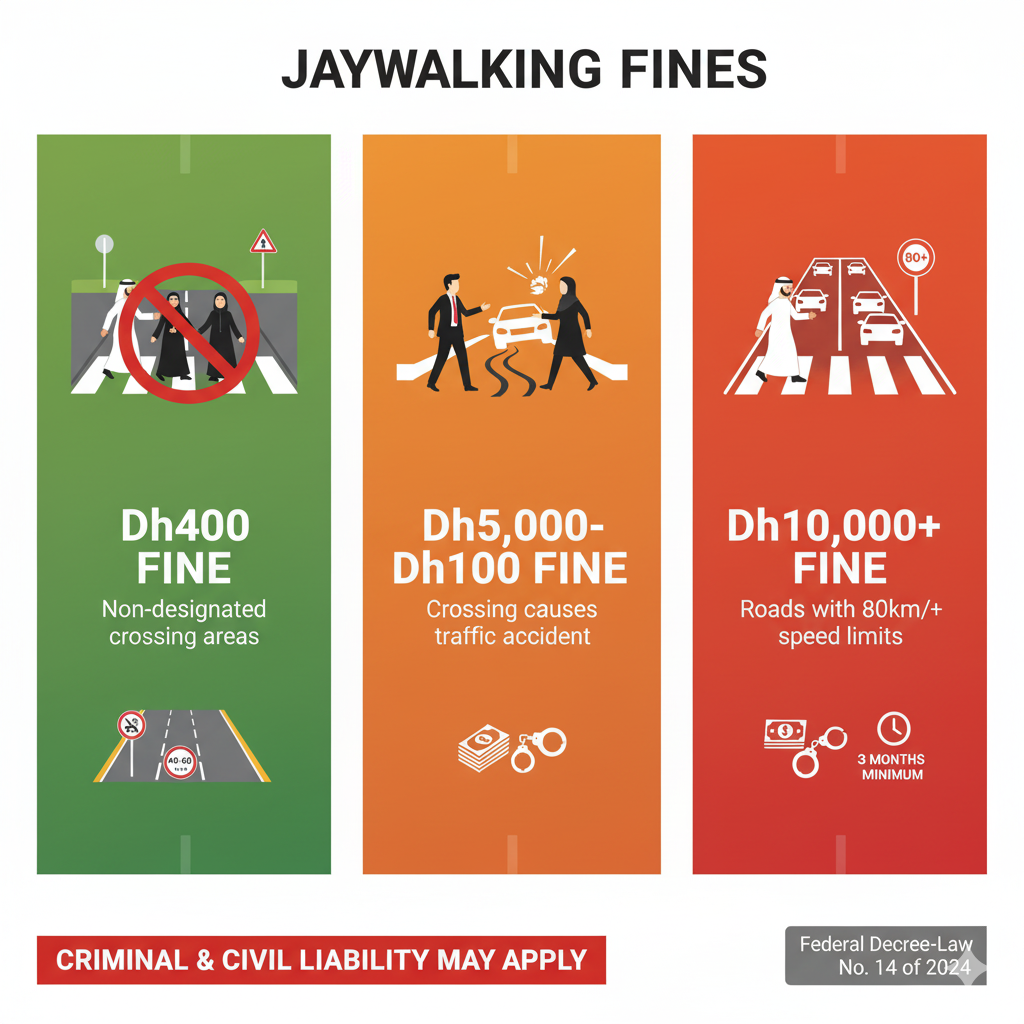
The new UAE traffic law introduced three-tiered penalty structure for jaywalking violations:
Standard Jaywalking Fine: Dh400 for crossing roads from non-designated areas under normal circumstances.
Jaywalking Causing Accidents: Dh5,000 to Dh10,000 fine plus imprisonment if you cross from an undesignated location and cause a traffic accident.
High-Speed Road Violations: Minimum Dh10,000 fine and three months imprisonment for jaywalking on roads with speed limits of 80 km/h or higher. Violators may also face civil or criminal liability for any resulting consequences.
These penalties mark a substantial increase from the previous Dh400 flat fine that applied to all jaywalking incidents before March 2025.
Where Can You Legally Cross Roads in UAE?
The UAE provides several safe crossing options designed to protect pedestrians:
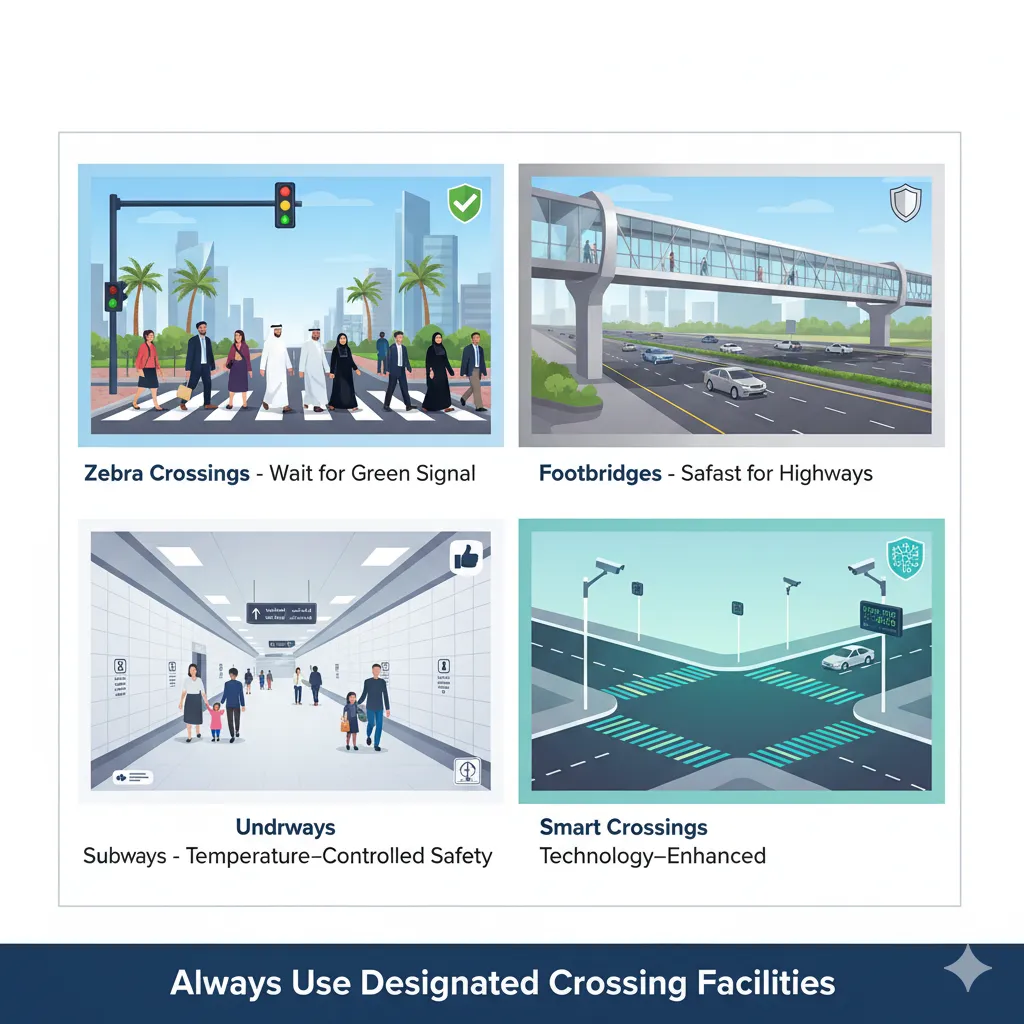
Zebra Crossings: Marked pedestrian crossings at street level, typically equipped with traffic signals. You must wait for the green pedestrian light before crossing.
Footbridges: Elevated walkways spanning major roads and highways. These provide the safest crossing method for high-speed routes.
Subways: Underground passages beneath busy roads and intersections, particularly common near metro stations and shopping areas.
Smart Pedestrian Crossings: Technology-enabled crossings with sensors and enhanced lighting, increasingly common in Dubai and Abu Dhabi’s modern districts.
When using any crossing facility, remain alert and avoid distractions like mobile phones or headphones.
Why Did UAE Increase Jaywalking Penalties?
The government introduced stricter penalties to address a growing pedestrian safety crisis. Statistical data reveals concerning trends in pedestrian-related incidents across the emirates.
According to Dubai’s traffic enforcement data, pedestrian fatalities dropped from 9.5 per 100,000 people in 2007 to 0.3 in 2024—a significant improvement. However, the 44,000 jaywalking violations caught in Dubai during January 2024 alone, combined with eight deaths that month, indicated that complacency remained a serious problem.
The new law aims to:
- Reduce pedestrian fatalities through deterrent fines
- Change public behaviour regarding road crossing habits
- Protect drivers from liability when pedestrians violate traffic laws
- Improve overall road safety statistics across all emirates
High-speed roads pose particular danger. When vehicles travel at 80 km/h or faster, drivers have significantly less reaction time to avoid pedestrians who appear suddenly in the roadway.
What Is Civil and Criminal Liability for Jaywalking?
The updated traffic law introduces a crucial legal concept: pedestrians who jaywalk can now be held both civilly and criminally liable for accidents.
Civil Liability: If you jaywalk and cause an accident, you may need to compensate the driver for vehicle damage, medical expenses, or other losses. Legal expert Hassan Elhais from Awatif Mohamed Shoqi Advocates explains that pedestrians might need to pay damages to drivers when they cross illegally.
Criminal Liability: Beyond financial compensation, you may face criminal charges including imprisonment for jaywalking that results in accidents—particularly on high-speed roads.
Loss of Compensation Rights: Pedestrians crossing at non-designated areas typically cannot hold drivers accountable for injuries if the driver was following traffic laws. Legal expert Abdulrahman Al Nabhan describes this as a “legal triangle” concept where the jaywalking pedestrian loses their right to claim damages from the driver.
This represents a significant shift from previous regulations where injured pedestrians could sometimes claim compensation regardless of their own traffic violations.
How Can You Avoid Jaywalking Penalties?
Following these RTA safety guidelines keeps you safe and penalty-free:
Use Designated Crossings Only: Always cross at zebra crossings, footbridges, or subways. Never attempt to cross between these facilities, even if it seems faster.
Follow Traffic Signals: Wait for the green pedestrian light at signalled crossings. Never cross on red, even if the road appears clear.
Stay Alert: Remove headphones and put away your phone when crossing. Visual and auditory awareness prevents accidents.
Make Eye Contact: Before stepping onto a crossing, make eye contact with approaching drivers to confirm they’ve seen you.
Look in All Directions: Check left, right, and left again before crossing. In the UAE, traffic approaches from directions that may differ from your home country.
Wait for Complete Stops: Don’t start crossing until all traffic lanes have fully stopped, even at designated crossings.
Use Reflective Clothing: If walking at night, wear bright or reflective clothing to increase visibility to drivers.
Walk Facing Traffic: On roads without pavements, walk facing oncoming traffic so you can see approaching vehicles.
Cross at Corners: At intersections, use corners rather than crossing mid-block, and follow all available traffic signals.
What Happens If You Get Caught Jaywalking?
The enforcement process depends on how authorities detect the violation:
On-the-Spot Fines: Police officers may issue immediate fines for observed jaywalking. You’ll receive a citation requiring payment through official channels.
Smart Camera Detection: UAE’s AI-powered traffic cameras monitor pedestrian crossings and can identify violations. Fines appear in your traffic record within several days.
Accident Investigations: If jaywalking causes an accident, police conduct thorough investigations. This process may result in criminal charges beyond standard fines.
Payment Process: Check fines through Dubai Police website, RTA app, or Ministry of Interior platforms. Payment options include online banking, mobile apps, and police station counters.
Unpaid fines can prevent visa renewals, vehicle registration, and other government services.
Which Roads Have the Highest Jaywalking Risk?
High-speed roads carry the most severe penalties for jaywalking:
Sheikh Zayed Road (E11): Speed limits reach 100-120 km/h. Crossing this highway at any non-designated point risks Dh10,000 fines plus imprisonment.
Sheikh Mohammed Bin Rashid Road (E311): Features 80-120 km/h speed limits throughout most sections, falling under the strictest penalty category.
Al Khail Road (E44): Another major highway with 100 km/h speeds where jaywalking carries maximum penalties.
Emirates Road (E611): This inter-emirate highway maintains 120 km/h limits with minimal safe crossing points.
These major arteries account for a disproportionate share of pedestrian fatalities. The government has made clear that crossing any road with 80+ km/h speed limits from non-designated areas will result in maximum enforcement.
For residential areas and internal roads with 40-60 km/h limits, while penalties remain serious, they typically fall into the standard Dh400 category unless accidents occur.
How Does UAE’s Jaywalking Law Compare to Other Countries?
The UAE’s approach to jaywalking penalties ranks among the strictest globally:
Singapore: Fines reach SGD 1,000 (approximately Dh2,700) with repeat offences leading to SGD 2,000 (Dh5,400) penalties. The UAE’s maximum penalties exceed Singapore’s for high-speed road violations.
United States: Jaywalking fines vary by state, typically ranging from USD 20-250 (Dh73-918). The UAE’s penalties significantly exceed most US jurisdictions.
United Kingdom: No specific jaywalking law exists. Pedestrians have the right of way in most situations, though they can be charged with careless behaviour causing accidents.
Saudi Arabia: As a GCC neighbour, Saudi Arabia enforces similar strict penalties with fines reaching SAR 500 (approximately Dh490) for standard violations.
The UAE’s three-tiered approach—combining financial penalties, imprisonment, and civil liability—represents one of the most comprehensive pedestrian regulation frameworks worldwide.
What Should Tourists Know About Jaywalking in UAE?
International visitors often struggle with UAE’s strict jaywalking enforcement, particularly those from countries with more relaxed pedestrian regulations.
Cultural Differences: In many European countries, pedestrians cross roads freely outside designated areas. This practice is illegal and heavily penalised in the UAE.
Speed Limit Awareness: Tourists may not recognise which roads fall into the 80+ km/h category. When in doubt, assume major roads require designated crossings only.
Language Barriers: Traffic signs appear in both Arabic and English, but visitors should familiarise themselves with pedestrian crossing symbols before arrival.
Tourist Areas: Popular destinations like Dubai Mall, Burj Khalifa, and Dubai Marina feature extensive footbridges and subways specifically designed for heavy pedestrian traffic. Use these facilities exclusively.
Enforcement Equality: Authorities enforce traffic laws equally on tourists and residents. “I didn’t know” provides no legal defence against jaywalking fines.
Visitors should budget for potential fines and understand that UAE traffic regulations apply to all individuals within the country’s borders.
How Effective Are the New Penalties?
Early data suggests the stricter penalties are changing pedestrian behaviour, though comprehensive long-term studies remain ongoing.
Traffic experts note that severe penalties alone don’t address all causes of dangerous pedestrian behaviour. Phil Clarke, director at 4E Road Safety and Transport Consultants, states: “Any deterrent to drivers committing violations should be welcomed. However, severe penalties alone will not address all bad driver behaviour.”
The same principle applies to pedestrians. Effective road safety requires combining enforcement with infrastructure improvements:
Infrastructure Development: Installing more footbridges and subways at high-risk crossing points reduces the temptation to jaywalk.
Public Education: Ongoing awareness campaigns teach residents and visitors about safe crossing practices.
Technology Integration: Smart crossing systems with countdown timers and audible signals help pedestrians make safer decisions.
Urban Planning: Designing communities with pedestrian safety built into road layouts prevents unsafe crossing situations.
The UAE’s strategy combines all these elements alongside strict penalties to create comprehensive pedestrian safety improvements.
Frequently Asked Questions
How much is the fine for jaywalking in Dubai?
Standard jaywalking in Dubai carries a Dh400 fine. However, if you jaywalk and cause an accident, fines increase to Dh5,000-Dh10,000 plus potential imprisonment. Jaywalking on roads with 80+ km/h speed limits results in minimum Dh10,000 fines and three months imprisonment.
Can tourists get fined for jaywalking in UAE?
Yes, jaywalking penalties apply equally to tourists and residents. Authorities enforce traffic laws without distinction based on nationality or residency status.
What counts as a designated crossing area?
Designated crossing areas include zebra crossings with traffic signals, footbridges spanning roads, underground subway passages, and any marked pedestrian crossing facility. All other crossing locations are considered non-designated.
Will my insurance cover accidents if I was jaywalking?
No. If you jaywalk and cause an accident, you may lose your right to insurance compensation and could become liable for damages to the driver’s vehicle. Jaywalking violators typically cannot claim compensation from drivers who were following traffic rules.
How do I check if I have a jaywalking fine?
Check fines through the Dubai Police website (dubaipolice.gov.ae), RTA mobile app, Ministry of Interior app, or by visiting police station traffic departments. Fines typically appear in the system within several days of the violation.
Can I go to jail for jaywalking in UAE?
Yes. Jaywalking that causes traffic accidents carries potential imprisonment, particularly on high-speed roads (80+ km/h). Minimum sentences of three months apply for violations on fast roads.
Are there safe places to cross Sheikh Zayed Road?
Never attempt to cross Sheikh Zayed Road at street level. Use the numerous footbridges and subway passages built specifically for pedestrian crossings. These facilities appear every few hundred metres along the highway.
What happens if I jaywalk but no accident occurs?
You still face penalties. The standard Dh400 fine applies for jaywalking even when no collision happens. Smart cameras and police officers can issue citations for crossing from non-designated areas.
Do children get fined for jaywalking?
Children themselves typically don’t receive direct fines. However, parents or guardians may be held responsible for children who jaywalk, and the adult accompanying the child could face penalties.
How quickly must I pay a jaywalking fine?
Pay fines promptly to avoid complications with visa renewals, vehicle registration, or other government services. Most fines can be paid immediately through online platforms or within standard traffic fine payment periods.
Key Takeaway
UAE’s updated jaywalking penalties—ranging from Dh400 for standard violations to Dh10,000 plus imprisonment for high-speed road crossings—represent some of the world’s strictest pedestrian regulations. With nearly 44,000 violations caught in Dubai during January 2024 alone and eight deaths that month, authorities prioritise deterring dangerous crossing behaviour through significant financial consequences and potential criminal liability. The safest approach: always use designated crossings including zebra crossings, footbridges, and subways while following all traffic signals.
Further Reading
- UAE Traffic Laws 2024: Complete Guide to New Fines & Penalties
- UAE Traffic Law 2024: New AED 10,000 Fine for Jaywalking on High-Speed Roads
- UAE Traffic Law 2025: New Licence Rules, Exemptions & Penalties
- Dubai AI Radar: 8 Traffic Offences That Could Cost You Thousands in 2025
- UAE Traffic Law 2024: Right of Way Rules Every Driver Should Know
The UAE week, every Monday
The week's stories on jobs, visas, money and daily life in one short email. Unsubscribe in one click.