Value-Agents Review: AI Buffett-Style Stock Research in 30 Min
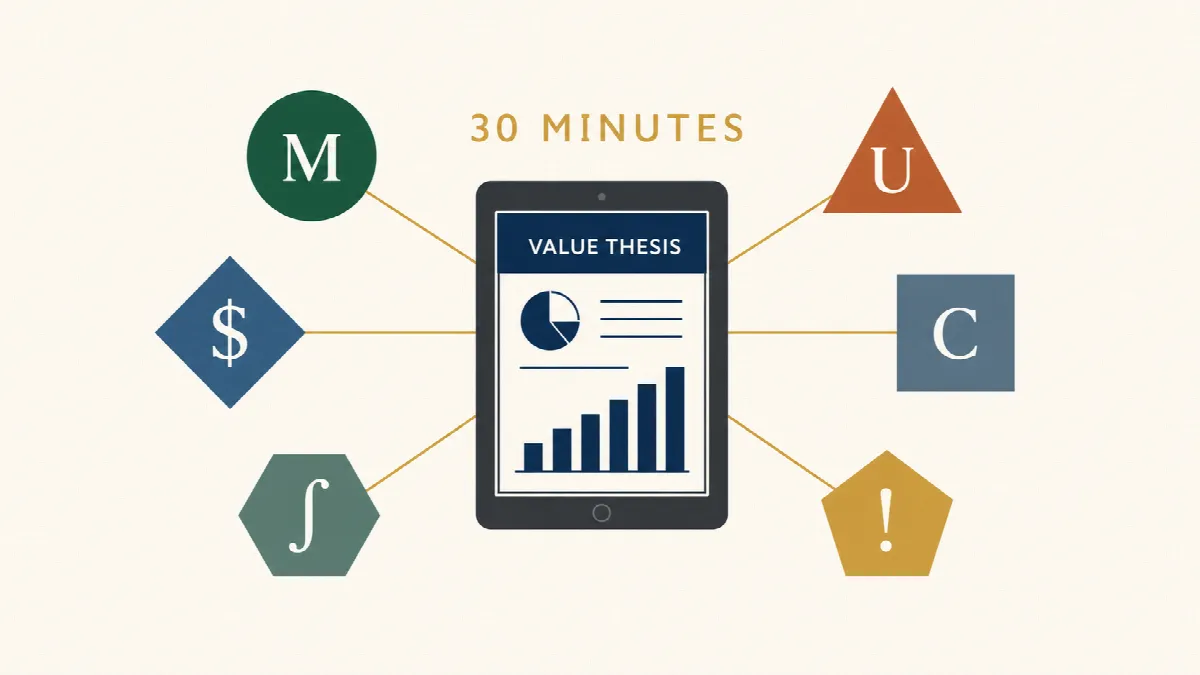
Value-Agents.com uses 6 AI agents to write a 12,000-word Buffett-style thesis on any US stock in 30 minutes. We break down how it works and what you get.
By Vadim Kouznetsov, published

Warren Buffett reads roughly 500 pages a day. So does Seth Klarman. So does Chris Hohn at TCI, Mohnish Pabrai, Joel Greenblatt — every great value investor treats deep reading as the actual job, not a chore that gets in the way of investing.
The reading is the investing.
For most of us, that is the problem. A working professional in Dubai, London or New York might have an hour a week to look at a stock they are curious about. A 200-page 10-K, three years of proxy filings, the competitor’s annual report, four earnings calls — that is a week of focused reading just to form a view on one company. The gap between the average investor and Buffett is not intelligence. It is hours.
A new tool called Value-Agents is trying to close that gap with AI. Here is what it does, how it works, and where it fits in.
Key Takeaway: Value-Agents.com is an AI research platform that produces a 12,000-word value-investing thesis on any US-listed stock in about 30 minutes. Six specialist AI agents read the SEC filings, triangulate intrinsic value three ways, apply the frameworks of Buffett, Klarman, Hohn and Chanos, and name four kill criteria that would falsify the thesis. The first thesis is free with no card required.
The Problem: Buffett-Grade Research Takes Hours You Don’t Have
Value investing is not a secret. The principles — owner earnings, intrinsic value, margin of safety, circle of competence — are public. Buffett’s letters are free to read. Klarman’s Margin of Safety is widely available. The discipline is no mystery either.
The bottleneck is hours. To form a real view on a single company you need to read the latest 10-K, ten years of audited financials, the most recent proxy, every material 8-K, the last four earnings releases, plus the equivalent for the closest one or two competitors. For one stock. Then repeat for the next one on your watchlist.
For UAE residents in particular, who are increasingly looking at international markets as part of building long-term wealth — see our breakdowns on passive income strategies and second-income options for UAE residents — the time problem is real. You have a day job. You have a family. You do not have Buffett’s Tuesdays.
What Value-Agents Actually Does
Value-Agents is built around one workflow. You type a US ticker. Roughly 30 minutes later, the platform emails you a 12,000-word thesis on that company.
The thesis is not a summary or a fact sheet. It includes:
- A line-by-line read of the latest 10-K
- Ten years of financial trend analysis from XBRL data
- Intrinsic value triangulated three ways — discounted free cash flow, earnings power value, and reverse-DCF
- A moat assessment in the style Buffett uses
- A management-quality read drawn from ten years of shareholder letters and proxy compensation data
- A capital-allocation history showing where the cash actually went
- A bear case with four named kill criteria — specific conditions that, if triggered, would falsify the thesis
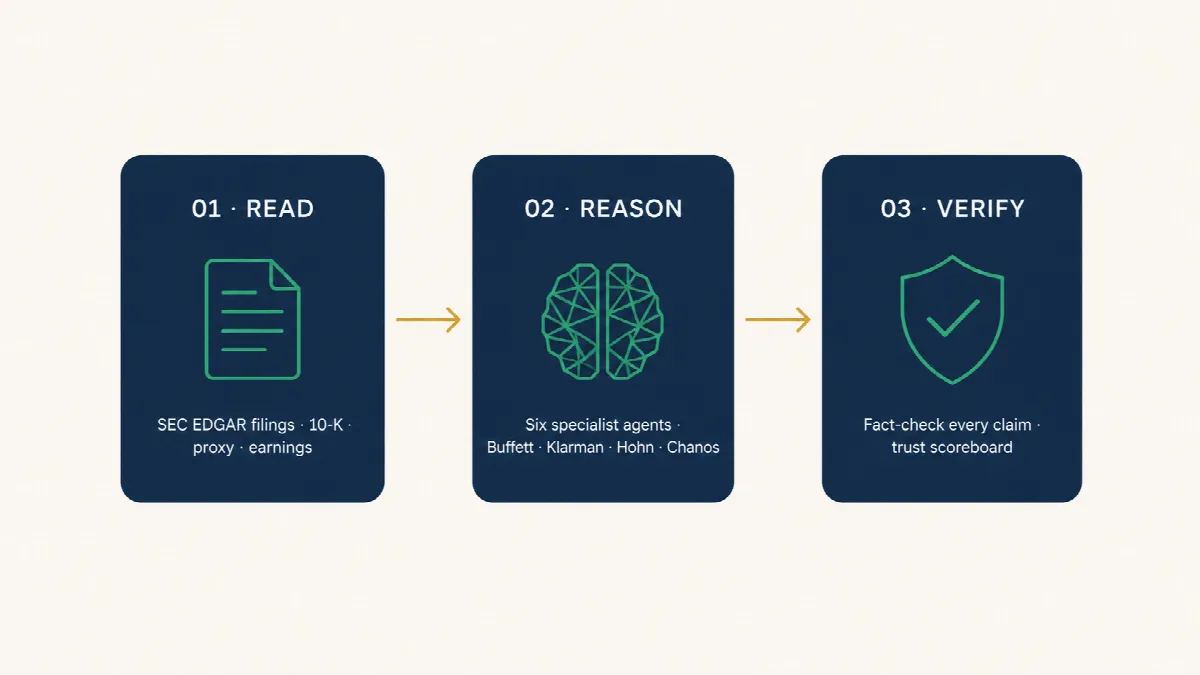
Every numeric claim and every quotation is independently audited against the source filing before delivery. The thesis ships with a trust scoreboard showing how many claims were matched, approximate, or unverifiable, with page references back to the original 10-K or proxy.
The pitch on the homepage sums it up cleanly: “No advice. No predictions. Just the work.”
How the AI Agents Actually Work
This is where it gets interesting. Rather than one large AI model doing everything, the platform uses six specialist agents, each owning a single question. Think of it as an AI investment committee where each member has a specialty.
Moat agent (Buffett lens) — Reads the 10-K and competitor filings looking for pricing power, switching costs, network effects, and structural durability.
Financials agent (Buffett & Greenblatt lens) — Works through ten-year XBRL data: revenue, gross margins, owner earnings, free cash flow conversion, return on tangible capital. Flags trend shifts and line items that do not tie.
Intrinsic-value agent (Klarman & Greenblatt lens) — Runs DCF, EPV, and reverse-DCF, then reports where the methods agree and disagree with sensitivities.
Management-quality agent (Hohn & Buffett lens) — Reads a decade of shareholder letters and proxy compensation to judge candour, capital-allocation history, and whether incentives reward owner returns or stock-price optics.
Capital-allocation agent (Hohn & Munger lens) — Tracks where the cash went: reinvestment, M&A, buybacks, dividends, debt paydown. Returns on incremental capital matter more than absolute level.
Bear case & kill criteria agent (Chanos & Hohn lens) — The thesis-killer. Forensic flags, regulatory risk, secular headwinds — and four named conditions that would falsify the thesis. If any trigger, the watchlist alerts you.
The output is not six separate reports — it is one coherent thesis where every claim has a named author and a citation underneath. Importantly, every figure comes from primary sources — SEC EDGAR directly. No scraping, no paid data resellers, no second-hand data.
A Real Example: The PLTR Thesis
The platform publishes a full sample thesis on Palantir Technologies, generated end-to-end on 26 May 2026. The verdict is worth noting because it is not flattering.
At a market price of $138.08, the agents calculated a base-case intrinsic value of $22.19 — a margin of safety of −522.2%. Verdict: Pass. Moderate conviction, quality 7/10.
The thesis runs to 18,500 words with 89 citations, four investor lenses applied, and explicit verdict zones (Buy ≤$18.86, Watch $18.86–$21.08, Pass $21.08–$22.19, Avoid ≥$22.19). Whether you agree with the conclusion or not is beside the point — the artifact is what would take a human analyst a full week to put together.
Coverage, Sources and Pricing
Coverage: Every US-listed company filing with the SEC — roughly 5,800 names across NYSE and Nasdaq. International coverage is on the roadmap.
Data sources: SEC EDGAR for filings (10-K, 10-Q, 8-K, DEF 14A), company investor relations sites for earnings releases and transcripts, and one live-price feed. No paid data resellers. Every figure traces back to a primary source.
Pricing:
- Free — One free thesis on any US ticker, no card required, emailed within 30 minutes
- Investor — $79/month — 20 fresh theses per month, every agent, every framework, source-audited footnotes, watchlist alerts on kill criteria, PDF export
- Analyst — $149/month — 50 theses per month, comparable-company tables, Buffett-style screener, priority queue (15-minute target), early access to new agents
Top-up credits are available at $26 for 5 extra credits and do not expire.
Where This Fits for UAE Investors
The UAE has become a serious wealth hub — Dubai alone is now home to over 81,000 resident millionaires and 237 centi-millionaires, and the country ranks third globally in sovereign wealth assets. With the new gratuity savings scheme giving private-sector workers more control over end-of-service investments, more residents are taking direct positions in US markets through international brokerages.
Dubai has also positioned itself as the Middle East’s largest AI hub, and tools like Value-Agents are part of that broader shift — using AI to compress what used to take a sell-side analyst a week into a 30-minute job.
For self-directed investors who want to think like Buffett but do not have his Tuesdays, Value-Agents is a tool worth trying. The first thesis is free and no card is required, so the cost of finding out whether it fits your process is zero.
Frequently Asked Questions
Is Value-Agents an investment advisor?
No. Value-Agents produces research, not advice. Every thesis ships with the explicit framing that it is not investment, financial, or legal advice. You make every decision yourself.
Which markets does Value-Agents cover?
All US-listed companies filing with the SEC — approximately 5,800 names across NYSE and Nasdaq. International coverage is on the product roadmap but not yet live.
How long does a thesis take to generate?
About 30 minutes from ticker entry to email delivery on the standard queue. The Analyst tier targets 15 minutes. Complex names with 30 years of filings can stretch to 45 minutes.
Where does the data come from?
Primary sources only — SEC EDGAR for filings, the company’s investor relations site for earnings releases and transcripts, plus a single live-price feed. No paid data resellers.
How reliable are the numbers in the thesis?
Every numeric claim and every quotation is independently audited against the source filing before delivery. The thesis ships with a trust scoreboard showing matched, approximate, or unverifiable claims, with page references back to the source document. You can falsify any line in under a minute.
What happens if the thesis becomes wrong later?
Every thesis ships with four named kill criteria. The platform watches the filings and alerts you when one triggers — the product is built to fail loudly, not quietly.
Is the first thesis really free?
Yes. One free thesis on any US ticker, no credit card required, no upsell. If the output does not change how you think about that company, you do not have to do anything else.
Who built Value-Agents?
The platform is operated by Inhype Live Limited, a London-registered company. Full disclosure: this article is published on JobXDubai, and Value-Agents is operated by the same founder. The product details above are taken directly from the public website.
Further Reading
- Value-Agents — Start a Free Analysis on Any US Ticker
- UAE Passive Income Guide: Top Ways to Earn Extra Money
- UAE Second Salary Guide: Monthly Income Options for Residents
- UAE’s New Gratuity Savings Scheme: Essential Guide for Dubai Workers
- UAE Wealth Boom: Why Centi-Millionaires Are Flocking to Dubai and Abu Dhabi
- UAE Ranks Third Globally in Sovereign Wealth Assets Worth $2.49T
- Dubai DIFC: Building Middle East’s Largest AI Hub
- UAE Financial Survey: 50% of Residents Overspend
Disclosure: Value-Agents is operated by Inhype Live Limited. This article is editorial in nature and based on publicly available information from value-agents.com. Nothing in this article constitutes investment advice.
The UAE week, every Monday
The week's stories on jobs, visas, money and daily life in one short email. Unsubscribe in one click.