UAE Petrol Prices May 2026: Will Fuel Hit Dh4 a Litre Again?
UAE May 2026 petrol prices announced April 30. Brent at $99.16. Will Super 98 cross Dh4 a litre? Full forecast, current rates and what drivers can do.
By Vadim Kouznetsov, published
UAE drivers are bracing for another fuel price revision. The Fuel Price Committee will announce May 2026 petrol rates next week, and oil markets have given residents little reason to relax — Brent crude traded mostly in the high $90s and above $100 a barrel through April 2026, driven by the closure of the Strait of Hormuz and ongoing regional military conflict involving the US, Israel, and Iran.
Here’s what the data points to, what April pump prices already look like, and whether petrol could cross Dh4 a litre for the first time since 2022.
What Drove April 2026 Prices
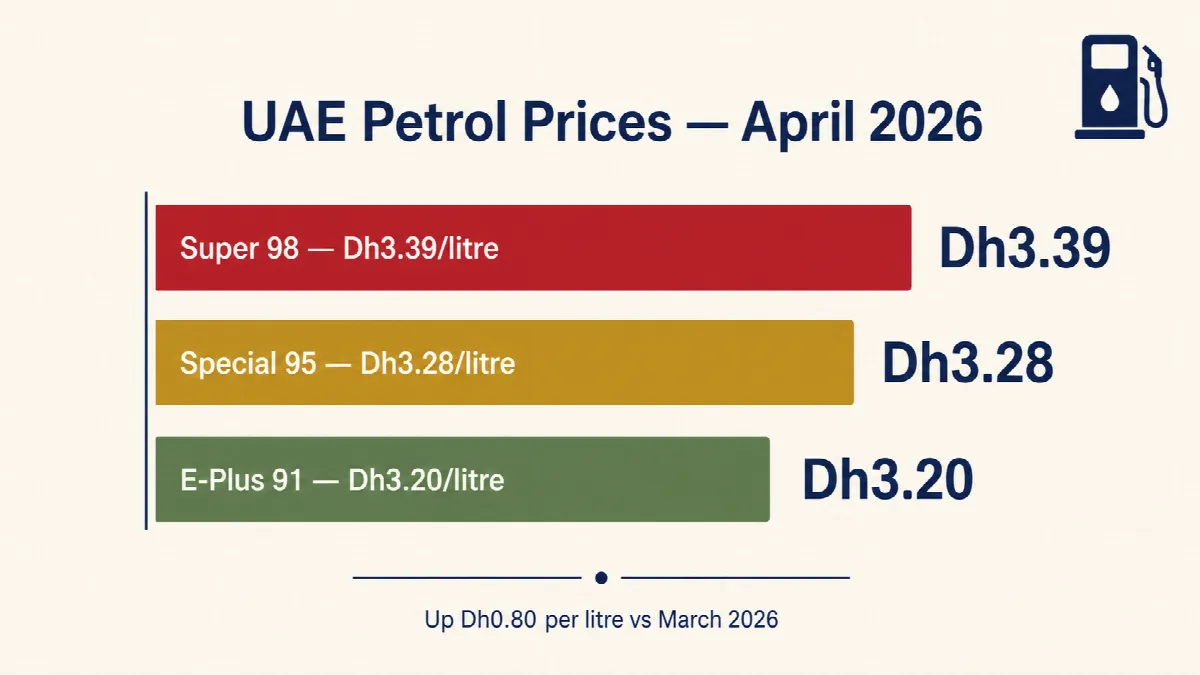
The Fuel Price Committee already raised petrol prices for April 2026 by approximately Dh0.80 per litre — close to a one-third increase — after oil surged in March following the outbreak of the Middle East war on February 28.
April 2026 pump prices:
- Super 98: Dh3.39 per litre
- Special 95: Dh3.28 per litre
- E-Plus 91: Dh3.20 per litre
That move followed the March 2026 price adjustment and wiped out most of the relief residents had enjoyed throughout 2025. For context, June 2025 had Super 98 at just Dh2.58 — the June 2025 fuel price breakdown shows just how much the market has shifted in under a year.
Will May 2026 See Another Increase?
The signal is leaning slightly higher.
The average closing Brent crude price in April 2026 was $99.16 a barrel, compared with $96.96 in March. That alone suggests fuel prices could be adjusted upward again, though the final decision rests with the Fuel Price Committee, which will announce the revised rates on April 30.
Two scenarios are realistic:
- Modest increase of Dh0.05–Dh0.15 per litre if Brent holds in the high $90s
- Steeper increase if the closing days of April push the average higher and supply concerns persist
A reduction looks unlikely given current market conditions.
Could Petrol Cross Dh4 a Litre?
The historical reference point is 2022. The UAE recorded its highest-ever petrol prices in July 2022 after the Russia-Ukraine war, when:
- Super 98 hit Dh4.63 per litre
- Special 95 hit Dh4.52 per litre
That was the first time fuel crossed Dh4 in the country’s history.
The current Middle East conflict has had a more severe impact on global oil markets in some respects — the closure of the Strait of Hormuz has removed an estimated 10–13 million barrels per day of supply, roughly 12% of global output. That’s the sharpest disruption to energy flows since the 1970s oil crises.
For the May rate to break Dh4, Super 98 would need to climb roughly Dh0.61 from its April price of Dh3.39. That’s a heavier jump than what April’s Brent average alone implies — but it isn’t out of reach if market conditions worsen quickly. June or July 2026 are arguably more likely candidates if the conflict continues.
How the Strait of Hormuz Closure Changes Everything
Crude prices eased after the ceasefire between the US and Iran was extended, but climbed back above $100 once both countries exchanged renewed military rhetoric.
The effective closure of the Strait of Hormuz since late February has:
- Removed an estimated 10–13 million barrels per day of supply
- Cut roughly 12% of global daily oil output
- Triggered the sharpest disruption to energy flows since the 1970s oil crises
This is the structural reason fuel prices are unlikely to fall meaningfully until shipping resumes through the strait.
What Higher Petrol Prices Mean for UAE Residents
The cost-of-living impact extends well beyond what you pay at the pump. Diesel — which fuels almost every link in the UAE supply chain — surged more than 70% in April 2026, prompting major supermarkets to absorb part of the cost while warning that selective price adjustments are likely on certain products. Our coverage of the UAE diesel price jump and grocery impact breaks down exactly where shoppers will and won’t see it on shelves.
For households already squeezed, this matters. Korn Ferry research found nearly 70% of UAE employees say rising living costs are outpacing their salaries, with two-thirds considering changing jobs within three months. Sustained high fuel and diesel prices will only deepen that pressure.
How UAE Fuel Pricing Actually Works
Since 2015, the UAE has linked domestic fuel prices to international market rates through monthly adjustments. The Fuel Price Committee sets new rates on the last day of each month, based on:
- Average international Brent crude prices for the previous month
- Currency exchange rates
- Local distribution and operating costs
That mechanism means consumers see the impact of global volatility within roughly 30 days — both up and down.
What Drivers Can Do Before May 1
A few practical steps to soften the impact:
- Fill up before April 30 if April prices are confirmed lower than the new May rate
- Use loyalty programmes at ADNOC, ENOC, EPPCO, and Emarat for cashback or discounts
- Combine errands to reduce overall mileage
- Maintain correct tyre pressure — under-inflation can cut fuel efficiency by up to 3%
- Consider fuel-efficient or electric vehicles for longer-term planning, especially as petrol costs stay elevated
Key Takeaway
UAE petrol prices for May 2026 are likely to rise again, with Brent crude averaging $99.16 a barrel in April versus $96.96 in March. The Fuel Price Committee announces new rates on April 30. April’s prices — Super 98 at Dh3.39, Special 95 at Dh3.28, E-Plus 91 at Dh3.20 — already reflect a Dh0.80 jump from earlier in 2026. Petrol crossing Dh4 a litre in May is possible but unlikely on April’s data alone; June or July 2026 are stronger candidates if the Strait of Hormuz remains closed and Brent stays above $100.
Frequently Asked Questions
When will UAE May 2026 petrol prices be announced? The Fuel Price Committee will announce May 2026 rates on April 30, 2026. New prices take effect from May 1 across all UAE petrol stations (ADNOC, ENOC, EPPCO, and Emarat).
What are the current April 2026 petrol prices in the UAE? Super 98 is Dh3.39 per litre, Special 95 is Dh3.28 per litre, and E-Plus 91 is Dh3.20 per litre. Diesel rose far more sharply — over 70% — to roughly Dh4.69 per litre.
Will UAE petrol cross Dh4 a litre in May 2026? Possible but unlikely based purely on April’s average Brent price of $99.16. Super 98 would need to climb roughly Dh0.61 from Dh3.39 to reach Dh4. June or July 2026 are stronger candidates if the Strait of Hormuz stays closed and oil holds above $100.
What was the highest petrol price in UAE history? July 2022, during the Russia-Ukraine war, when Super 98 hit Dh4.63 per litre and Special 95 reached Dh4.52 per litre. It was the first time UAE petrol crossed Dh4.
Why are UAE petrol prices rising in 2026? The closure of the Strait of Hormuz since late February has removed an estimated 10–13 million barrels per day — roughly 12% of global output — caused by ongoing military conflict involving the US, Israel, and Iran.
How does the UAE Fuel Price Committee set prices? Since 2015, prices are linked to global Brent crude averages from the previous month, plus currency rates and local distribution costs. Reviews happen monthly, with rates announced on the last day of each month.
Should I fill up before April 30, 2026? If May prices are confirmed higher, filling up before the change takes effect saves money on at least one tank. Watch for the official announcement on April 30.
Are diesel prices going up too? Yes — significantly. Diesel jumped over 70% in April 2026 to around Dh4.69 per litre, well above petrol. This is feeding through to UAE supply chains and grocery prices.
How long will high oil prices last? Until the Strait of Hormuz reopens to normal commercial shipping and the US-Iran ceasefire holds. Crude eased briefly when the ceasefire was extended but climbed back above $100 on renewed military rhetoric.
Further Reading
- UAE Fuel Prices April 2026: Brent’s 54% Surge and Forecast
- UAE Diesel Price Jumps 70%: Will Supermarket Prices Go Up?
- UAE Fuel Prices June 2025: Cost Breakdown & Full Tank Analysis
- UAE Fuel Prices Drop in April 2025: Save on Petrol and Diesel Costs
- UAE Petrol Prices May 2025: Forecast & Third Consecutive Drop
- UAE Employees Want to Quit Over Rising Living Costs 2025
The UAE week, every Monday
The week's stories on jobs, visas, money and daily life in one short email. Unsubscribe in one click.