Abu Dhabi Court Rejects Bank’s Dh950,000 Loan Case Over Missing Guarantees
Abu Dhabi court rejects bank’s Dh949,938 loan claim under Article 150 of Federal Decree-Law No. 6 of 2025. What it means for UAE borrowers and guarantors.
By Vadim Kouznetsov, published

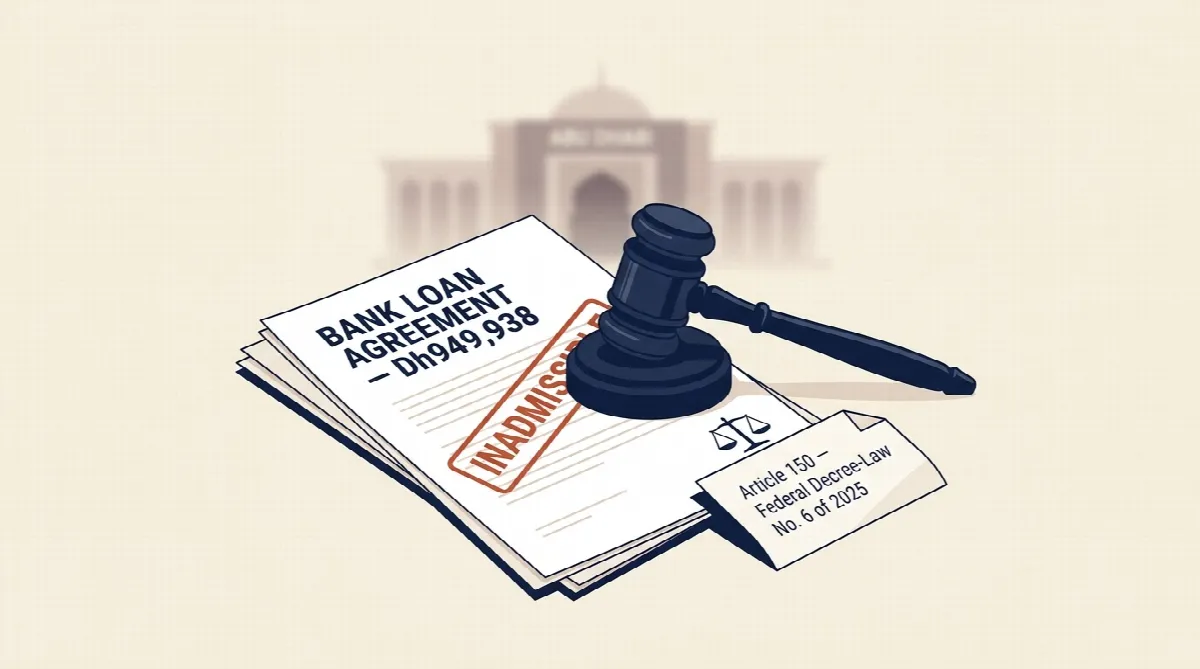
The Abu Dhabi Commercial Court has dismissed a bank’s lawsuit seeking to recover Dh949,938 from a woman and her guarantor, ruling that the lender failed to comply with central bank regulations requiring adequate guarantees for loans. The decision is a sharp reminder for both borrowers and lenders that Article 150 of Federal Decree-Law No. 6 of 2025 has real teeth.
Here’s what happened, what the law actually says, and what it means for anyone with a personal loan or guarantee in the UAE.
What the Bank Was Seeking
The bank had filed a case demanding that both defendants:
- Jointly repay the outstanding loan amount of Dh949,938
- Pay 9% annual interest from the date of default until full settlement
- Cover legal fees and expenses
According to court records, the loan was granted to the first defendant, while the second defendant signed as a guarantor. The bank submitted a loan agreement, account statement, and a copy of the guarantee in support of its claim.
On paper, this looked like a standard recovery case. The court disagreed.
Why the Court Threw the Case Out
The court found that the bank had not secured any valid guarantees from either the borrower or the guarantor at the time the credit facility was granted.
In its reasoning, the court cited Article 150 of Federal Decree-Law No. 6 of 2025 concerning the Central Bank and regulation of financial institutions. The article obliges licensed financial entities to obtain and retain sufficient guarantees for all credit facilities extended to individuals or sole proprietors.
The consequence is severe. The court stressed that failure to obtain such guarantees renders any related claim inadmissible before courts or arbitration bodies.
That phrase is the centre of the ruling. The bank wasn’t just fined or penalised — it lost the right to bring the claim at all.
The Single Cheque Issue
The court also clarified an important rule on security cheques.
Banks are not permitted to rely on a single cheque covering the full loan amount unless:
- The loan is repayable in one instalment, and
- The amount falls within the capped limit set by the regulator
For loans repaid in instalments, lenders must obtain:
- Multiple cheques matching the number and value of instalments
- Total cheque coverage not exceeding 120% of the loan value
The court noted that the case file contained no evidence the bank had complied with either of these requirements — neither valid guarantees nor multiple cheques.
“Contracts Are Binding — But Not Above the Law”
While reaffirming that contracts are binding on both parties, the court made clear that contractual terms must not violate applicable laws or public order. The bank’s failure to follow regulatory requirements counted as a breach of the law itself.
Accordingly, the court ruled the claim inadmissible and ordered the bank to bear the legal costs.
What This Means for UAE Borrowers
The ruling does not erase the underlying debt morally — but legally, it puts borrowers in a much stronger position when banks have cut corners on documentation. Three things to take from it:
- Banks must follow the rules to recover money. A loan agreement alone is not enough. The lender must demonstrate that valid guarantees were collected at the time of issuance.
- Single cheques are not a free pass. For instalment loans, banks need multiple cheques matching the schedule, capped at 120% of the loan value.
- A guarantor signature without backup is fragile. If the bank didn’t follow Article 150 properly, the guarantor’s exposure can disappear with the case.
This case is part of a broader pattern of UAE courts holding banks accountable. A recent Fujairah Federal Court ruling ordered a bank to refund Dh338,641 to a customer who had overpaid loans, plus Dh10,000 compensation for distress and a clearance certificate.
Where This Sits in UAE Banking Law
Article 150 sits alongside several other consumer protection layers under UAE Central Bank rules. Borrowers facing financial pressure should know that:
- If you default on a loan, you remain legally responsible for repayment, but courts may grant instalment-based payment plans based on your financial situation
- Banks typically file cases after three missed instalments, though the exact trigger depends on your contract
- Banks cannot raise loan interest rates unilaterally — the borrower’s rights under Article 267 of the UAE Civil Transactions Law require mutual consent for changes
- For credit cards, travel bans tied to debt typically require a court order or bank request after default
If you’ve lost income and are worried about repayments, the step-by-step guide on what happens to your loan if you lose your job in the UAE covers payment holidays, restructuring options, and how to approach the bank.
What Borrowers and Guarantors Should Do Now
If you have a live UAE loan or have signed as a guarantor:
- Request your loan file from the bank. Confirm what guarantees were collected at issuance and what cheques were taken.
- Check whether the cheque structure matches the instalment schedule. A single full-amount cheque on an instalment loan is a regulatory red flag.
- Keep all original documents. Loan agreements, signed cheque copies, account statements, SMS confirmations.
- Don’t ignore bank communication. Even if you suspect the bank has weak documentation, silence is treated as default risk.
- Get legal advice before signing as a guarantor. Your liability depends entirely on whether the bank has done its paperwork properly.
This isn’t a green light to stop paying loans — but it’s a clear signal that UAE courts will scrutinise lender compliance, not just borrower behaviour.
Key Takeaway
The Abu Dhabi Commercial Court has dismissed a bank’s claim to recover Dh949,938 because the lender failed to obtain valid guarantees as required by Article 150 of Federal Decree-Law No. 6 of 2025. Banks must collect proper guarantees and, for instalment loans, must take multiple cheques matching the instalment schedule (capped at 120% of the loan value) — relying on a single cheque for the full amount is not allowed unless the loan is repayable in one go. Where banks fail this standard, the claim becomes inadmissible before courts or arbitration. The bank also paid all legal costs.
Frequently Asked Questions
What is Article 150 of Federal Decree-Law No. 6 of 2025? Article 150 obliges licensed financial entities in the UAE to obtain and retain sufficient guarantees for all credit facilities extended to individuals or sole proprietors. Failure to comply makes any related claim inadmissible before courts or arbitration bodies.
Why did the Abu Dhabi court reject the bank’s Dh949,938 case? The court found that the bank had not secured any valid guarantees from either the borrower or the guarantor at the time the credit facility was granted, breaching Article 150.
Can a UAE bank rely on a single cheque for a personal loan? Only if the loan is repayable in one instalment and within the regulator’s capped limit. For instalment loans, the bank must obtain multiple cheques matching the number and value of instalments, with total coverage capped at 120% of the loan value.
Does this ruling mean borrowers no longer have to repay their loans? No. The ruling does not cancel the underlying debt morally or commercially. It limits the bank’s ability to enforce recovery through courts when it has not met its regulatory obligations.
What happens to a guarantor if the bank fails to comply with Article 150? The court found that without valid guarantees collected at the time of issuance, the bank’s claim against the guarantor becomes inadmissible. The guarantor’s exposure can effectively disappear if the bank failed regulatory standards.
Are bank-borrower contracts always binding in the UAE? Yes — but only when they comply with applicable laws and public order. Where contractual terms violate the law (such as Central Bank guarantee rules), the affected provisions cannot be enforced.
What should I do if my bank is suing me over an old loan? Request the full loan file, including the original guarantees and cheques collected. Compare them against the instalment schedule and consult a UAE-licensed banking lawyer to assess whether the bank complied with Article 150 and the cheque-coverage rules.
Does this apply to credit cards as well? Article 150 covers credit facilities to individuals and sole proprietors broadly. Credit card defaults follow specific Central Bank rules — typically three consecutive missed payments or six non-consecutive missed payments trigger default status.
Can the bank appeal the Abu Dhabi court’s ruling? UAE court decisions can usually be appealed within statutory time limits. Whether the bank pursues an appeal would be a commercial and legal decision based on the strength of its compliance evidence.
Where can I file a complaint against a UAE bank? Through Sanadak, the UAE Central Bank’s independent dispute resolution body for consumer banking complaints, or directly with the Central Bank’s Consumer Protection Department before pursuing court action.
Further Reading
- UAE Bank Ordered to Refund Dh338,000 to Customer Who Overpaid Loans
- UAE Bank Loan Default: Legal Rights When You Can’t Pay Your Instalments
- What Happens to Your Bank Loan If You Lose Your Job in the UAE?
- Can UAE Banks Raise Loan Interest Rates Without Notice? Your Rights
- UAE Loan Defaults: When Banks File Police Cases & Travel Impact
- UAE Travel Ban Check: How to Verify Credit Card Debt Restrictions
- UAE Credit Card Default: Legal Actions Banks Can Take Against Non-Payment
- UAE Bank Fraud Compensation: When Banks Must Refund Scam Victims
The UAE week, every Monday
The week's stories on jobs, visas, money and daily life in one short email. Unsubscribe in one click.