UAE Universities Shift Focus to Job-Ready Graduates Under New Federal Law
New UAE federal law requires universities to align programmes with job market needs. Compulsory internships, AI and fintech courses now priority focus.
By Vadim Kouznetsov, published

A new federal law issued on 30 December 2025 is reshaping higher education across the UAE. The legislation tightens regulations for universities and vocational training centres, with one clear objective: producing graduates who are ready for the workforce from day one.
The law aims to align educational outcomes with labour market demands, support lifelong learning, and strengthen the UAE’s position as a knowledge-based economy.
For students and job seekers, this means degrees that carry greater weight with employers—and academic programmes that reflect what the UAE job market actually needs.
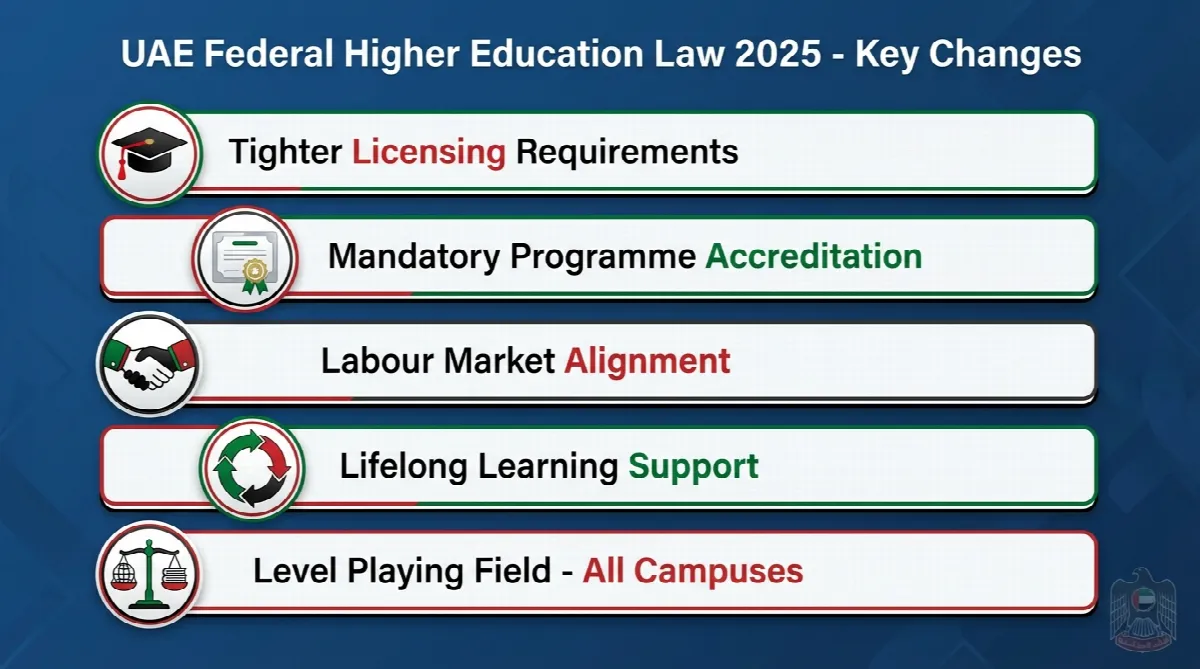
What Does the New Higher Education Law Change?
The federal legislation introduces several key reforms:
Tighter licensing requirements for educational institutions across the UAE.
Mandatory programme accreditation that creates transparency for students and parents choosing universities.
Alignment with labour market needs so graduates enter the workforce with relevant, applicable skills.
Lifelong learning support through flexible academic pathways and ongoing upskilling opportunities.
A level playing field across private, free-zone, and international university campuses operating in the UAE.
Prof. A Somasundaram, Associate Dean of Academic Undergraduate Studies at BITS Pilani Dubai Campus, explained: “This framework provides an added layer of assurance regarding quality, governance, and outcomes. It enables informed decision-making and reinforces confidence in recognised qualifications.”
How Are UAE Universities Responding?
Several institutions have already embedded job-readiness into their programmes—and the new law accelerates these efforts.
BITS Pilani Dubai: 7.5-Month Compulsory Internship
BITS Pilani Dubai’s Practice School programme requires students to complete a seven-and-a-half month compulsory internship before graduation.
Prof. Somasundaram noted: “Courses are regularly updated in close collaboration with industry partners to keep pace with workforce needs. Students can also expect a stronger emphasis on lifelong learning, supported by flexible academic pathways and practical skill-based modules.”
This hands-on approach directly addresses employer concerns about graduate readiness for professional roles.
Middlesex University Dubai: Employability Throughout the Student Journey
Professor Cedwyn Fernandes, Pro-Vice Chancellor at Middlesex University and Director of Middlesex University Dubai, confirmed that employability has been central to their approach for years.
“Employability is integrated throughout the student journey, from industry-informed course content and applied assessments to opportunities for real-world learning, internships, and employer engagement,” he said.
The results speak for themselves. The university recorded its largest-ever intake in September 2025, with strong growth in future-focused programmes including data, technology, business, and cybersecurity.
“For current students, it means greater confidence when transitioning into the workforce, as their learning experiences and academic pathways are increasingly aligned with employer expectations and industry needs that support progression into high-growth sectors,” Fernandes added.
Symbiosis Dubai: Job-Readiness From Day One
Dr Anita Patankar, Executive Director of Symbiosis Dubai, emphasised that career preparation begins immediately.
“Job-readiness is not something we think about at the end of a degree; it’s built into the learning journey from day one,” she said.
The university’s courses reflect fast-growing sectors aligned with the UAE’s AI strategy and economic priorities:
- Artificial intelligence
- Data analytics
- Digital business
- Sustainability
- Fintech
“Students work on real industry projects and internships, engage with professionals, and gain practical exposure alongside classroom learning,” Dr Patankar explained.
Which Skills Are UAE Universities Prioritising?
The new law pushes institutions to focus on skills that employers are actively seeking. Based on university programme updates and in-demand roles across Dubai, priority areas include:
Technology and AI: Machine learning, data science, prompt engineering, and cybersecurity skills remain in high demand as the UAE targets 20% GDP contribution from AI by 2031.
Business and Finance: Digital business, fintech, and financial technology expertise align with Dubai’s position as a regional financial hub.
Sustainability: Environmental management and sustainable business practices support the UAE’s green economy initiatives.
Applied Communication: Presentation skills, professional writing, and cross-cultural communication prepare students for the UAE’s international work environment.
What This Means for Current Students
Students enrolled at UAE universities can expect several immediate changes:
More application-based assessments that test practical skills rather than theoretical knowledge alone.
Stronger internship programmes with genuine industry connections and professional mentorship.
Updated course content reflecting current industry tools, technologies, and methodologies.
Flexibility to build skills matching individual career goals rather than following rigid curricula.
Dr Patankar noted that students have already observed these shifts: “Our students have noticed the more application-based assessments, stronger internships and industry connect opportunities, updated course content, and more flexibility to build skills that match their career goals.”
How Does This Benefit Job Seekers?
For graduates entering the UAE job market, the new law creates several advantages:
Qualifications that employers trust: Mandatory accreditation and quality standards mean UAE degrees carry greater credibility with hiring managers.
Practical skills from graduation: Compulsory internships and industry projects provide demonstrable experience before the first job application.
Alignment with growth sectors: Programmes focusing on AI, data, cybersecurity, and fintech prepare graduates for high-paying roles in expanding industries.
Lifelong learning pathways: Upskilling opportunities help professionals remain competitive throughout their careers as technology evolves.
Fresh graduates from top-500 ranked universities can apply for the UAE Job Seeker Visa, giving them 60-120 days to attend interviews and secure employment without needing a sponsor.
Key Takeaway
The UAE’s new federal higher education law, issued 30 December 2025, mandates that universities align academic programmes with labour market demands. Institutions including BITS Pilani Dubai, Middlesex University Dubai, and Symbiosis Dubai are implementing compulsory internships, industry partnerships, and courses in high-demand fields like AI, data analytics, and fintech. For students and graduates, this translates to qualifications that employers trust and practical skills that accelerate career entry in the UAE’s knowledge-based economy.
FAQs
When did the new UAE higher education law come into effect?
The federal law was issued on 30 December 2025. It regulates higher education institutions, technical and vocational training centres, and scientific research across the UAE.
What does the law require from UAE universities?
Universities must obtain tighter licensing and mandatory programme accreditation. They must also align educational outcomes with labour market needs and support lifelong learning for students.
How will this affect current students?
Students can expect more application-based assessments, stronger internship opportunities, regularly updated course content, and greater flexibility to develop skills matching their career goals.
Which skills are UAE universities focusing on?
Priority areas include artificial intelligence, data analytics, cybersecurity, digital business, fintech, and sustainability—reflecting sectors driving the UAE’s knowledge economy.
Does this law apply to international universities in the UAE?
Yes. The law creates a level playing field across private, free-zone, and international campuses, meaning all institutions operating in the UAE must meet the same quality and accreditation standards.
Further Reading
The UAE week, every Monday
The week's stories on jobs, visas, money and daily life in one short email. Unsubscribe in one click.