UAE Law Reforms 2025: Narcotics Penalties, Foster Care Rules & Criminal Sentencing Updates
UAE 2025 law changes: Tougher drug penalties for doctors (5 years+), foster care opens to expats and single women, stricter sentences for crimes against minors.
By Vadim Kouznetsov, published

The UAE has introduced significant amendments to key federal laws in late 2025. These changes tighten penalties for drug-related offences, expand protections for minors, and open foster care eligibility to foreign residents and single women.
Here’s what these reforms mean for residents, families, and healthcare professionals.
What Are the New Narcotics Law Penalties for Pharmacies and Doctors?
The amended Federal Decree-Law on Combating Narcotic Drugs and Psychotropic Substances introduces stricter consequences for medical professionals who violate prescription standards.
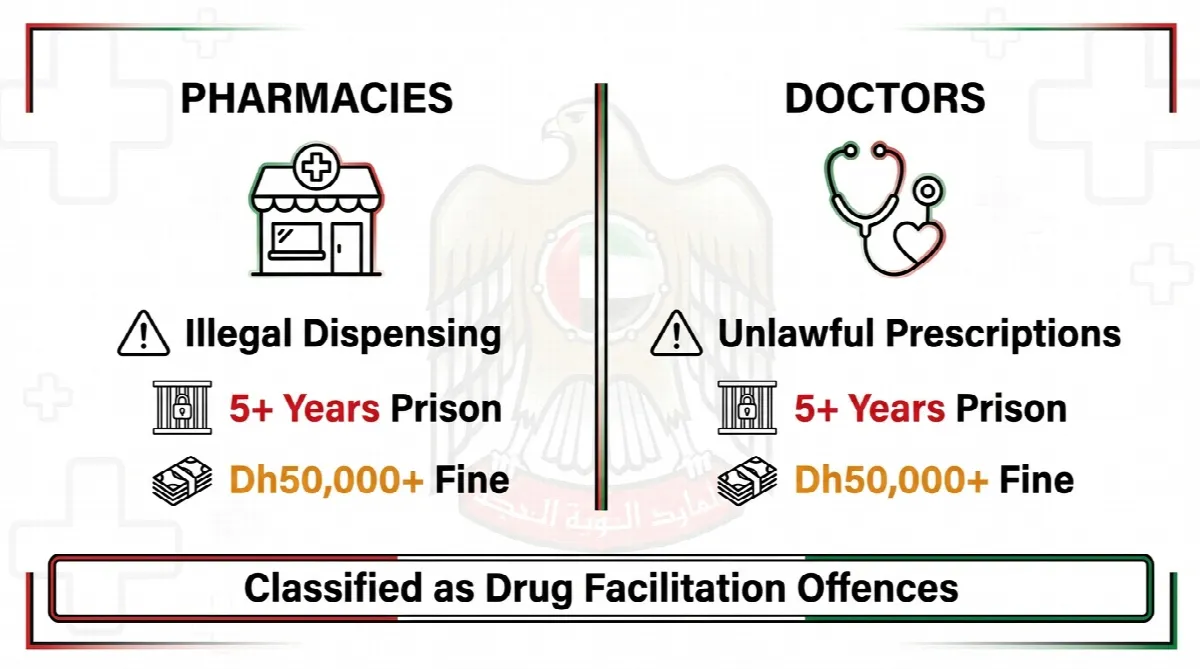
Pharmacies dispensing narcotics illegally now face:
- Minimum five-year prison sentence
- Fines starting from Dh50,000
These offences are classified as facilitating drug use under UAE law.
Doctors prescribing narcotics unlawfully face:
- At least five years imprisonment
- Fines of Dh50,000 or more
Unlawful prescriptions include those written without a licence, without medical justification, or exceeding approved limits. The law reinforces national prescription standards by treating these violations as drug facilitation offences.
For healthcare professionals working in the UAE, understanding licensing requirements is now more critical than ever.
How Do Deportation Rules Apply to Drug Offences?
Foreign nationals convicted of narcotics-related offences are generally deported after completing prison sentences.
Courts may grant exemptions if:
- The convicted person is a spouse or first-degree relative of a UAE citizen at the time of the offence
- Deportation would seriously affect family stability or deprive a dependent of essential care
The family must demonstrate financial ability to support treatment for exemptions to apply. This provision balances enforcement with humanitarian considerations for family unity.
What Treatment Options Are Available for Addiction?
The amendments expand rehabilitation services across the UAE. Federal health authorities and private health facilities can now establish specialised treatment and rehabilitation centres for addiction.
Local authorities may also create similar units, supporting a nationwide framework for addiction treatment. This marks a shift from purely punitive measures toward incorporating recovery support.
What Are the New Sexual Offence Penalties Involving Minors?
The UAE has issued a new federal decree-law introducing harsher sentences for sexual offences involving anyone under 18.
Key penalties:
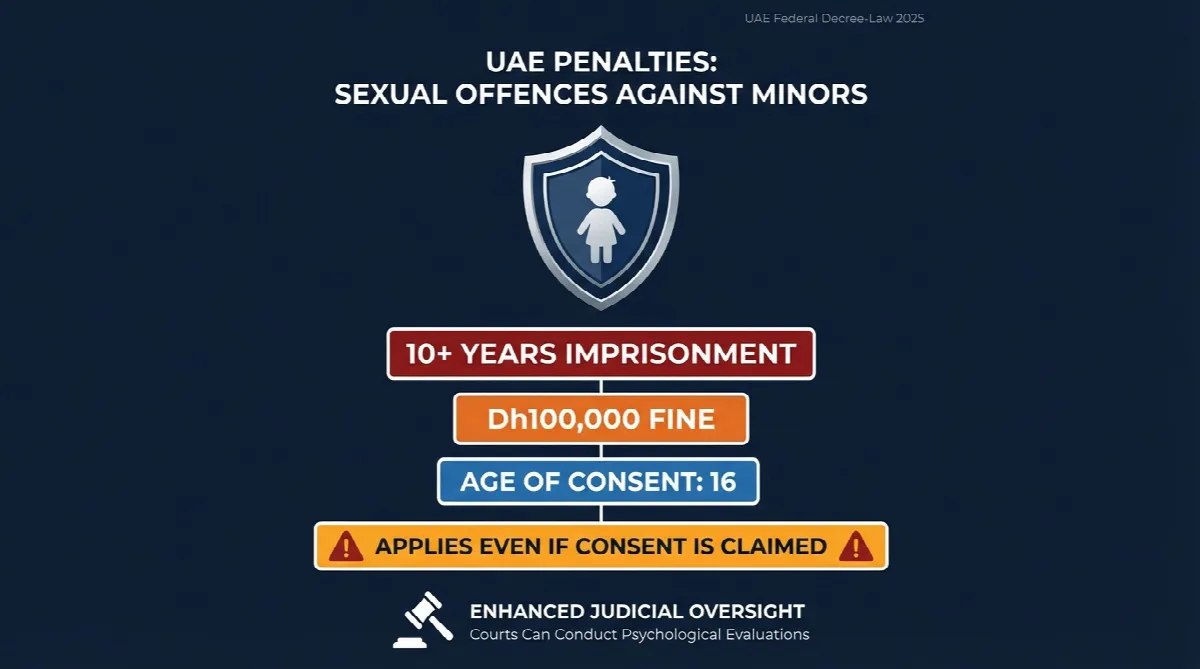
- Adults engaging in sexual activity with anyone under 18 face a minimum of 10 years imprisonment and Dh100,000 fine
- This applies even if consent is claimed
- Consent is only legally recognised if the victim is at least 16 years old
Individuals under 18 involved in consensual sexual acts are dealt with under the Juvenile Delinquents and Juveniles at Risk Law, regardless of gender or sexual orientation.
The amendments also strengthen judicial oversight. Courts can now conduct medical, psychological, and social evaluations of convicted offenders during the final six months of their sentence to assess criminal risk.
What Are the Updated Prostitution Penalties?
The new decree tightens sentences for prostitution and related offences:
- General offences carry at least two years imprisonment plus a fine
- If the victim is under 18, penalties increase significantly
These changes aim to protect minors and vulnerable individuals from exploitation while enhancing the judiciary’s ability to monitor high-risk offenders.
Can Foreign Residents Now Foster Children in the UAE?
Yes. Federal Decree-Law No. 12 of 2025 significantly expands foster care eligibility for the first time.
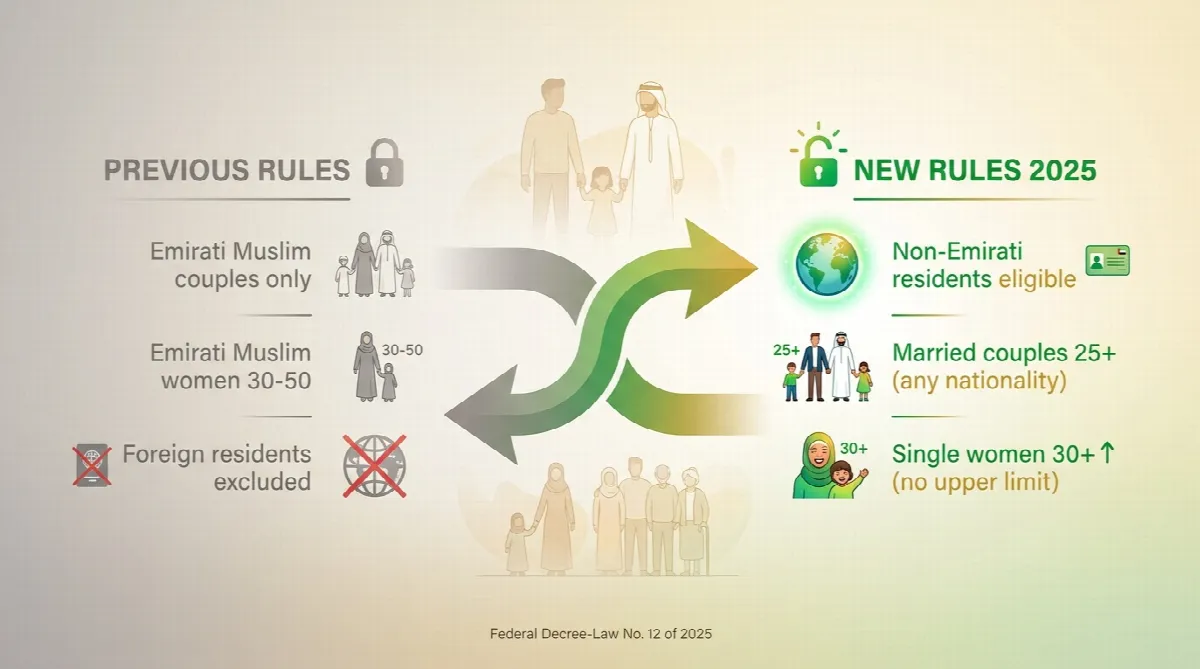
Previous restrictions:
- Foster care was limited to married Emirati Muslim couples
- Emirati Muslim women aged 30 to 50 could apply
New eligibility rules:
- Non-Emirati residents can now foster children of unknown parentage
- Married couples aged 25 and above can apply regardless of nationality or religion
- Single women aged 30 and above can apply, with no upper age limit
This represents a major expansion of the UAE’s social welfare framework, opening pathways for foreign residents to participate in child protection.
What Are the Eligibility Criteria for Foster Care?
For married couples under amended Article 6:
- Both spouses must be UAE residents living together
- Each spouse must be at least 25 years old
- No convictions related to honour or trust, even if rehabilitated
- Free from infectious diseases or psychological disorders affecting childcare
- Demonstrate financial ability to support the child
- Meet any additional conditions set by the Ministry or local authorities
For single women:
- Must reside in the UAE
- Unmarried, divorced, or widowed
- Aged 30 years or older (no upper age limit)
- No convictions related to honour or trust
- Good physical and mental health
- Financial ability to support the child
What Legal Clarifications Apply to Foster Care?
The UAE law makes clear distinctions that differ from adoption systems in other countries:
- Foster care is not adoption under UAE law
- Children do not gain inheritance rights
- The child does not become part of the family lineage
- Guardians must sign an agreement not to change the child’s identity or beliefs
The new law also introduces more proportionate responses to minor issues. Children will no longer be removed immediately for small concerns—committees may recommend corrective measures unless the issue is deemed serious.
For families already in the UAE, understanding child sponsorship rules and family visa requirements remains essential.
Key Takeaway
The UAE’s 2025 law reforms signal a dual approach: stricter enforcement for serious offences—particularly involving drugs and crimes against minors—alongside expanded social protections for vulnerable children. Medical professionals face significant penalties for prescription violations (minimum 5 years + Dh50,000), while the foster care system now welcomes foreign residents and single women for the first time. These changes reflect the UAE’s commitment to balancing public safety with broader humanitarian frameworks.
FAQs
What penalties do doctors face for illegal prescriptions in the UAE?
Physicians who prescribe narcotics without a licence, without medical justification, or beyond approved limits face a minimum of five years imprisonment and fines starting from Dh50,000. These actions are treated as drug facilitation offences under the amended Federal Decree-Law on Combating Narcotic Drugs.
Can foreign residents adopt children in the UAE?
Foster care is now open to foreign residents under Federal Decree-Law No. 12 of 2025, but this is not adoption. Fostered children do not gain inheritance rights or become part of the family lineage. Non-Emirati married couples aged 25+ and single women aged 30+ can apply for children of unknown parentage.
What is the minimum sentence for sexual offences against minors in the UAE?
Adults engaging in sexual activity with anyone under 18 face a minimum of 10 years imprisonment and a Dh100,000 fine, even if consent is claimed. Legal consent is only recognised from age 16.
Are deportation exemptions available for drug offence convictions?
Courts may grant exemptions if the convicted person is a spouse or first-degree relative of a UAE citizen, or if deportation would seriously affect family stability. The family must demonstrate financial ability to support treatment.
Can single women apply for foster care in the UAE?
Yes. Under the 2025 amendments, single women aged 30 and above who are unmarried, divorced, or widowed can apply for foster care. They must be UAE residents in good health with financial ability to support a child.
Further Reading
The UAE week, every Monday
The week's stories on jobs, visas, money and daily life in one short email. Unsubscribe in one click.