UAE Public Holidays 2026: 12 Days Off & Long Weekend Guide
UAE public holidays 2026 calendar: New Year, Eid Al Fitr (March 20-22), Eid Al Adha (May 26-31), National Day. School breaks & leave planning tips.
By Vadim Kouznetsov, published

Planning ahead for 2026 starts with knowing when UAE public holidays fall. From New Year’s Day to Eid celebrations and National Day, next year promises plenty of opportunities for long weekends and family time. Whilst some dates are fixed on the Gregorian calendar, others follow the Islamic lunar calendar and shift annually.
UAE residents can expect at least 12 public holidays in 2026, with strategic opportunities to extend breaks through smart annual leave planning. Understanding when these holidays occur helps families book travel, coordinate school schedules, and maximise time off.
What Are the Confirmed UAE Public Holidays for 2026?
The UAE government determines public holidays through a combination of fixed Gregorian dates and Islamic lunar calendar observances.
Confirmed fixed holidays for 2026 include New Year’s Day on January 1 and Eid Al Etihad (UAE National Day) on December 2-3. These dates remain constant each year and can be planned well in advance.
Islamic calendar holidays depend on moon sighting confirmations and include Eid Al Fitr (expected March 20-22), Arafat Day and Eid Al Adha (expected May 26-31), Islamic New Year (expected June), and Prophet Muhammad’s Birthday (expected September). Official dates will be announced by UAE authorities closer to each observance, typically 24-48 hours before the holiday begins.
According to UAE public holiday regulations, Cabinet Resolution No. 27 of 2024 allows certain holidays to be shifted to the start or end of the week to create longer breaks. However, this flexibility does not apply to Eid holidays, which maintain their traditional timing based on Islamic calendar observations.
Predictions based on astronomical data and historical patterns suggest the following schedule for 2026, though final confirmation depends on official announcements:
- January 1: New Year’s Day
- March 20-22 (Shawwal 1-3): Eid Al Fitr
- May 26 (Dhu Al Hijjah 9): Arafat Day
- May 27-29 (Dhu Al Hijjah 10-12): Eid Al Adha
- June (Muharram 1): Islamic New Year
- September (Rabi Al Awwal 12): Prophet Muhammad’s Birthday
- December 2-3: Eid Al Etihad (UAE National Day)
Understanding UAE labour law regarding public holidays helps employees know their rights when holidays fall on working days.
Which Holidays Create the Best Long Weekends?
Strategic planning around public holidays can significantly extend time off without exhausting annual leave allowances.
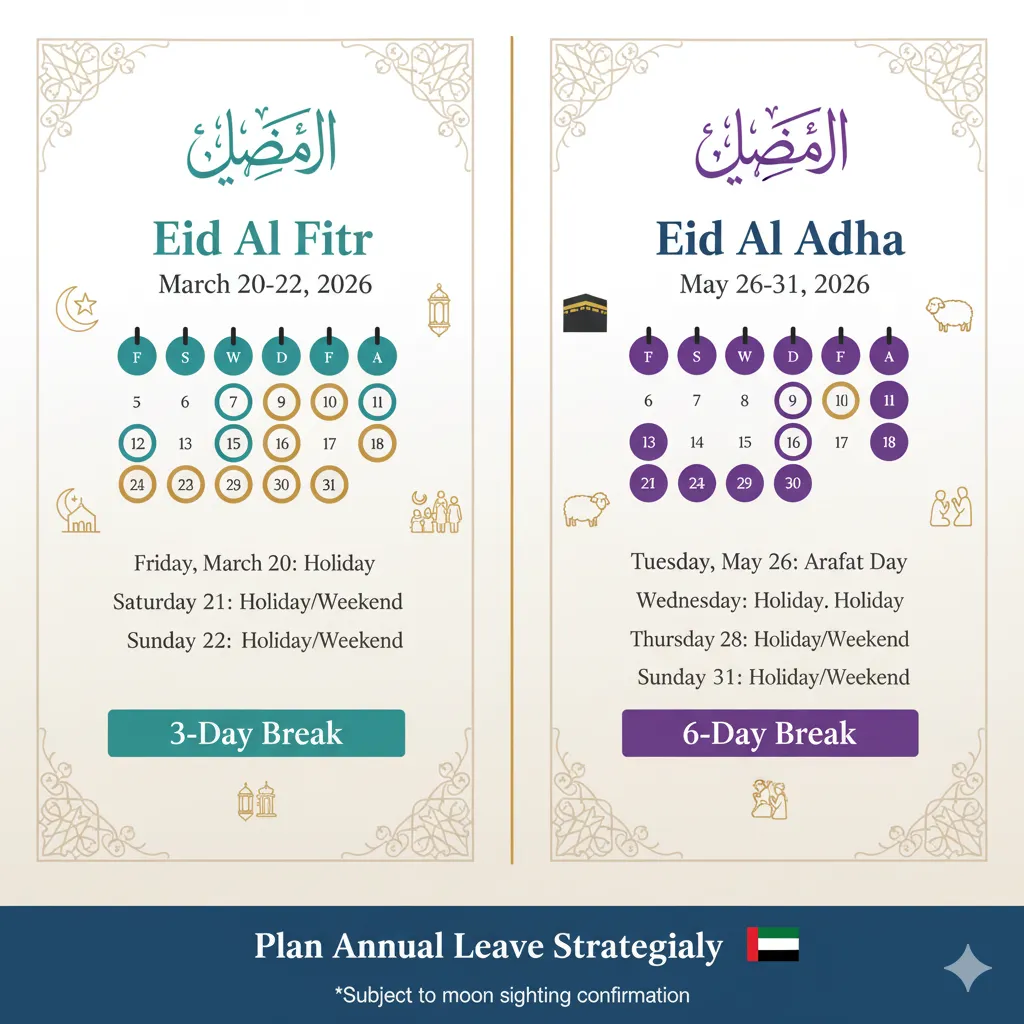
Eid Al Fitr 2026 is expected to fall from Friday, March 20 to Sunday, March 22, creating a standard three-day weekend. This marks the end of Ramadan and provides families with time for celebrations and gatherings.
Eid Al Adha 2026 presents the most significant opportunity for extended time off. Expected to begin on Tuesday, May 26 (Arafat Day) and continue through Thursday, May 29, the holiday connects with the regular weekend to create a potential six-day break from May 26-31. This extended period requires no annual leave and provides excellent opportunity for international travel or extended family visits.
Eid Al Etihad (UAE National Day) falls on Wednesday, December 2 and Thursday, December 3 in 2026. If Friday is included as part of the weekend, this creates another potential long weekend opportunity. Some organisations may offer extended breaks around National Day, though this varies by employer policy.
Maximising UAE public holidays through strategic leave planning can transform standard breaks into extended vacations. Employees who add annual leave days before or after official holidays can create week-long breaks or longer.
Important note: Islamic holidays remain subject to official moon sightings. The UAE’s Moon sighting committee observes the crescent moon to determine the start of Islamic months, with announcements typically made 24-48 hours before holidays begin. This creates uncertainty for advance planning, particularly for international travel during Eid periods.
How Are UAE Public Holidays Determined?
The UAE employs a dual calendar system for determining public holidays.
Gregorian calendar holidays maintain fixed dates every year. New Year’s Day always falls on January 1, whilst National Day is consistently celebrated on December 2-3. These dates require no confirmation and can be incorporated into long-term planning immediately.
Islamic holidays follow the Hijri lunar calendar, which contains 354-355 days compared to the Gregorian calendar’s 365-366 days. This difference causes Islamic dates to shift approximately 10-11 days earlier each Gregorian year. Eid Al Fitr, Eid Al Adha, Islamic New Year, and Prophet Muhammad’s Birthday all move through the Gregorian calendar over time.
Moon sighting methodology determines Islamic holiday timing. Traditional observation by moon sighting committees confirms when new Islamic months begin. The UAE coordinates with other GCC countries for consistency, though geographical and atmospheric factors occasionally create one-day differences between nations.
Cabinet Resolution No. 27 of 2024 provides flexibility for certain holidays. Government authorities can shift some observances to week beginnings or endings to create longer breaks, maximising opportunities for rest and tourism. However, Eid holidays maintain fixed timing based on Islamic calendar observations and cannot be moved for convenience.
If a public holiday falls on a weekend or overlaps with another holiday, it is not carried forward. This means employees do not receive compensatory days off. Local governments may declare additional holidays for special occasions beyond the federal list.
When Are the School Holidays in UAE for 2026?
School calendars follow different schedules depending on curriculum and regulatory authority.
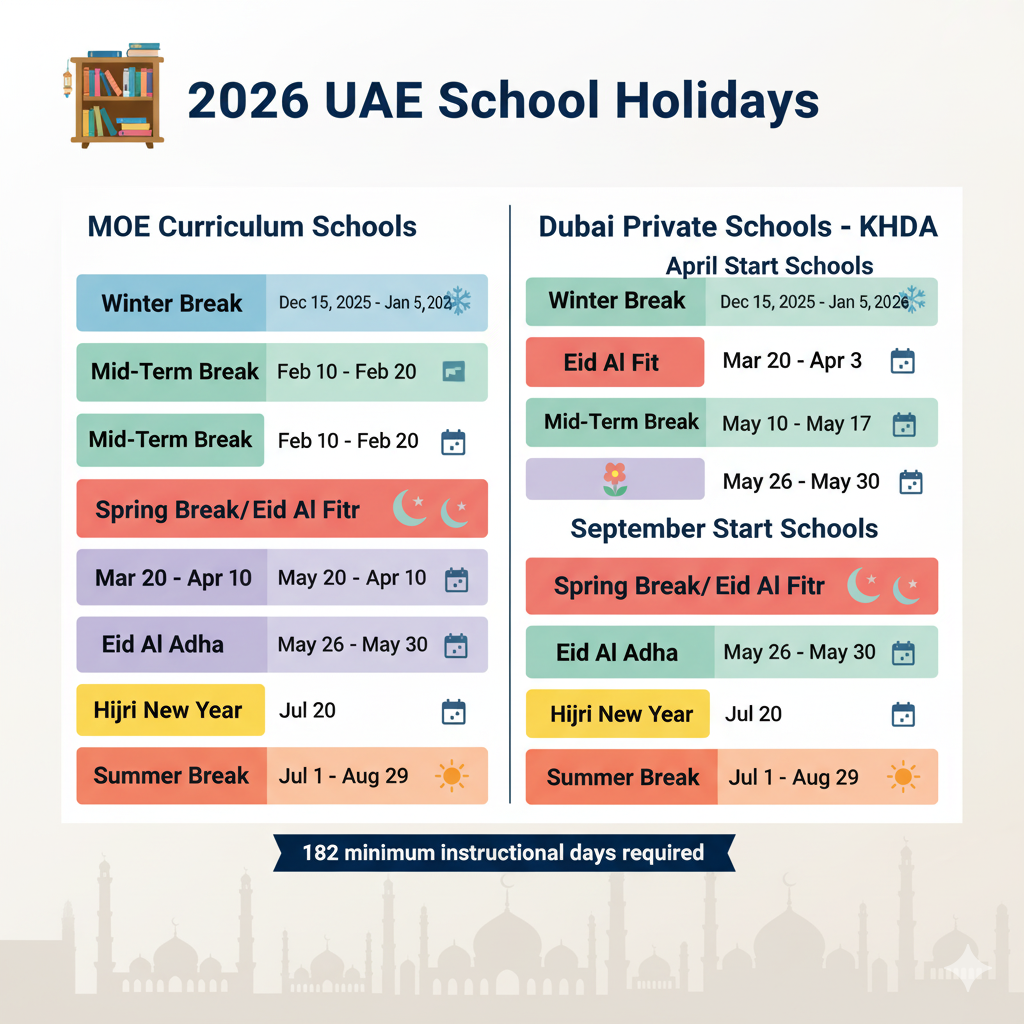
MOE (Ministry of Education) curriculum schools observe these breaks for 2026:
- Winter Break: December 15, 2025 to January 4, 2026
- Spring Break & Eid Al Fitr: March 16-29, 2026
- Mid-Term Break & Eid Al Adha: May 25-29, 2026
- Hijri New Year: June 17, 2026
- Summer Break (staff): Begins July 18, 2026
Dubai private schools regulated by KHDA follow slightly different schedules based on academic year start dates.
For schools starting in April 2025-2026:
- Winter Break: December 15 to January 5
- Spring Break: March 16-30
- End of Academic Year: March 30, 2026
For schools starting in September 2025-2026:
- Winter Break: December 15 to January 5
- Spring Break: March 16-30
- End of Academic Year: March 3, 2026
All private schools in Dubai must provide a minimum of 182 instructional days per academic year as mandated by education authorities. This requirement ensures consistent educational quality across different curricula and school types.
Parents should verify specific dates with their children’s schools, as individual institutions may have slight variations in their calendars. KHDA school regulations provide framework guidelines, but schools maintain some flexibility in scheduling.
School holiday timing often aligns with major public holidays, particularly Eid periods, allowing families to travel together without students missing instructional days.
What Are Your Rights When Working on Public Holidays?
UAE labour law provides clear protections for employees required to work during official holidays.
Federal Decree-Law No. 33 of 2021 guarantees all private sector employees specific rights regarding public holiday work. Working on UAE public holidays triggers mandatory compensation requirements that employers must observe.
If your employer requires you to work during any public holiday, you are entitled to one of two compensation methods. First option provides another day off for each holiday worked, with the replacement day granted at a mutually agreed time. Second option provides regular wages plus a minimum 50% bonus calculated on basic salary for the holiday worked.
These rights apply universally across the UAE private sector regardless of employee category, salary level, or job type. Entry-level staff receive the same protections as senior executives. Part-time workers have identical rights to full-time employees.
According to legal experts, specific conditions must be met for compensation requirements to apply. Your employer must specifically request you to work, or job requirements must necessitate your presence during the holiday. You need proper permission to work during the holiday period, and the day must be officially recognised by government as a public holiday.
Understanding how leave days interact with official holidays helps employees plan effectively. Official holidays falling within annual leave periods generally become part of your annual leave allocation unless specific circumstances apply.
If your employer fails to provide proper holiday compensation, you can contact the Ministry of Human Resources and Emiratisation (MOHRE) through multiple channels. Call the MOHRE hotline at 800 60, use the official MOHRE mobile app to file a labour complaint, or visit http://www.mohre.gov.ae and select the labour complaint option.
Essential services including healthcare, hospitality, retail, emergency services, and transportation require continuous operation during public holidays. Workers in these sectors maintain identical compensation rights but may face different scheduling arrangements due to operational requirements.
How Can You Maximise Your Time Off in 2026?
Strategic annual leave planning transforms standard holidays into extended breaks.
The May 2026 Eid Al Adha period offers the best value opportunity. With Arafat Day falling on Tuesday, May 26, followed by three Eid days and the weekend, employees automatically receive six consecutive days off without using any annual leave. This natural break provides excellent opportunity for international travel.
For New Year celebrations, adding just one or two annual leave days before or after January 1 can create a four or five-day break. This works particularly well if your employer offers flexible holiday scheduling.
National Day in early December presents another opportunity. With December 2-3 falling on Wednesday and Thursday, adding Friday as annual leave (if it’s a working day) plus the following weekend creates a five-day break.
Some employees successfully combine multiple holidays with annual leave to create extended vacations. For instance, planning annual leave around Eid Al Adha and extending into June could create a multi-week break for those with sufficient leave allowance.
Important considerations for leave planning include checking company policies regarding leave combinations. Some organisations restrict how many days you can add to public holidays. UAE employer discretion over annual leave varies by company, though employers must provide one month’s notice for scheduled leave.
Book travel early for Eid periods. Airlines and hotels typically increase prices by 15-20% during peak holiday periods. Advance booking several months ahead often secures better rates.
Remain flexible for Islamic holidays. Moon sighting creates 24-48 hour uncertainty about exact dates. Some travellers book refundable tickets or wait for official confirmations before finalising plans.
Coordinate with family members and colleagues. If everyone in your household plans leave simultaneously, you avoid conflicts. Workplace coordination prevents entire teams being absent during critical periods.
Frequently Asked Questions
Can my employer deny my leave request during Eid holidays?
Employers maintain discretion over annual leave timing based on operational requirements. However, they cannot unreasonably deny leave requests that don’t significantly impact business operations. According to Federal Decree-Law No. 33 of 2021, employers must provide one month’s notice for leave scheduling. If you want time off during Eid periods, submit requests early and discuss timing with your manager. Some industries like retail and hospitality may restrict Eid leave due to increased business activity, but this must be communicated clearly in employment policies.
What happens if a public holiday falls on my regular day off?
If a public holiday coincides with your regular day off (typically Friday or Saturday), you are not automatically entitled to additional compensation or a replacement day unless you’re specifically asked to work. The holiday is considered observed on your regular non-working day. This differs from situations where you’re required to work on a public holiday, which triggers compensation requirements under UAE labour law.
How soon are Islamic public holidays officially confirmed?
UAE authorities typically confirm Islamic public holidays 24-48 hours before they begin, following moon sighting committee observations. This short notice period creates challenges for advance planning, particularly for international travel. Astronomical predictions provide estimated dates months ahead, but official confirmation always depends on crescent moon visibility. Most organisations and schools plan provisionally based on predictions whilst remaining flexible for official announcements.
Do free zone employees receive the same public holidays?
Free zones may operate under different regulatory frameworks than mainland UAE. Whilst most free zone companies align their holiday schedules with federal public holidays, some maintain distinct policies based on their free zone authority’s regulations. Employees should verify holiday entitlements in their employment contracts and check with their specific free zone authority. DIFC, DMCC, and other major free zones typically observe UAE federal holidays but may have additional flexibility.
Can I carry forward public holidays to next year?
No, UAE public holidays cannot be carried forward to future years. If a holiday falls on a weekend or overlaps with another holiday, you don’t receive compensatory days off. This differs from annual leave, which employees can carry forward under specific conditions outlined in Federal Decree-Law No. 33 of 2021. Public holidays are use-it-or-lose-it benefits tied to specific calendar dates.
What is sandwich leave and does it apply to public holidays?
Sandwich leave refers to situations where official holidays fall within your annual leave period. According to Article 29 (7) of UAE Federal Labour Law, such holidays typically become part of your annual leave allocation unless they’re at the beginning or end of your leave period. This means if you take leave from Monday through Friday and Wednesday is a public holiday, that Wednesday still counts as annual leave. Understanding this helps calculate actual days deducted from your leave allowance.
Do private sector employees get the same holidays as public sector?
Yes, under the UAE’s unified holiday policy implemented in recent years, both public and private sector employees receive the same official holidays. The Ministry of Human Resources and Emiratisation announces private sector holidays simultaneously with public sector dates, eliminating previous discrepancies. However, individual companies may offer additional holidays beyond the federal minimum, so employment contracts should be reviewed for specific benefits.
How do school holidays align with public holidays?
School calendars strategically align major breaks with public holidays, particularly Eid periods. MOE and KHDA schedule spring breaks to coincide with Eid Al Fitr and mid-term breaks with Eid Al Adha, allowing families to travel together. Winter breaks extend over New Year’s Day. This alignment helps working parents coordinate their annual leave with children’s school schedules, though exact dates vary between MOE and KHDA-regulated institutions.
What compensation am I entitled to if I work on National Day?
If required to work on National Day (December 2-3, 2026), you’re entitled to either a replacement day off at a mutually agreed time or your regular wages plus a minimum 50% basic salary bonus for each day worked. This compensation applies universally to all private sector employees under Federal Decree-Law No. 33 of 2021. The choice between replacement day off or financial compensation typically rests with the employer, though both options must be offered.
Will UAE holidays in 2026 be shifted to create long weekends?
Under Cabinet Resolution No. 27 of 2024, certain holidays can be shifted to week beginnings or endings to create longer breaks. However, this flexibility does not apply to Eid holidays, which maintain their timing based on Islamic calendar observations. New Year’s Day and National Day could potentially be shifted if they fall mid-week, though this would be announced by authorities closer to the dates. Historical practice suggests government seeks to maximise long weekend opportunities when possible.
Further Reading
Explore these related articles for comprehensive information about UAE public holidays and employment rights:
The UAE week, every Monday
The week's stories on jobs, visas, money and daily life in one short email. Unsubscribe in one click.