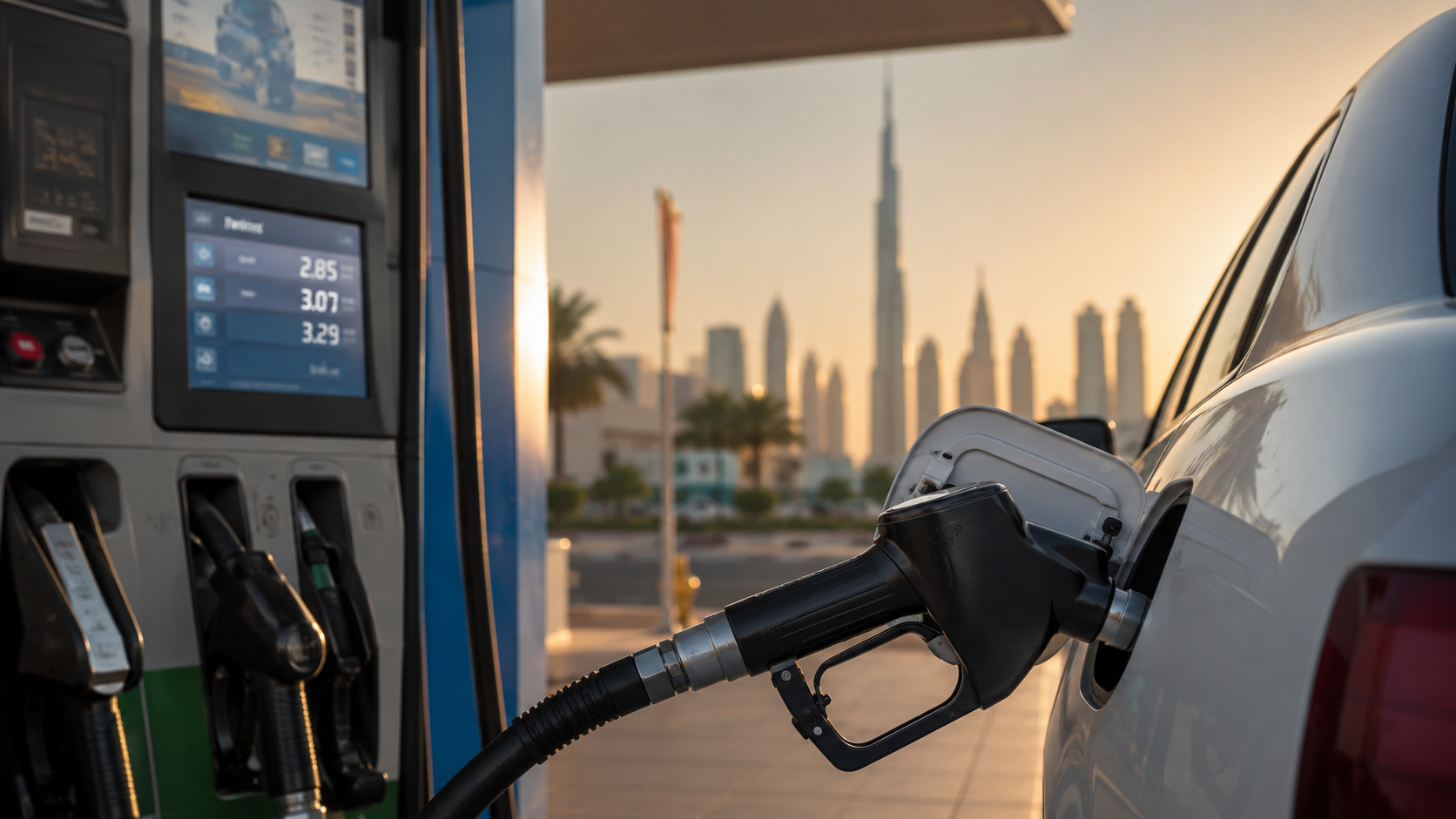
UAE Fuel Prices November 2025: Petrol and Diesel Drop Across All Grades
UAE fuel prices November 2025: Super 98 AED 2.63, Special 95 AED 2.51, E-Plus AED 2.44, Diesel AED 2.67. All grades drop 12-16 fils from October.
By Vadim Kouznetsov, published

Quick Answer: UAE fuel prices for November 2025 show decreases across all categories. Super 98 costs AED 2.63 per litre, Special 95 is AED 2.51, E-Plus 91 stands at AED 2.44, and diesel is AED 2.67. All grades dropped 12-16 fils from October’s rates.
The UAE Fuel Price Committee announced welcome price reductions for November 2025 on Friday, 31st October. Motorists across Dubai, Abu Dhabi, and the Northern Emirates will see lower costs at the pump starting 1st November.
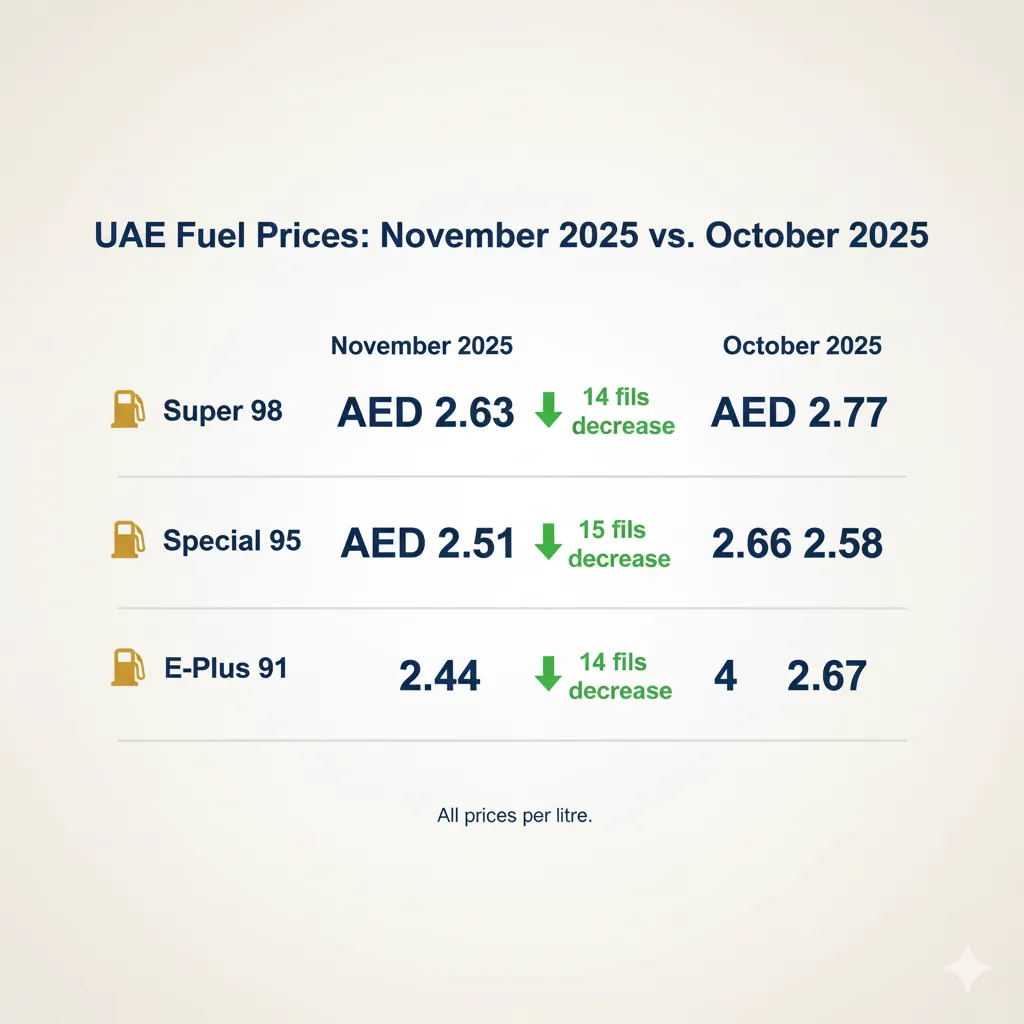
Here’s exactly what you’ll pay per litre:
Super 98 Petrol: AED 2.63
- Down 14 fils from October’s AED 2.77
Special 95 Petrol: AED 2.51
- Down 15 fils from October’s AED 2.66
E-Plus 91 Petrol: AED 2.44
- Down 14 fils from October’s AED 2.58
Diesel: AED 2.67
- Down 4 fils from October’s AED 2.71
What November’s Price Drop Means for Your Budget
A standard 50-litre tank now costs approximately AED 7 less than last month for Special 95 users. That translates to AED 84 in annual savings for drivers filling up monthly, or AED 168 for those filling fortnightly.
Families running multiple vehicles will see more substantial relief. Two cars filling 50-litre tanks twice monthly save roughly AED 28 monthly, or AED 336 annually.
Commercial operators benefit even more. Fleet managers using 1,000 litres of diesel monthly save approximately AED 40 compared to October rates. For logistics companies and transportation businesses, this reduction helps offset rising operational costs elsewhere.
Why Did Fuel Prices Drop This Month?
The UAE follows a liberalised pricing system introduced in 2015. Monthly adjustments mirror international crude oil market movements. The Fuel Price Committee reviews global benchmark prices and sets local rates accordingly.
November’s reductions reflect October’s global oil market performance. Previous predictions suggested potential decreases based on weakening crude prices, and those forecasts proved accurate.
Several factors influenced this month’s drop:
International crude oil prices softened during October. Brent crude averaged below $70 per barrel for portions of the month. Global supply levels remained adequate despite geopolitical tensions in producing regions.
Recent Fuel Price Trends
Looking at the past three months shows consistent volatility:
September 2025 brought relative stability with Super 98 at AED 2.70 and Special 95 at AED 2.58. October saw prices climb by 7-8 fils across all grades. November reverses that trend with broader decreases.
For comparison, August 2025 showed mixed changes with petrol dropping slightly whilst diesel jumped 15 fils. November’s uniform decreases provide consistent relief across all fuel types.
How UAE Fuel Pricing Works
The monthly review system balances fair consumer prices with market realities. Prices are announced on the last day of each month and take effect from the first day of the following month.
All Emirates follow identical pricing. Whether you fill up in Dubai, Abu Dhabi, Sharjah, or Fujairah, the rates remain uniform. No station can charge more or less than the committee’s announced prices.
This standardised approach prevents price wars and guarantees transparency. Motorists know exactly what they’ll pay regardless of location or petrol station brand.
Impact on Transportation Costs
Fuel prices directly affect overall living expenses in the UAE. November’s reductions provide modest relief for household budgets already managing multiple cost increases implemented in 2025.
For expatriates evaluating job offers and relocation packages, fuel costs represent a consistent monthly expense. Current rates sit below 2024’s peak but above the lowest points seen in late 2024.
Ride-hailing services and taxis may adjust their rates based on fuel price movements, though formal tariff changes typically lag behind monthly price announcements.
Tips to Maximise Fuel Efficiency
Regular vehicle maintenance improves consumption efficiency. Properly inflated tyres reduce rolling resistance and improve mileage by up to 3%.
Combining trips reduces total kilometres travelled. Planning errands in clusters saves both fuel and time.
Smooth acceleration and braking patterns improve efficiency. Aggressive driving can reduce fuel economy by 15-30% on motorways and 10-40% in stop-and-go traffic.
Air conditioning significantly impacts fuel consumption, particularly in UAE’s climate. Using it judiciously when temperatures permit helps reduce overall fuel costs.
Frequently Asked Questions
When do November fuel prices take effect?
The new rates apply from 1st November 2025 at all UAE petrol stations. The committee announced them on 31st October 2025.
Are fuel prices the same across all seven Emirates?
Yes. The UAE Fuel Price Committee sets uniform prices for Dubai, Abu Dhabi, Sharjah, Ajman, Umm Al Quwain, Ras Al Khaimah, and Fujairah.
Can petrol stations charge different prices?
No. All licensed fuel retailers must charge the government-regulated prices. Price variations between stations are not permitted.
Which fuel grade should I use for my vehicle?
Check your vehicle’s manual for manufacturer recommendations. Most family cars operate efficiently on Special 95. High-performance or luxury vehicles may require Super 98.
How often do UAE fuel prices change?
The Fuel Price Committee reviews and announces prices monthly, typically on the last day of each month for implementation from the first day of the following month.
Why don’t UAE fuel prices stay constant?
The UAE aligns local prices with international crude oil markets. This system reflects global supply and demand whilst maintaining price stability through regular monthly adjustments rather than sudden fluctuations.
Do fuel prices affect other living costs in UAE?
Yes. Transportation costs influence goods pricing, delivery services, and overall inflation rates. Lower fuel prices can help moderate increases in other sectors.
What payment methods work at UAE petrol stations?
All stations accept cash, credit cards, and debit cards. Many also support digital payment platforms and contactless transactions.
Looking Ahead: December Price Outlook
December rates will reflect November’s global oil market performance. Current indicators suggest continued moderate pricing, though unexpected geopolitical developments could shift trajectories quickly.
Oil markets remain sensitive to OPEC+ production decisions, demand projections from major consumers like China and India, and supply disruptions in producing regions.
Motorists should monitor late November announcements for December pricing guidance. The committee typically releases information around 30th November.
Further Reading
The UAE week, every Monday
The week's stories on jobs, visas, money and daily life in one short email. Unsubscribe in one click.