Dubai NRI Wills: How to Draft for Property in India 2025
Complete guide for NRIs in Dubai to draft wills for Indian property. Learn registration requirements at DIFC, Dubai Courts, or Indian Consulate with document checklist.
By Vadim Kouznetsov, published

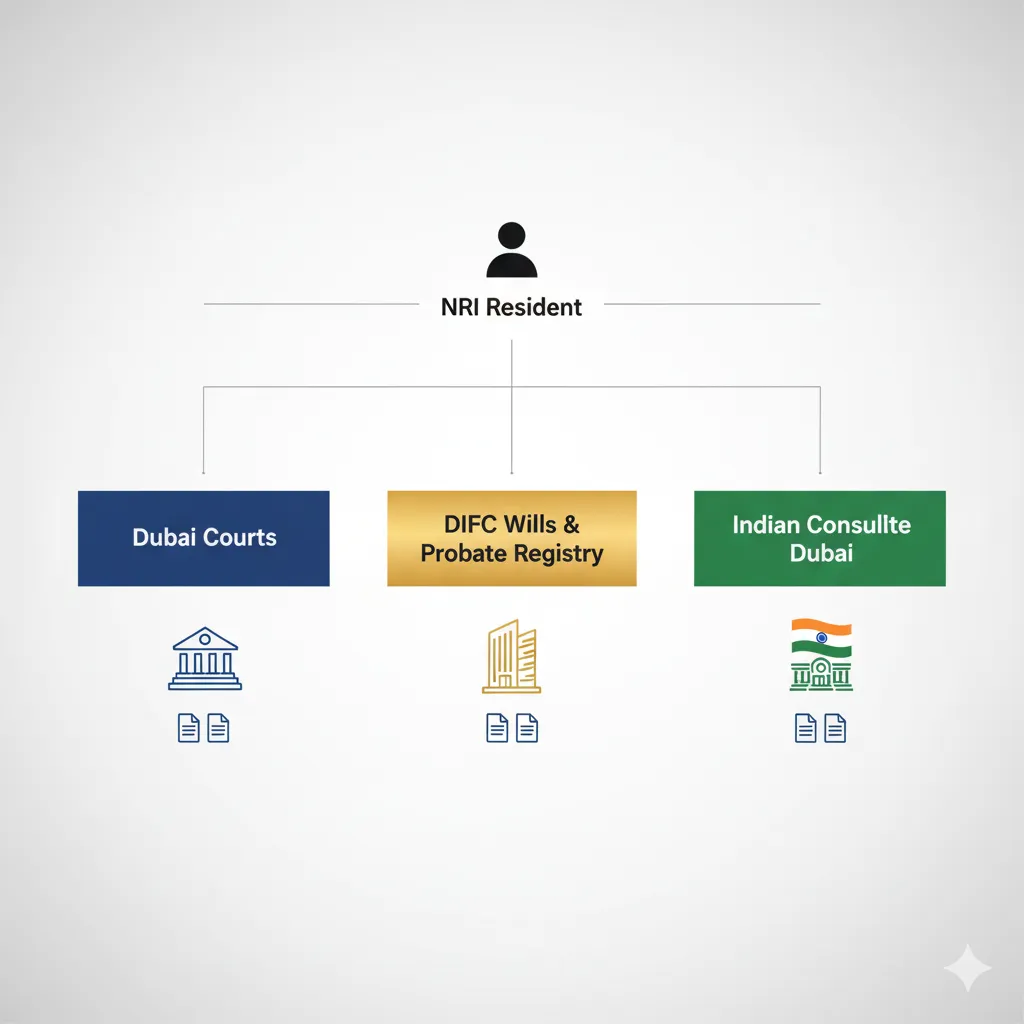
Can you register a will in Dubai for property you own in India? Yes. Non-resident Indians living in the UAE have three legal pathways to register wills covering their Indian assets: the Indian Consulate in Dubai, the DIFC Wills and Probate Registry, or Dubai Courts.
Under Federal Decree Law No. 41 of 2022, non-Muslim residents can apply their home country’s inheritance laws for wills, marriage, divorce, and proof of parentage. This legislation creates clear protections for expatriates who want their assets distributed according to the legal systems they know best.
For Indian expats building careers in the UAE, proper estate planning becomes crucial. Many work in Dubai’s thriving sectors whilst maintaining property, investments, and family connections in India. Without a registered will, your assets may be distributed under UAE Sharia law rather than Indian succession law.
Understanding UAE Personal Status Law for Non-Muslims
The Personal Status Law for Non-Muslims changed the legal landscape for expatriates. Article 1(1) of Federal Decree Law No. 41 of 2022 states clearly: provisions apply to non-Muslim citizens and foreign residents “unless any of them adheres to the application of the law of their home country.”
This gives you choice. You can select UAE law or Indian law for inheritance matters.
Article 11(1) further specifies that “a legator may leave a Will with all his or her assets in the State to anyone of his/her choice according to the controls set out by the Implementing Regulations.” The freedom to distribute your estate as you see fit represents significant flexibility for estate planning.
For legal professionals in Dubai, understanding these regulations has become increasingly important as more expatriates seek proper will registration services.
Three Registration Options in Dubai
Indian Consulate General in Dubai
The Consulate General of India in Dubai provides will registration services for Indian nationals with valid UAE residence visas. This option works best when your assets are primarily located in India.
The consulate keeps one original will in their records whilst returning the second original to you after attestation. This dual-copy system provides security and accessibility.
DIFC Wills and Probate Registry
Law No. 15 of 2017 established the administration of estates and implementation of wills for non-Muslims in Dubai. Article 6(a) specifically created “a register known as the ‘Register of Wills of non-Muslims'” at Dubai Courts and DIFC Courts.
Article 11 of the DIFC WPR Rules states wills “may give or dispose of Immovable and Movable Property, located in any part of the world, to which the Testator is entitled at the time of his death.”
This global coverage makes DIFC registration attractive for Indians with assets spread across multiple countries. The will remains valid whether you acquired the property before or after registration.
Dubai Courts
Dubai Courts maintain their own Register of Wills for non-Muslims under Article 3 of the Dubai Wills Law. The registration applies to “all Wills and Estates of non-Muslims in the Emirate, including in the Dubai International Financial Centre.”
This creates overlap between Dubai Courts and DIFC jurisdiction, giving you flexibility in choosing your preferred registration venue.
Documents Required for Indian Consulate Registration
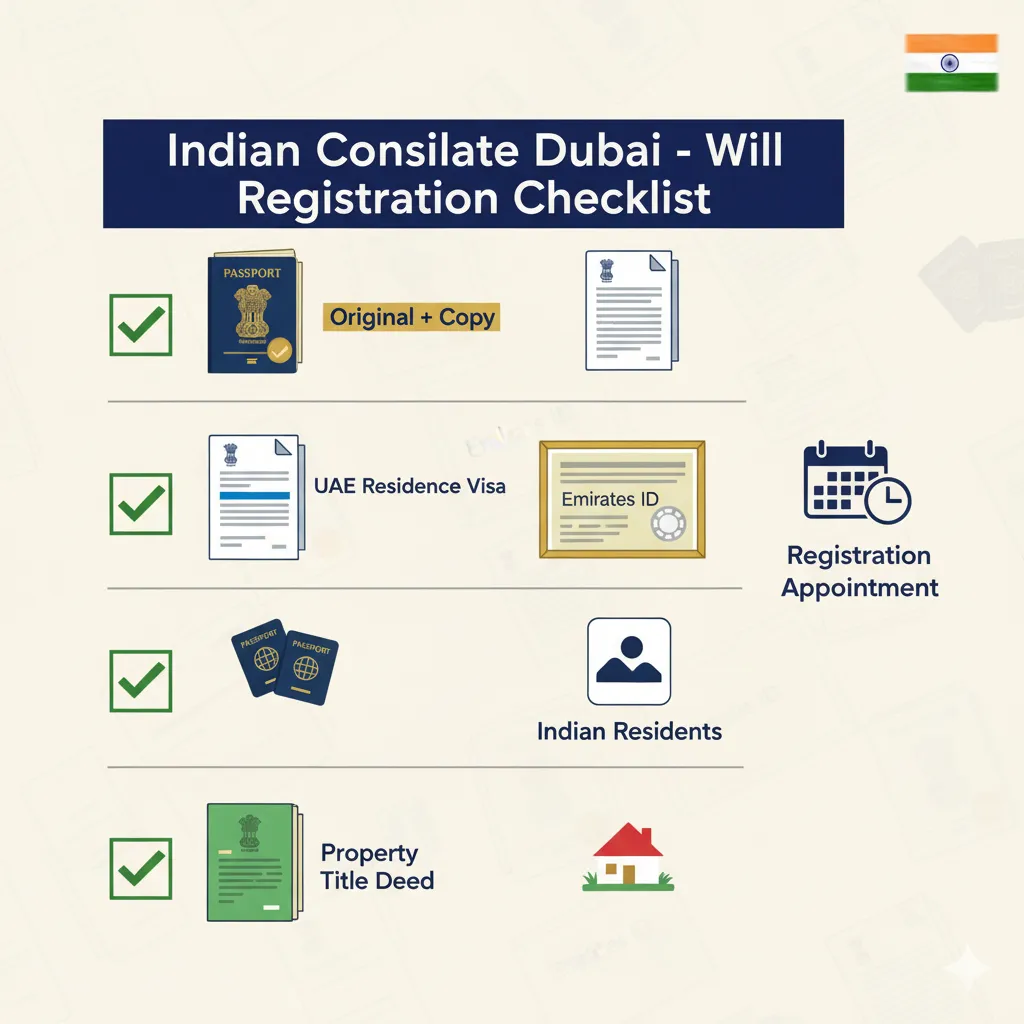
Before visiting the Indian Consulate, gather these materials:
Your Documents:
- Two original final drafts of your will
- Original passport
- Copy of passport including photo page and UAE visa page
- Recent photograph with white background (no glasses)
- Copy of Emirates ID card
- Copy of property title deeds for Indian properties (optional but recommended)
Witness Requirements:
- Two individual witnesses who are Indian nationals
- Witnesses must hold valid UAE residence visas
- Witness passports plus copies of photo pages and visa pages
- Copies of witness Emirates ID cards
The physical presence requirement cannot be waived. You and both witnesses must appear before the consulate officer to sign the will simultaneously. Witnesses observe your signature before adding their own signatures in the officer’s presence.
Step-by-Step Registration Process
1. Engage Legal Counsel
Consult a lawyer familiar with Indian inheritance laws. India’s succession laws vary significantly based on religion, state of residence, and property type. Hindu Succession Act, Indian Succession Act, and various state-specific laws create a complex framework.
Professional legal guidance protects your interests and prevents future disputes among beneficiaries.
2. Draft Your Will
Your legal counsel prepares a will document following Indian legal requirements. The draft should clearly identify:
- All properties and assets in India (immovable and movable)
- Named beneficiaries with complete identification details
- Executor appointment for estate administration
- Specific bequests or distribution percentages
- Residuary clause for any remaining assets
3. Prepare Two Original Copies
Print two original final drafts on proper legal paper. Both copies require your signature and witness signatures. The consulate retains one copy whilst you keep the second for your records.
4. Schedule Consulate Appointment
Contact the Indian Consulate in Dubai to book a will registration appointment. Bring all required documents, both witnesses, and applicable fees.
5. Sign Before Consulate Officer
At your appointment, you sign the will in the presence of the consulate officer. Your two witnesses then sign whilst observing your signature. The officer attests both copies, stamps them with the consulate seal, and returns one copy to you.
DIFC vs Dubai Courts: Key Differences
Both venues provide legal will registration, but several factors may influence your choice:
Asset Location: DIFC explicitly covers global assets. Dubai Courts focus primarily on UAE-based estates.
Registration Fees: DIFC charges structured fees based on estate value. Dubai Courts maintain different fee schedules.
Processing Time: DIFC offers streamlined digital services. Dubai Courts follow traditional government department procedures.
Amendment Process: DIFC provides clear protocols for will amendments and updates. Dubai Courts require complete re-registration for changes.
For professionals earning competitive salaries and building substantial assets, the registration venue becomes an important consideration in comprehensive financial planning.
Why Legal Counsel is Essential
Indian inheritance law contains numerous complications. Muslim personal law, Hindu succession rules, Christian and Parsi succession acts, and secular Indian Succession Act create different frameworks depending on your religious community.
Additional considerations include:
- Agricultural land restrictions in certain states
- Joint family property rights under Hindu law
- Coparcenary rights that may supersede will provisions
- Stamp duty and registration requirements in different Indian states
- Tax implications under Indian Income Tax Act
A lawyer experienced in cross-border estate planning navigates these complexities. The upfront investment in professional legal services prevents expensive litigation and family disputes after your death.
Dubai’s growing expatriate community increasingly recognizes the importance of proper estate planning as they accumulate assets both in the UAE and their home countries.
Common Mistakes to Avoid
Using Unqualified Witnesses
Both witnesses must be Indian nationals holding valid UAE residence visas. Using non-Indian witnesses or tourists invalidates the registration.
Incomplete Property Details
Vague property descriptions create execution problems. Include complete addresses, survey numbers, and title deed references for all Indian properties.
Ignoring Indian Legal Requirements
A will valid under UAE law may not satisfy Indian legal requirements. Work with counsel who understands both jurisdictions.
Forgetting Digital Assets
Modern estates include bank accounts, investment portfolios, cryptocurrency holdings, and digital property. Specifically address these assets in your will.
Not Updating After Major Life Changes
Marriage, divorce, births, deaths, property acquisitions, and business ownership changes all require will updates. Review your will every two to three years.
Costs and Timeline
Indian Consulate: Consulate fees for will attestation typically range from AED 50 to AED 200. Legal counsel fees vary based on estate complexity, generally starting from AED 2,000 to AED 5,000 for straightforward wills.
Total timeline: Two to four weeks from initial consultation to completed registration.
DIFC: DIFC registration fees start at approximately AED 10,000 depending on estate value. Legal fees add AED 5,000 to AED 15,000.
Total timeline: Four to six weeks for complete registration.
Dubai Courts: Dubai Courts charge government fees plus legal representation costs. Total expenses generally fall between AED 3,000 to AED 8,000.
Total timeline: Three to five weeks.
For residents managing living costs alongside savings and investments, these fees represent a modest investment in family security.
Property Market Implications
Dubai’s booming property market attracts significant Indian investment. Many NRIs own property in both countries, creating cross-border estate planning requirements.
With Dubai property prices continuing to rise, proper will registration becomes increasingly important for protecting substantial asset values.
When to Review and Update Your Will
Life changes require will updates:
- Marriage or remarriage
- Birth or adoption of children
- Divorce or legal separation
- Death of named beneficiaries or executors
- Acquisition or sale of significant property
- Business ownership changes
- Immigration status changes
- Changes in Indian or UAE inheritance laws
Schedule regular reviews with your legal counsel every two to three years even without major life changes.
FAQ: NRI Wills in Dubai
Can I register a will in Dubai for property located entirely in India?
Yes. Federal Decree Law No. 41 of 2022 allows non-Muslims to register wills under their home country’s laws. Both DIFC and the Indian Consulate accept wills covering property in India.
Do I need separate wills for UAE assets and Indian assets?
Not necessarily. DIFC wills can cover global assets including both UAE and Indian property. However, some legal experts recommend separate wills for different jurisdictions to simplify probate processes. Consult your legal counsel for personalized advice based on your specific asset portfolio.
What happens if I don’t register a will in Dubai?
Without a registered will, UAE Sharia inheritance law applies to your assets by default. This may not align with your wishes or your family’s expectations under Indian law. Your assets could be distributed differently than you intended.
Can I change my will after registration?
Yes. DIFC allows amendments through codicils or complete rewrites. The Indian Consulate requires registration of a completely new will that supersedes the previous version. Dubai Courts typically require re-registration for substantial changes.
Are Indian Consulate wills recognized in India?
Yes. Consulate-attested wills receive recognition in Indian courts. The attestation by an Indian government official adds legal weight to the document’s validity.
How much does will registration cost in Dubai?
Costs vary by registration venue. Indian Consulate attestation costs AED 50-200 plus legal fees of AED 2,000-5,000. DIFC registration starts at AED 10,000 plus legal fees of AED 5,000-15,000. Dubai Courts generally cost AED 3,000-8,000 total.
Can witnesses be my family members?
Legally yes, but practically no. Using independent witnesses avoids future conflicts of interest. Beneficiaries should never serve as witnesses to maintain document integrity.
What identification do I need for registration?
You need your original passport, UAE residence visa, Emirates ID, and recent photographs. Witnesses require the same documents. All parties must present original documents at the registration appointment.
Does my will cover bank accounts and investments in India?
Yes, if specifically included in your will. List all financial assets including bank accounts, investment portfolios, mutual funds, stocks, bonds, and insurance policies. Provide complete account details and beneficiary designations.
How long does the registration process take?
Indian Consulate registration typically takes two to four weeks from initial consultation to completed attestation. DIFC registration requires four to six weeks. Dubai Courts process wills in three to five weeks. Timeline varies based on document preparation, appointment availability, and legal review requirements.
Key Takeaway
Non-resident Indians in Dubai can register wills for their property in India through three main channels: Dubai Courts, DIFC Wills and Probate Registry, or the Indian Consulate in Dubai. Under Federal Decree Law No. 41 of 2022, non-Muslim residents can choose to apply their home country’s laws for inheritance matters.
The Indian Consulate requires two original will drafts, passport copies, UAE visa pages, Emirates ID, two Indian witnesses, and property title deeds (optional) for registration. Professional legal counsel familiar with Indian inheritance laws is essential for proper will drafting and protecting your family’s interests.
Further Reading
Interested in learning more about living and working in Dubai as an expat? Check out these related articles:
- Jobs in Dubai for Foreigners: Your 2025 Guide to UAE Career Success
- Work in the United Arab Emirates (UAE): Complete Guide to Finding Jobs in 2025
- Legal Salaries in Dubai/UAE for 2024
- Dubai Salary Guide: Average Earnings & Living Costs in 2025
- Dubai Indian Passport Photo Rules 2025: New ICAO Requirements Start Sept 1
- Dubai Property Prices Surge 20%: 2025 Real Estate Market Analysis
- The Complete Cost to Live in Dubai as an Expat in 2025
Disclaimer: This article provides general information about will registration for non-resident Indians in Dubai. Laws and procedures may change. Consult qualified legal professionals for advice specific to your situation before making any legal decisions regarding your estate planning.
The UAE week, every Monday
The week's stories on jobs, visas, money and daily life in one short email. Unsubscribe in one click.