UAE Probation Termination: Your Rights and 14-Day Notice Explained
Terminated during probation in UAE? Learn your legal rights, 14-day notice requirements, final settlement, repatriation costs, and when arbitrary dismissal claims apply.
By Vadim Kouznetsov, published

Facing potential termination during your probation period raises urgent questions about your rights and what happens next. Understanding UAE employment law provides clarity during this uncertain time.
The UAE maintains specific regulations governing probation termination that differ significantly from standard employment termination rules. Knowing these distinctions helps you navigate the process and understand your entitlements.
Understanding Probation Termination Rules
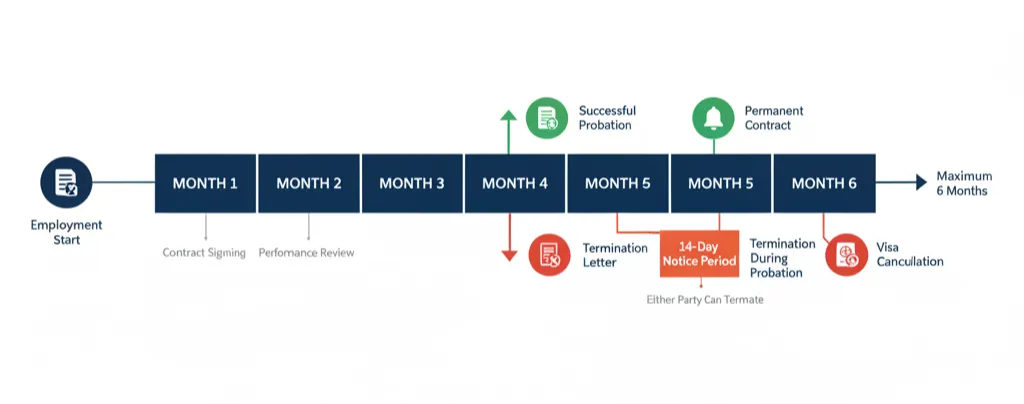
UAE employers can terminate employment during the probation period by providing 14 days’ written notice to the employee. This right stems from Article 9(1) of Federal Decree Law No. 33 of 2021 on the Regulations of Employment Relations.
The law states: “The employer may employ an employee on probation for a period not exceeding (6) six months from the service commencement date. The employer may terminate the employee during such period by giving the employee (14) fourteen days’ prior written notice.”
This six-month maximum probation period applies to mainland companies and most free zones across the UAE. Your probation cannot exceed this duration, though employers may set shorter probation periods in employment contracts.
The critical aspect? Employers don’t need to specify reasons for termination during probation. The Employment Law remains silent on whether employers must provide justification for probation dismissals.
This flexibility allows employers to assess employee suitability without lengthy documentation requirements. However, it also means employees have limited recourse to challenge probation terminations. UAE’s probation period regulations establish this framework clearly.
What You’re Entitled to Upon Termination
Despite the employer’s flexibility during probation, terminated employees retain specific entitlements protected by UAE labour law.
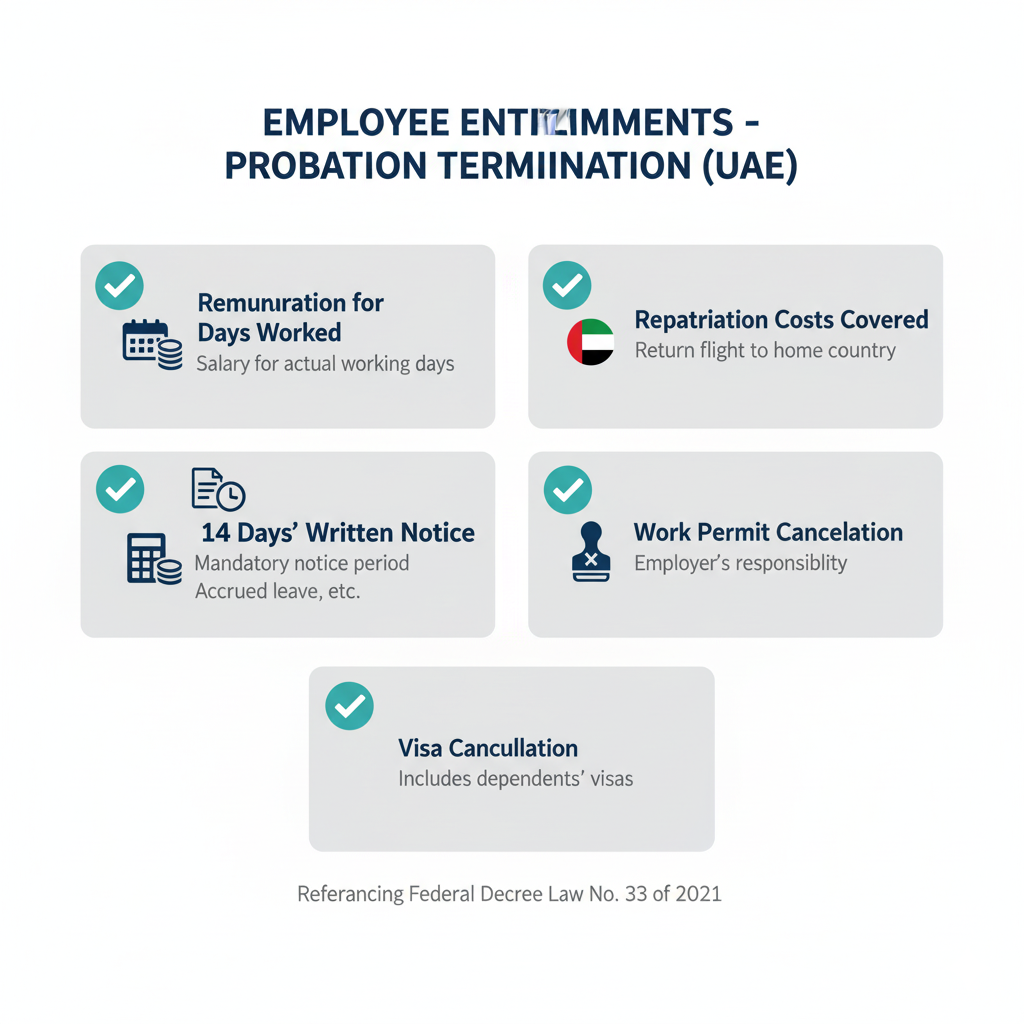
Payment for Days Worked: You receive full remuneration for all days you actually worked, calculated on a prorated basis. If terminated mid-month, your salary reflects the actual working days completed.
14 Days’ Written Notice: Employers must provide written notice 14 days before your termination takes effect. This notice period gives you time to prepare for the transition and begin seeking new employment.
During this 14-day notice period, you remain employed and should continue fulfilling your job responsibilities. Some employers may offer payment in lieu of notice, allowing immediate separation instead of working the full notice period.
Final Settlement: Before cancelling your work permit and residency visa, employers must settle your final account. This settlement includes:
- Salary for days worked
- Any accrued but unused annual leave (though probation period leave policies vary)
- Outstanding allowances or reimbursements
- Payment for the notice period (whether worked or paid in lieu)
Repatriation Costs: If you’re leaving the UAE after termination, your employer bears repatriation costs. Article 13(12) of the Employment Law addresses this obligation.
The law states: “The Employer shall bear the cost of employee’s repatriation to his point of hire or to any other point that was mutually agreed upon, unless the employee joins another employer, or the employment contract is terminated for reasons due to the employee, in which case, the costs shall be borne by the latter.”
This means if you’re departing the UAE after probation termination (not joining another UAE employer), your employer covers airfare to your recruitment location or other mutually agreed destination.
However, if you’re immediately joining another UAE employer, repatriation costs don’t apply since you’re remaining in the country. Understanding notice period rules helps clarify these transitions.
Proper Termination Procedure Explained
Employers should follow specific steps when terminating employment during probation:
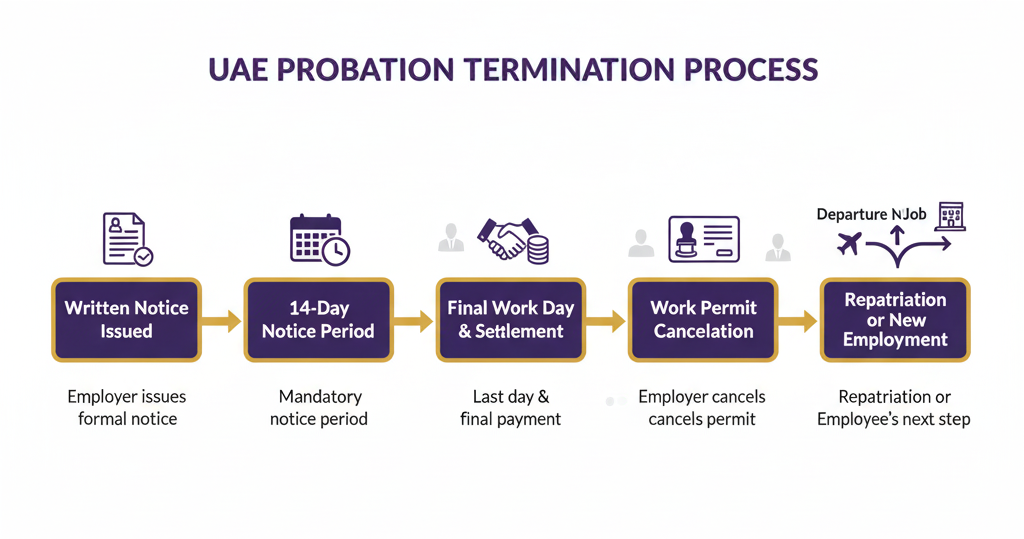
Step 1: Written Notice Delivery: The employer provides written termination notice stating your employment will end in 14 days. This notice should be formal and documented.
Step 2: Notice Period: You continue working during the 14-day notice period unless the employer offers payment in lieu of notice. Your employment contract and company policies determine available options.
Step 3: Final Settlement: Before your last day, the employer calculates and processes your final settlement covering all outstanding payments.
Step 4: Work Permit and Visa Cancellation: After settling your final account, the employer initiates work permit cancellation through the Ministry of Human Resources and Emiratisation (MoHRE). The immigration authorities then cancel your residency visa.
This cancellation process typically takes several days to complete. You’ll receive official notification of the cancellation and should verify completion through official channels.
Step 5: Departure or Transfer: If leaving the UAE, your employer arranges and covers repatriation. If joining another UAE employer, you coordinate visa transfer with your new employer.
The visa cancellation creates a 60-day grace period allowing you to remain in the UAE to seek new employment, arrange departure, or transfer to a new sponsor. However, resigning during probation involves different procedures if you initiate the separation.
Can You Claim Arbitrary Dismissal?
This question arises frequently, but the answer is straightforward: no, you cannot claim arbitrary dismissal during probation.
UAE employment law provides extensive protections against arbitrary dismissal for employees who complete probation. Article 42 and related provisions protect permanent employees from termination without valid reasons.
However, these protections don’t extend to probation periods. The law intentionally grants employers flexibility during probation to assess employee suitability without justification requirements.
This doesn’t mean employers can act discriminatorily or violate other employment rights. Termination based on protected characteristics (nationality, gender, religion) remains prohibited even during probation. Terminating an employee for filing legitimate complaints also violates labour law regardless of probation status.
But absent such violations, employers can terminate probation employment without specifying performance concerns, cultural fit issues, or business reasons.
The rationale behind this policy balances employer and employee interests. Probation serves as a mutual evaluation period where both parties assess fit before committing to longer-term employment.
Employees also enjoy reciprocal flexibility. You can resign during probation with shorter notice periods than permanent employees face.
Understanding Your Limited Recourse Options
Whilst you cannot challenge probation termination on arbitrary dismissal grounds, you can take action if employers violate specific legal obligations:
Non-payment of Final Settlement: If your employer fails to pay outstanding wages or final settlement, you can file complaints with MoHRE. The ministry investigates non-payment complaints and can compel settlement.
Failure to Provide Written Notice: Termination without proper 14-day written notice violates Article 9(1). Document the termination timeline and circumstances if notice wasn’t provided.
Discrimination or Retaliation: Termination based on protected characteristics or retaliation for legitimate complaints violates UAE law. These violations warrant MoHRE complaints regardless of probation status.
Refusal to Cancel Visa: Employers must cancel work permits and residency visas after termination. Failing to do so creates legal complications for both parties. MoHRE can intervene if employers refuse proper visa cancellation.
Non-payment of Repatriation Costs: If you’re leaving the UAE and your employer refuses to cover repatriation costs, this violates Article 13(12). Document the refusal and seek MoHRE assistance.
For issues beyond probation termination, understanding broader employment termination rights provides valuable context.
Practical Steps When Facing Probation Termination
If you suspect or receive probation termination notice, take these practical steps:
Document Everything: Keep copies of your employment contract, termination notice, salary slips, and all written communications with your employer. This documentation proves crucial if disputes arise.
Review Your Contract: Examine your employment contract for any specific probation terms, notice period details, or settlement provisions that might differ from standard legal requirements.
Calculate Expected Payments: Determine what you should receive in final settlement based on days worked, notice period, and any contractual allowances. Having clear expectations helps identify payment shortfalls.
Confirm Repatriation Arrangements: If leaving the UAE, discuss repatriation details with your employer early. Confirm destination, booking arrangements, and payment method to avoid last-minute complications.
Understand Visa Timing: Know that your residency visa will be cancelled after final settlement. The 60-day grace period begins from cancellation date, not your last working day.
Seek New Employment Quickly: Begin job searching immediately upon receiving termination notice. The 14-day notice period provides time to apply for positions and potentially secure new employment before your visa cancellation.
Check Final Payments: Verify that final settlement matches your calculations. Address discrepancies with HR immediately rather than after departure.
Obtain Experience Certificate: Request a job experience certificate or employment reference letter before departure. These documents prove valuable for future UAE employment applications.
Understanding employee dismissal rights more broadly helps contextualize probation-specific procedures.
Moving Forward After Probation Termination
Probation termination doesn’t reflect permanently on your UAE employment record. Many professionals experience probation separations as employers and employees discover mismatches in expectations, culture, or role requirements.
Focus on these constructive actions:
Learn from the Experience: Reflect on what didn’t work. Was it job responsibilities, company culture, management style, or performance expectations? Understanding the mismatch helps you make better choices next time.
Maintain Professionalism: Complete your 14-day notice period professionally. How you exit affects references and your professional reputation within Dubai’s interconnected business community.
Network Actively: Leverage professional networks to identify new opportunities. Dubai’s job market moves quickly, and many positions fill through referrals before public advertising.
Consider Contract Reviews: For future roles, review employment contracts more carefully before accepting. Understanding probation terms, job expectations, and company culture reduces mismatch risk.
Know Your Rights: Familiarise yourself with UAE employment law for future situations. Knowing your rights creates confidence during employment negotiations and transitions.
The UAE’s labour market offers abundant opportunities across industries. Probation terminations, whilst stressful, represent temporary setbacks rather than career obstacles in a dynamic market like Dubai.
Frequently Asked Questions
Can my employer terminate me during probation without any warning?
Yes. Employers can terminate during probation without prior warnings or performance improvement plans. The 14-day written notice is the only required warning. However, many professional employers provide informal feedback before formal termination.
Do I receive gratuity or end-of-service benefits if terminated during probation?
No. Gratuity (end-of-service benefits) only applies to employees who complete at least one full year of continuous service. Probation periods don’t qualify for gratuity calculations.
What if I find another job during my 14-day notice period?
You can join a new employer after serving your notice period. Coordinate with both employers regarding visa transfer timing. Your new employer typically handles visa transfer procedures after your current visa cancellation.
Can I refuse to work during the 14-day notice period?
No. You remain legally employed during the notice period and must fulfil your job responsibilities unless your employer agrees to payment in lieu of notice, allowing immediate separation.
What happens if my employer doesn’t pay my final settlement?
File a complaint with MoHRE immediately. The ministry investigates wage complaints and can compel payment. Don’t leave the UAE without resolving payment issues, as pursuing claims from abroad proves much more difficult.
Does probation termination affect future UAE employment?
No. Probation terminations don’t create employment bans or appear on official employment records. Future employers won’t automatically know about probation terminations unless you disclose them or they contact your previous employer for references.
Can I negotiate a longer notice period during probation?
Employment contracts can specify longer notice periods than the legal minimum 14 days. However, if your contract states 14 days, you cannot unilaterally demand more time. Negotiation depends on employer willingness and relationship.
Further Reading
- UAE Probation Period Guide: 7 Essential Rights and Rules for 2025
- Resigning During Probation in Dubai: Do Employees Pay Visa and Hiring Costs?
- UAE Labour Law: Complete Guide to Employment Contract Termination 2024
- UAE Notice Period Rules 2024: Essential Guide for Employers & Employees
- UAE Labour Law: Employee Dismissal Rights and Compensation Guide 2025
The UAE week, every Monday
The week's stories on jobs, visas, money and daily life in one short email. Unsubscribe in one click.