Abu Dhabi Court: Dh20,000 for Social Media Privacy Violation 2025
Abu Dhabi court orders Dh20,000 compensation for sharing photos/videos without consent. Learn about UAE privacy laws and social media consequences
By Vadim Kouznetsov, published

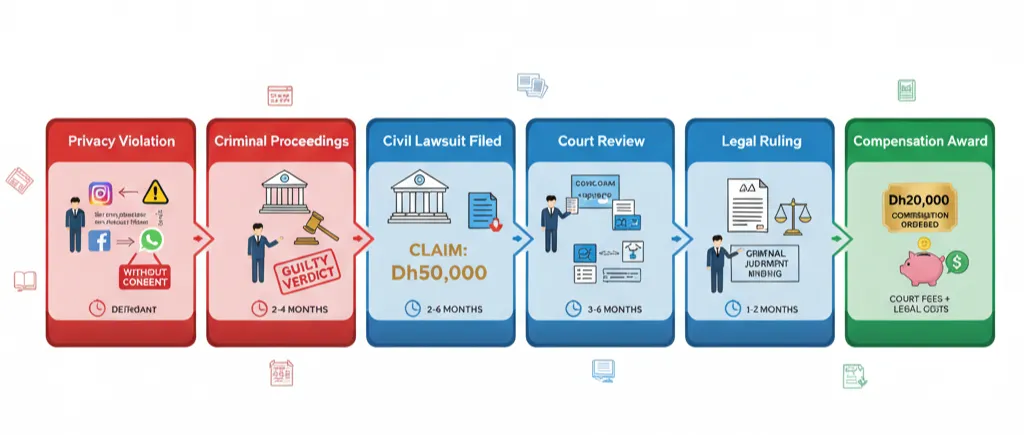
The Abu Dhabi Family, Civil and Administrative Cases Court has issued a significant ruling on social media privacy, ordering a young man to pay Dh20,000 in compensation after he violated a woman’s privacy by sharing her photos and videos on social media platforms without consent.
This case, reported by Emarat Al Youm, highlights the serious legal consequences of sharing another person’s personal images online without permission—particularly when the violator has already been criminally convicted for the same offence.
The Case Details
According to court records, the woman filed a civil lawsuit seeking Dh50,000 in damages for the emotional and reputational harm she experienced. Her legal argument centred on the defendant’s unauthorised publication of her personal images and video clips on social media.
The defendant had already faced criminal proceedings for this violation and received a criminal conviction before the civil case proceeded. This prior criminal judgment proved crucial to the civil court’s decision-making process.
The woman’s claim documented both emotional distress and mental anguish resulting from having her private photos and videos shared publicly without her consent. These personal images, once shared on social media, can spread rapidly and remain accessible even after removal attempts, compounding the violation’s impact.
Court Ruling and Legal Precedent
The Abu Dhabi court’s ruling establishes important legal principles regarding the relationship between criminal and civil proceedings for the same act.
Binding Authority of Criminal Judgments
The court emphasised that criminal judgments carry binding authority in civil cases when they conclusively establish the facts forming the basis of both proceedings. This legal principle means that once a criminal court has determined certain facts—in this case, that the defendant violated the plaintiff’s privacy—those facts are accepted as proven in subsequent civil litigation.
This binding authority prevents defendants from re-litigating established facts and streamlines civil proceedings following criminal convictions. The plaintiff doesn’t need to prove the violation occurred again; the criminal conviction already established that fact.
Causation of Harm
The court noted specifically that the defendant had been found guilty of violating the plaintiff’s privacy and that his actions caused her emotional distress and mental anguish. This causation link between the privacy violation and the harm suffered justified the compensation award.
Whilst the woman sought Dh50,000 in damages, the court determined that Dh20,000 represented appropriate compensation for the harm suffered. The court also ordered the defendant to bear all court fees and legal costs associated with the case.
Understanding UAE Privacy Laws
The UAE maintains comprehensive legal protections for personal privacy, particularly regarding digital content and social media activity.
Federal Decree-Law No. 34 of 2021
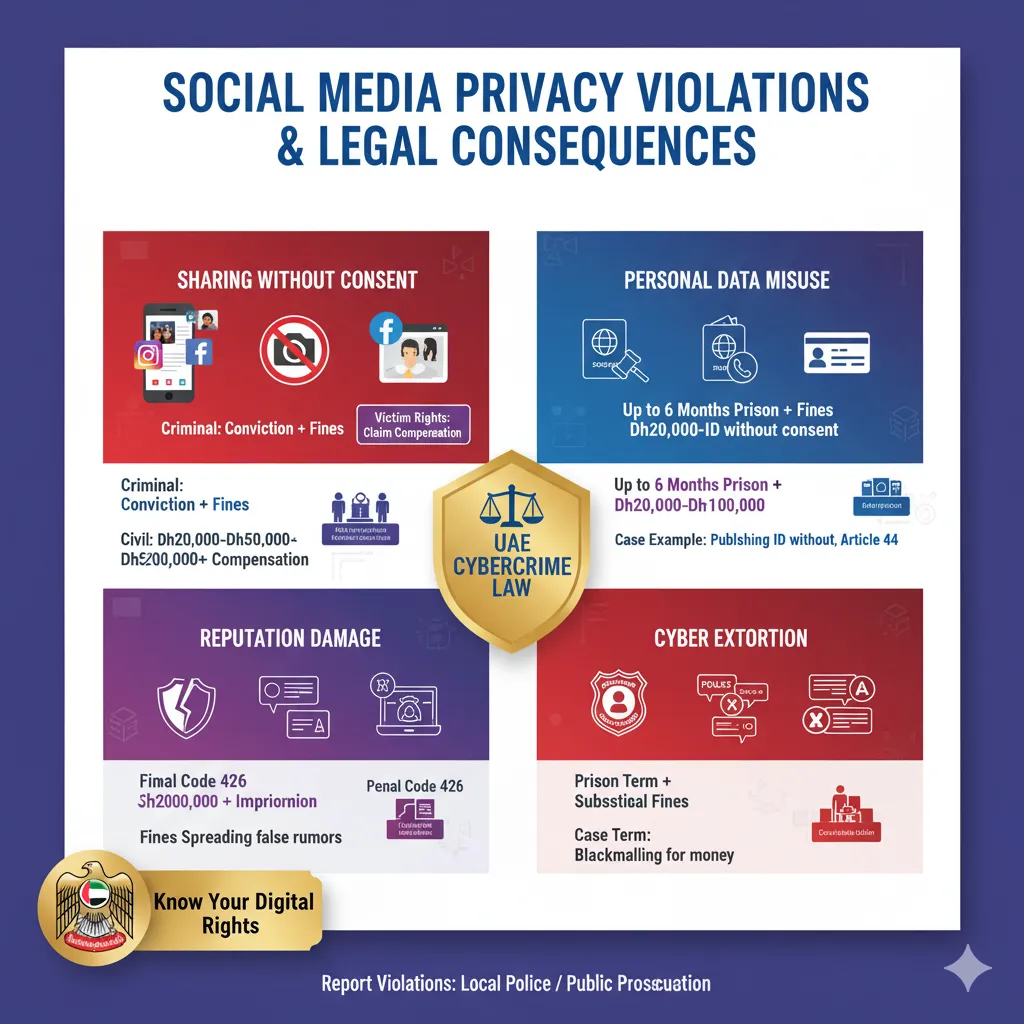
The primary legislation governing privacy violations on social media is Federal Decree-Law No. 34 of 2021 Concerning the Fight Against Rumours and Cybercrimes. This law addresses various forms of digital misconduct, including unauthorised sharing of personal images.
Article 42 of this law specifically addresses obtaining or publishing personal data without authorisation. Violations can result in imprisonment and fines ranging from Dh20,000 to Dh100,000.
Personal Image Rights
UAE law recognises that individuals have rights over their personal images. Photographing or sharing someone’s photos without consent constitutes a privacy violation, particularly when those images are published on public platforms like social media.
This protection extends beyond simple photographs to include video recordings, as demonstrated in this case where both photos and videos were shared without permission.
Why Prior Criminal Conviction Matters
The defendant’s prior criminal conviction significantly strengthened the plaintiff’s civil case. Understanding why requires examining how criminal and civil proceedings differ and intersect.
Criminal vs Civil Proceedings
Criminal proceedings focus on punishing unlawful behaviour and deterring future violations. The state prosecutes criminal cases, and convictions can result in imprisonment, fines, and criminal records. The burden of proof requires proving guilt “beyond reasonable doubt”—a high evidentiary standard.
Civil proceedings, by contrast, focus on compensating victims for harm suffered. Individuals initiate civil lawsuits seeking monetary damages or other remedies. The burden of proof requires establishing liability based on “balance of probabilities”—a lower evidentiary standard than criminal cases.
Dual Proceedings for the Same Act
A single act can give rise to both criminal and civil liability. In this case, sharing the woman’s photos and videos without consent:
- Constituted a criminal offence under cybercrime laws
- Created civil liability for damages caused by the privacy violation
The defendant faced criminal prosecution first, resulting in conviction. The woman then filed a separate civil lawsuit seeking compensation for the harm she suffered.
Binding Effect in Civil Court
When the civil case proceeded, the prior criminal conviction carried binding authority. The civil court accepted as proven that the defendant violated the woman’s privacy—a fact already established in criminal proceedings. This eliminated the need for the plaintiff to re-prove the violation occurred.
The civil proceedings focused instead on determining appropriate compensation for the harm suffered, rather than re-litigating whether the violation occurred at all.
Emotional Distress and Mental Anguish
The court specifically recognised that the defendant’s actions caused the plaintiff emotional distress and mental anguish. These forms of harm, whilst not physical, constitute legitimate grounds for compensation under UAE civil law.
Privacy Violations’ Psychological Impact
Having personal photos and videos shared publicly without consent can cause significant psychological harm:
Loss of Control: Victims lose control over their personal image and how others perceive them
Reputational Damage: Unauthorised sharing can damage personal and professional reputations
Ongoing Anxiety: The permanence of digital content creates lasting concern about future discovery and sharing
Relationship Strain: Privacy violations can strain personal and professional relationships
Trust Erosion: Victims may struggle to trust others with personal information afterwards
The court’s recognition of these harms validates victims’ experiences and provides a legal remedy for psychological suffering caused by privacy violations.
Compensation Considerations
The plaintiff sought Dh50,000 in damages but received Dh20,000. Several factors likely influenced the final compensation amount:
Severity of Violation: The extent and nature of the privacy breach affects compensation levels
Harm Evidence: Documentation of emotional distress, reputational damage, and other consequences supports higher awards
Prior Convictions: The defendant’s criminal conviction established the violation but the civil court independently assesses appropriate compensation
Legal Precedents: Similar cases provide guidance on reasonable compensation ranges
Defendant’s Conduct: Whether the defendant showed remorse, took corrective action, or continued the violation affects awards
Whilst the awarded amount fell below the requested sum, Dh20,000 represents substantial compensation that acknowledges the seriousness of privacy violations whilst remaining proportionate to the harm proven.
Social Media’s Role in Privacy Violations
Social media platforms amplify privacy violations’ impact and complicate enforcement:
Rapid Dissemination: Content shared on social media can reach thousands of people within hours
Permanence: Even after deletion, content may persist through screenshots, downloads, or shares
Multiple Platforms: Content often appears across multiple platforms, complicating removal efforts
Beyond Original Audience: Content shared on social media can reach far beyond the intended audience
Digital Permanence: Online content can resurface years later, extending violations’ impact indefinitely
These characteristics make social media privacy violations particularly harmful and justify serious legal consequences for violators.
Protecting Your Privacy on Social Media
This case provides lessons for protecting personal privacy in digital spaces:
Control Your Content: Carefully manage who can access your photos and videos. Use privacy settings to restrict visibility to trusted individuals only.
Grant Permission Carefully: Be selective about who you allow to photograph or record you. Establish clear expectations about sharing restrictions.
Document Violations: If someone shares your content without permission, immediately document the violation with screenshots, timestamps, and platform information.
Report Promptly: Report privacy violations to the relevant social media platform and consider filing police reports for serious breaches.
Pursue Legal Remedies: As this case demonstrates, UAE law provides both criminal and civil remedies for privacy violations. Don’t hesitate to seek legal assistance.
Educate Others: Make sure friends, family, and associates understand your expectations regarding your images and respect for privacy.
Legal Recourse for Privacy Violation Victims
Victims of social media privacy violations in the UAE have several legal options:
Criminal Complaints: File complaints with local police or the Public Prosecution regarding cybercrime violations
Civil Lawsuits: Pursue compensation through civil courts for emotional distress, reputational damage, and other harms
Platform Reports: Report violations to social media platforms for content removal
Evidence Preservation: Document violations thoroughly to support both criminal and civil proceedings
Legal Representation: Consult with lawyers specialising in cybercrime and privacy law to understand your options
This case demonstrates that pursuing both criminal and civil remedies can be effective, with criminal convictions strengthening subsequent civil claims.
Broader Implications for Digital Behaviour
This ruling reinforces important principles about digital behaviour in the UAE:
Personal images belong to individuals: Others cannot share your photos or videos without your permission
Criminal and civil consequences: Privacy violations can result in both criminal convictions and civil compensation orders
Courts take privacy seriously: UAE courts award substantial compensation for privacy breaches
Prior convictions matter: Criminal convictions strengthen civil claims for the same conduct
Digital permanence matters: Actions taken online have lasting legal consequences
These principles should guide everyone’s behaviour on social media and other digital platforms.
Conclusion
The Abu Dhabi Family, Civil and Administrative Cases Court’s order requiring Dh20,000 compensation for a social media privacy violation sends a clear message about the seriousness of sharing personal images without consent.
The ruling, influenced by the defendant’s prior criminal conviction for the same act, demonstrates how criminal and civil proceedings can work together to provide comprehensive remedies for privacy violation victims. The criminal conviction established the facts of the violation, whilst the civil proceedings addressed the harm suffered through monetary compensation.
For UAE residents, this case reinforces the importance of respecting others’ privacy online and the significant legal consequences—both criminal and civil—that flow from violations. The substantial compensation award reflects courts’ recognition that privacy violations cause real harm worthy of legal remedy.
Anyone who has experienced privacy violations on social media should understand that UAE law provides strong protections and meaningful remedies through both criminal and civil proceedings.
Frequently Asked Questions
Can I sue someone for sharing my photos on social media without permission in the UAE?
Yes. UAE law allows you to file both criminal complaints and civil lawsuits for unauthorised sharing of personal images. As this case demonstrates, you can seek monetary compensation for emotional distress, reputational damage, and other harms caused by the privacy violation.
How does a criminal conviction affect a civil lawsuit for the same act?
Criminal convictions carry binding authority in subsequent civil cases when they establish the facts. Once a criminal court has determined that a privacy violation occurred, the civil court accepts those facts as proven, eliminating the need to re-prove the violation in the civil case.
What compensation can I receive for privacy violations in the UAE?
Compensation varies based on the violation’s severity, harm suffered, and other factors. This case awarded Dh20,000, though the plaintiff sought Dh50,000. Other cases may result in different amounts depending on circumstances, evidence, and the specific harms proven.
What should I do if someone shares my photos without consent?
Immediately document the violation with screenshots and timestamps, report it to the social media platform, consider filing a police report, and consult with a lawyer about your legal options. Preserve all evidence for potential criminal or civil proceedings.
Do I need a criminal conviction before filing a civil lawsuit for privacy violations?
No. You can file civil lawsuits independently of criminal proceedings. However, as this case shows, obtaining a criminal conviction first can strengthen your civil claim by establishing the facts of the violation with binding authority.
Further Reading
- UAE Social Media Guidelines: Legal Requirements for Digital Citizenship in 2025
- UAE Social Media Laws 2025: Comments Can Lead to Dh500k Fines
- UAE Privacy Laws: Legal Guide to Photographing Private Property
- UAE’s 6 Banned Online Content Types: Dh500,000 Fine and 5-Year Jail Risk
- UAE Cyber Extortion: 6 Tactics Exposed by Abu Dhabi Study
The UAE week, every Monday
The week's stories on jobs, visas, money and daily life in one short email. Unsubscribe in one click.