UAE Climate Law 2024: Dh2 Million Fines Drive MENA Environmental Leadership
UAE becomes first MENA nation with comprehensive climate law featuring Dh2 million penalties, emissions tracking, and carbon market integration.
By Vadim Kouznetsov, published

The United Arab Emirates has taken a groundbreaking step in environmental governance with Federal Decree-Law No. (11) of 2024, which came into effect on 30th May 2025. This comprehensive climate legislation establishes the UAE as the first MENA nation to create a robust legal framework addressing climate resilience and emissions accountability, positioning the country at the forefront of regional climate action ahead of COP30.
Comprehensive Climate Framework Sets Regional Precedent
The new climate law introduces ambitious emissions reduction targets spanning critical sectors including energy infrastructure and waste management. This strategic approach demonstrates the UAE’s commitment to achieving climate neutrality whilst maintaining economic growth momentum. The legislation incorporates advanced climate technologies such as carbon capture, utilisation and storage (CCUS) alongside natural carbon sink enhancement programmes.
Strict Enforcement Through Financial Penalties
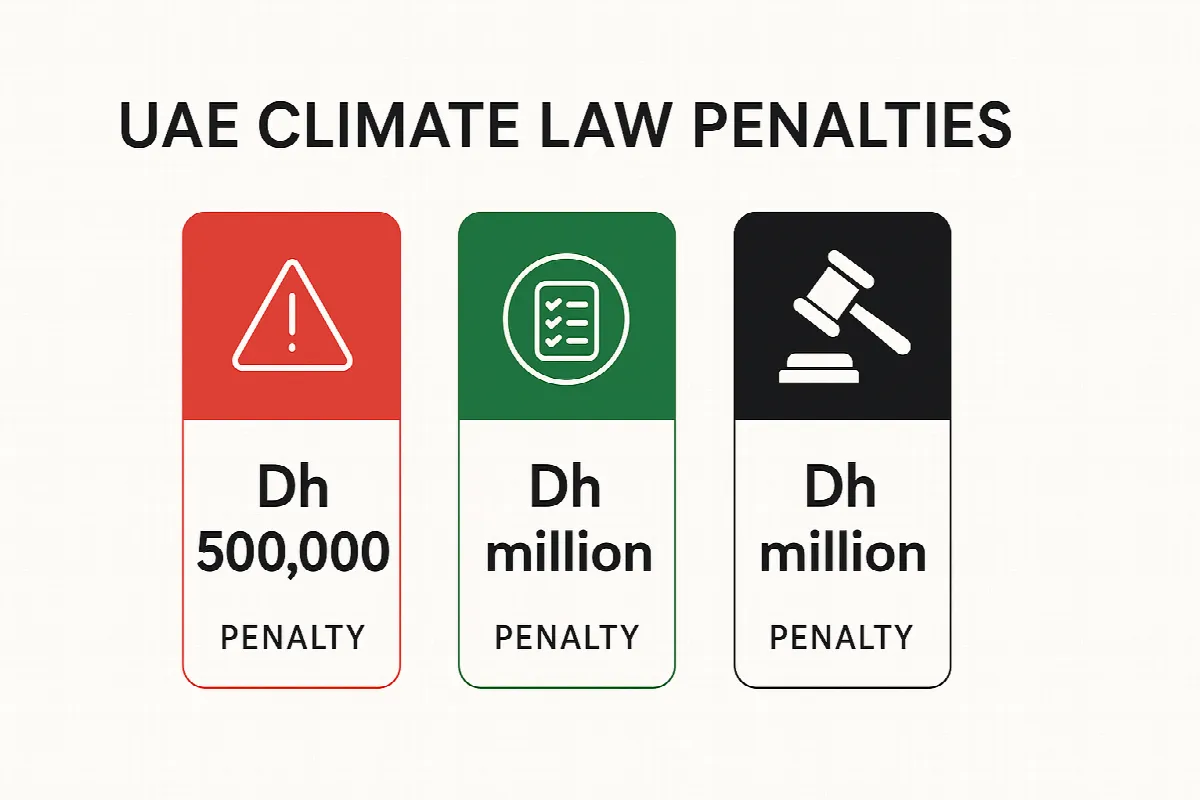
Central to the law’s effectiveness is its enforcement mechanism featuring substantial financial penalties. Organisations violating climate regulations face fines ranging from Dh500,000 to Dh2 million. This penalty structure sends a clear message about the UAE’s serious commitment to climate compliance and emissions reduction.
The legislation establishes a comprehensive Measurement, Reporting, and Verification (MRV) framework requiring mandatory emissions inventories and third-party audits. Companies must now participate in a national electronic tracking platform designed to monitor climate performance across all sectors.
Carbon Markets Integration and Economic Opportunities
The National Carbon Credit Registry represents a significant development, connecting UAE businesses with international carbon markets. This system rewards proactive climate action whilst creating new revenue streams for companies investing in sustainable practices. The framework encourages emissions trading systems, carbon offset projects, and internal carbon pricing mechanisms.
These market-based approaches aim to stimulate investment in renewable energy technologies, green innovation, and circular economy models. Such initiatives form the backbone of the UAE’s economic diversification strategy, helping maintain competitiveness in an increasingly low-carbon global economy.
Industry Adaptation Period and Expert Insights
Navandeep Matta, senior associate at Kochhar & Co Inc Legal Consultants Dubai, highlights the law’s pragmatic approach: “By institutionalising mitigation, adaptation, and innovation, the UAE not only safeguards its future but also sets a precedent for hydrocarbon-rich economies.”
The legislation provides a one-year grace period, allowing industries sufficient time to adapt their operations to new climate requirements. This transitional approach balances environmental urgency with business practicality, facilitating smoother implementation across diverse sectors.
Climate Adaptation and Data-Driven Decision Making
Beyond emissions reduction, the law mandates sector-specific climate adaptation plans. These requirements include data-sharing protocols for climate-related damages, enabling policymakers to make evidence-based decisions about future climate strategies.
The legislation supports the UAE’s commitments under international agreements including the Paris Agreement and Nationally Determined Contributions (NDCs), demonstrating alignment with global climate objectives.
Environmental Groups Praise Progressive Approach
Greenpeace Middle East and North Africa has commended the UAE’s climate law as “a transformative step toward a more climate-resilient and sustainable future.” Ghiwa Nakat, executive director of Greenpeace MENA, stated: “This law marks a bold and progressive move in the UAE’s climate leadership. By institutionalizing emissions monitoring and climate adaptation, the UAE is setting a compelling example for countries across the region.”
The environmental organisation emphasises that this strategic action sends powerful signals regionally and globally about climate resilience and sustainable development as national priorities.
Career Opportunities in Climate Action
This landmark legislation is creating substantial employment opportunities in sustainability sectors. As businesses adapt to new compliance requirements, demand for sustainability consultants, environmental auditors, and carbon management specialists continues growing. The law’s implementation will particularly benefit professionals with expertise in green building and sustainable construction, as companies seek to meet stringent environmental standards.
The eco-innovation sector stands to benefit significantly from these regulatory changes, with increased investment in clean technologies creating new career pathways for environmental engineers, renewable energy specialists, and sustainability managers.
Regional Leadership and Global Impact
The UAE’s climate legislation establishes new standards for environmental governance in the MENA region. With robust frameworks for emissions reduction and adaptation now in place, the country positions itself to lead by example in addressing climate challenges whilst maintaining economic prosperity.
The law’s success will depend on collaborative execution between government agencies, private sector partnerships, and continuous adaptation to emerging climate science developments. As other nations observe the UAE’s implementation approach, this legislation could influence broader regional climate policy frameworks.
This pioneering climate law represents more than regulatory compliance—it demonstrates how resource-rich economies can transition towards sustainable development without compromising growth objectives. The UAE’s approach may serve as a blueprint for other nations seeking to balance environmental responsibility with economic advancement.
The legislation aligns with the country’s broader sustainability initiatives and supports the development of eco-tourism sectors that contribute to environmental conservation whilst generating economic value.
Key Takeaway
The UAE’s new climate law establishes the first comprehensive legal framework for emissions accountability in the MENA region, featuring penalties up to Dh2 million and creating pathways for businesses to participate in international carbon markets whilst maintaining economic growth.
Further Reading
The UAE week, every Monday
The week's stories on jobs, visas, money and daily life in one short email. Unsubscribe in one click.