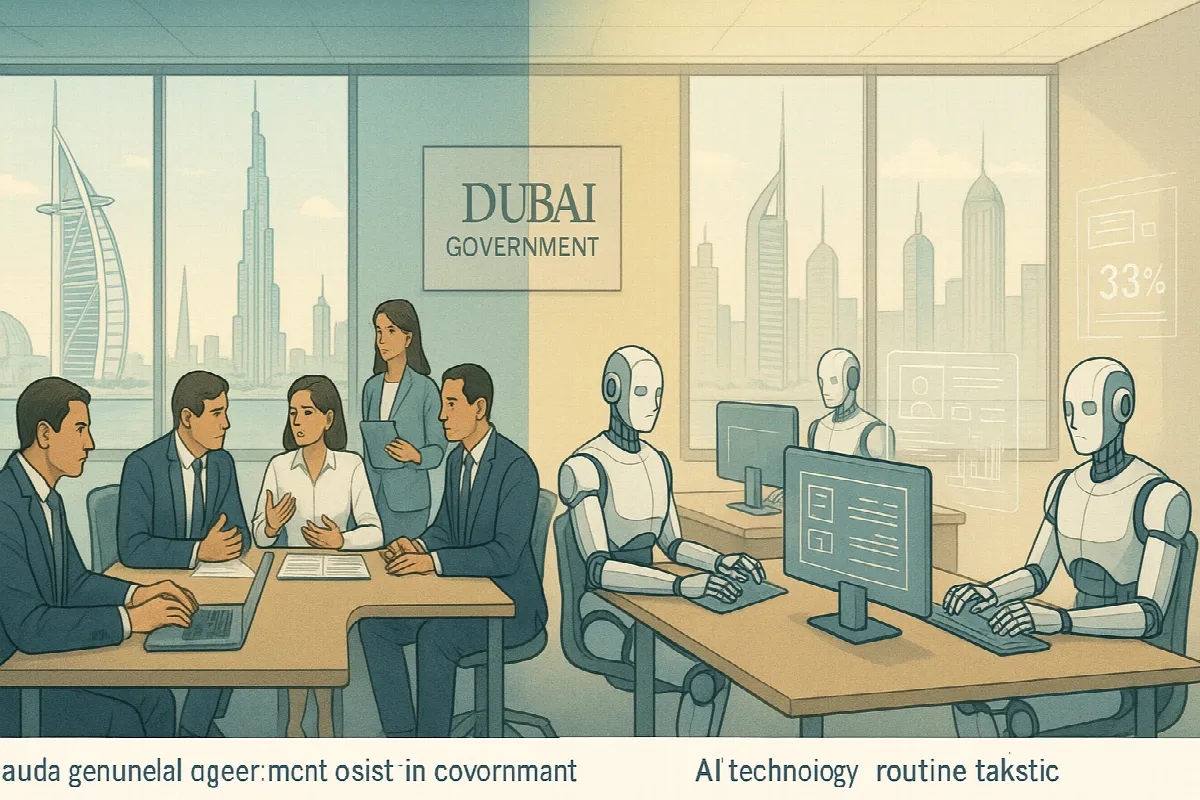
33% of Dubai Government Jobs at High Risk from AI Impact
New study finds one-third of Dubai government jobs face AI disruption, with clerical roles seeing 24% of tasks potentially automated. Training identified as critical response.
By Vadim Kouznetsov, published

Published on April 23, 2025
A comprehensive new study has revealed that approximately one-third of Dubai government jobs face significant exposure to generative Artificial Intelligence (AI), with clerical support roles particularly vulnerable to technological disruption.
Dubai Government Jobs Under AI Scrutiny
Research conducted by the Mohammed bin Rashid School of Government (MBRSG) in collaboration with the Dubai Government Human Resources Department shows that 33% of positions across government entities are at high risk of transformation due to AI advances. The study indicates that clerical support workers could see 24% of their job tasks replaced by AI systems.
The extensive research surveyed 2,480 employees from 34 Dubai government entities to assess generative AI’s impact on various job roles. Additionally, researchers interviewed Chief AI Officers (CIAOs) from five leading government departments to gather strategic recommendations.
AI Adoption Already Widespread
“Most of the employees that took the survey already used Gen AI in some form or another with 64% being users,” noted Keertana Subramani, a researcher with MBRSG. “Most of the employees were at a regular or intermediate level, with a smaller percentage, around 16%, being advanced or expert users.”
The study revealed an interesting finding regarding management attitudes toward AI usage. A survey of senior managers “surprisingly” found that 48% “were okay with people using Gen AI without disclosing that they used it”—suggesting the technology has already become deeply integrated into workplace practices.
How Government Employees Are Using AI
The research identified specific applications where AI tools are making the most impact:
- Content creation emerged as the primary use case
- Strategy development ranked as the second most common application
- Data analysis completed the top three implementation areas
Over 80% of users reported saving valuable time by leveraging AI tools, while 46% noted improvements in both work quality and productivity levels.
Challenges in AI Implementation
Despite widespread adoption, government employees reported several concerns with current AI systems:
- Information inaccuracy: 40% of respondents flagged this as a significant issue
- Data privacy concerns: Many worried about organisational handling of sensitive information
- Cultural representation: Limited reflection of local culture and language in international AI tools
- Algorithmic bias: Concerns about fairness and equitable outcomes from AI systems
The Path Forward: Training and Awareness
The study emphasised that “training and upskilling employees” represents “the key of the hour” for successful AI integration. Additionally, researchers highlighted that “awareness and openness to the adoption of new technology across departments are also very important.”
These recommendations align with Dubai’s broader strategy of embracing technological innovation while supporting workforce development to maintain competitive advantage in the global digital economy.
AI Adoption Among UAE Small Businesses
A parallel MBRSG report examined AI usage in the private sector, revealing that 99% of small and medium enterprises (SMEs) were either actively using or exploring generative AI applications.
The highest adoption rates appeared in:
- Marketing departments
- Customer service functions
- Design teams
- Analytics units
However, SMEs face distinct challenges including:
- Affordable computing resources
- Adequate data storage solutions
- Talent shortages across the region
- Low foreign intellectual property registration (only 9% among AI-focused SMEs)
UAE’s Position in Global AI Rankings
The findings come as the UAE continues to strengthen its position as an AI leader. Currently, the nation ranks fifth globally in Stanford’s AI Vibrancy Index and 13th in the Oxford Government AI Readiness Index.
With SMEs representing 94% of UAE companies, their AI adoption rates are considered crucial for national economic development and technological competitiveness.
Key Takeaway
As AI continues transforming Dubai’s government sector, strategic investment in human capital development through targeted training programmes will be essential. While technological disruption presents challenges, particularly for clerical roles, it also creates opportunities for workers to develop new skills aligned with emerging digital requirements. The most successful adaptation strategies will balance technological innovation with thoughtful workforce transition planning.
For more insights on technology’s impact on employment in the UAE, stay connected with JobXDubai.
Additional Reading Material
The UAE week, every Monday
The week's stories on jobs, visas, money and daily life in one short email. Unsubscribe in one click.