How Long Can You Stay in the UAE After Your Work Visa Is Cancelled?
Fired in Dubai? Learn your legal grace period after work visa cancellation, your options to stay, and how to avoid AED 50 daily overstay fines in 2025.
By Vadim Kouznetsov, published

Losing your job in the UAE raises an immediate question: how much time do you actually have before you need to leave the country? If you’re employed by a mainland company in Dubai and facing termination, here’s exactly what UAE law says about your options.
What Happens When Your Employment Ends?
Once you’re terminated or resign from your position, your employer is legally required to cancel your work permit through the Ministry of Human Resources and Emiratisation (MOHRE). This is governed by Article 7(3) of Cabinet Resolution No. 1 of 2022, which implements Federal Decree-Law No. 33 of 2021.
Your employer must complete several steps during this process, including submitting a cancellation application through MOHRE’s official channels, clearing any outstanding fines, and confirming that all your end-of-service entitlements have been settled.
Once the work permit is cancelled, your residency visa follows. The two are directly linked — there’s no scenario where your work permit is cancelled but your residency visa remains active.
How Long Is the Grace Period After Visa Cancellation?
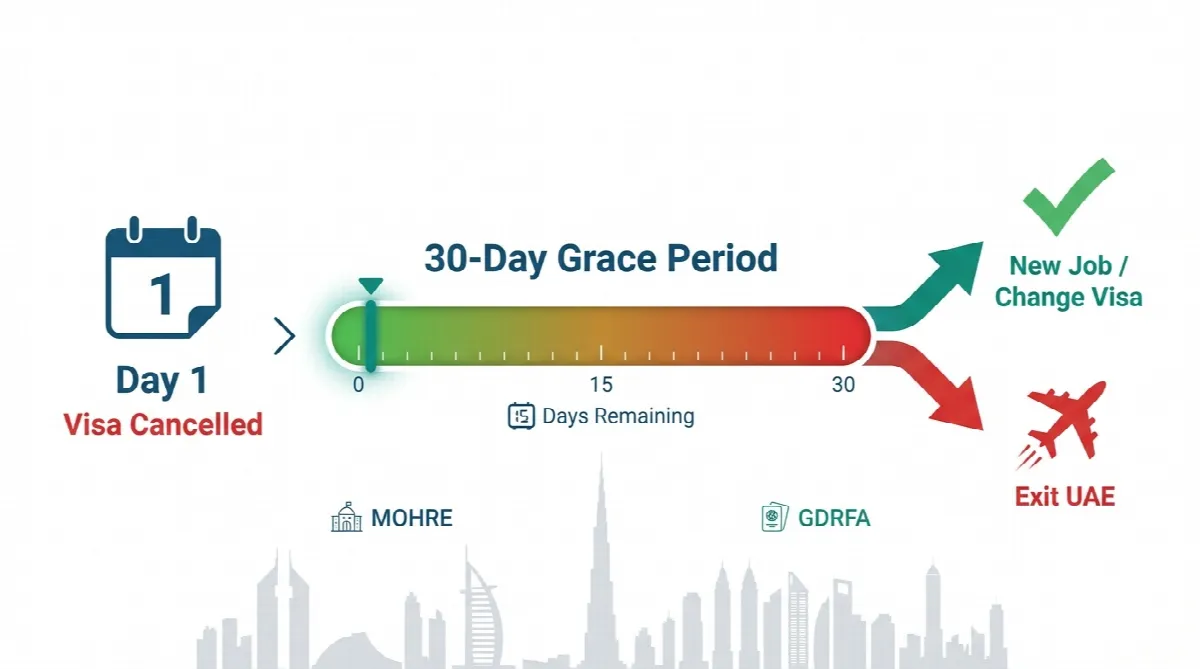
Here’s the critical part. After your residency visa is cancelled, you receive a grace period to remain in the UAE. The exact duration is stated in your visa cancellation document issued by the General Directorate of Residency and Foreigners Affairs (GDRFA).
For standard employment visa holders, this grace period is typically 30 days. During this window, you can either exit the country or take steps to change your residency status.
If you stay past this grace period without taking action, Article 11 of Federal Decree-Law No. 29 of 2021 (the UAE Immigration Law) kicks in. You’ll face daily administrative fines for every day you remain in the country illegally. The fine amount is set by the Council of Ministers and currently stands at AED 50 per day.
What Are Your Options During the Grace Period?
You have several legal pathways available during your grace period.
Find New Employment
If you secure a new job before your grace period expires, your new employer can apply for a fresh work permit and residency visa while you’re still in the country. You won’t need to exit and re-enter the UAE.
Switch to a Visit or Tourist Visa
Your new employer may also obtain a visit visa or tourist visa on your behalf without requiring you to leave the UAE first. However, it’s best to confirm this process directly with GDRFA Dubai, as requirements can vary.
Exit the Country
If you haven’t found new employment or an alternative visa arrangement, you’ll need to leave before the grace period ends to avoid overstay fines and potential legal issues.
Don’t Forget Your Financial Obligations
Before you leave or change visa status, sort out your banking, rental contracts, and any other financial commitments. Your bank account won’t be automatically closed upon visa cancellation, but you should inform your bank about your situation to keep your account active.
If you’re considering a permanent departure, review our complete checklist for leaving the UAE covering visa, banking, and property matters.
What About Families and Dependants?
If you sponsor family members, their visas are tied to yours. Once your residency is cancelled, you’ll need to address their visa status as well. Parents concerned about their children completing the school year should explore legal options for academic year completion after visa cancellation.
Key Takeaways
- Your employer must cancel your work permit through MOHRE once employment ends
- A grace period (typically 30 days) is granted after visa cancellation — check your cancellation document for the exact duration
- You can find new employment and change your visa status during the grace period without leaving the UAE
- Overstaying past the grace period results in AED 50 daily fines under UAE Immigration Law
- Contact GDRFA Dubai (helpline: 8005111) for guidance specific to your situation
Frequently Asked Questions
How many days can I stay in the UAE after my work visa is cancelled?
You can stay for the duration of the grace period specified in your visa cancellation document. For standard employment visas, this is typically 30 days. Green Visa holders and Golden Visa holders may receive longer grace periods of up to 90 or 180 days respectively.
Can I work during the grace period after visa cancellation?
No. Once your work permit is cancelled, you cannot legally work in the UAE until a new employer issues you a fresh work permit and your new residency visa is activated.
What happens if I overstay after my grace period expires?
You’ll be charged an administrative fine of AED 50 for each day you remain in the country past the grace period. Extended overstays can also result in deportation and potential entry bans.
Can my new employer process my visa while I’m still in the UAE?
Yes. If you find a new job during your grace period, your new employer can apply for a work permit and arrange your new residency visa without you needing to exit the country first.
Do I need to leave the UAE to get a tourist visa after my work visa is cancelled?
Not necessarily. In many cases, a tourist or visit visa can be arranged without exiting the country. Confirm the specific process with GDRFA Dubai, as procedures may vary depending on your circumstances.
What laws govern work visa cancellation in the UAE?
Two primary laws apply: Cabinet Resolution No. 1 of 2022 (implementing Federal Decree-Law No. 33 of 2021 on employment relations) governs work permit cancellation, while Federal Decree-Law No. 29 of 2021 covers residency and immigration matters including grace periods and overstay penalties.
Further Reading
- UAE Visa Grace Period: How Long Can You Stay After Visa Cancellation?
- UAE Visa Overstay Fines 2025: Complete Guide to Penalties & Waivers
- UAE Work Permits Guide 2025: 13 Types Explained
- Can UAE Residents Keep Their Bank Accounts After Visa Cancellation?
- Permanently Leaving UAE? Essential Checklist for Visa, Banking & Property
The UAE week, every Monday
The week's stories on jobs, visas, money and daily life in one short email. Unsubscribe in one click.