Dubai Eviction Rules: How Landlords Can Legally Remove Tenants Who Stop Paying Rent
Dubai landlord with an unpaid tenant? Learn the legal 30-day notice process, RDC eviction procedures, and 12-month notice rules for selling property.
By Vadim Kouznetsov, published

Key Takeaway: If your tenant stops paying rent in Dubai, you can serve a 30-day written notice through a notary public demanding payment. If they still don’t pay, you can file an eviction case at the Rental Dispute Settlement Centre (RDC). If you also want to sell the property, a separate 12-month eviction notice is required under Dubai’s tenancy law.
Your tenant paid on time for the first year. Then the excuses started — personal issues, cash flow problems, promises of “next month.” Six months later, you’re still waiting. And now you want to sell the property.
This is one of the most common scenarios Dubai landlords face. The good news? The law provides clear steps to reclaim your property. But the process must be followed precisely, or you risk delays and rejected claims.
Here’s exactly how to proceed.
Can You Evict a Tenant for Not Paying Rent in Dubai?
Yes. Dubai law gives landlords the right to request eviction before the lease contract expires if a tenant fails to pay rent within 30 days of receiving a formal written notice.
This is established under Article 25(1)(a) of Law No. 33 of 2008, which amends Law No. 26 of 2007 regulating the relationship between landlords and tenants in Dubai.
The law states that a landlord may request eviction when:
“the tenant fails to pay the rent or any part thereof within 30 days from the date of service of a notice on the tenant by the landlord requesting the payment.”
Two critical requirements here:
1. The notice must be served through a notary public or by registered mail. A WhatsApp message, email, or verbal warning does not satisfy the legal requirement.
2. The 30-day window starts from the date the tenant receives the notice — not from when rent was originally due.
If the tenant pays within those 30 days, the eviction grounds disappear. If they don’t, you can move to the next step.
Step-by-Step: Evicting a Tenant for Non-Payment
Here’s the legal process Dubai landlords should follow:
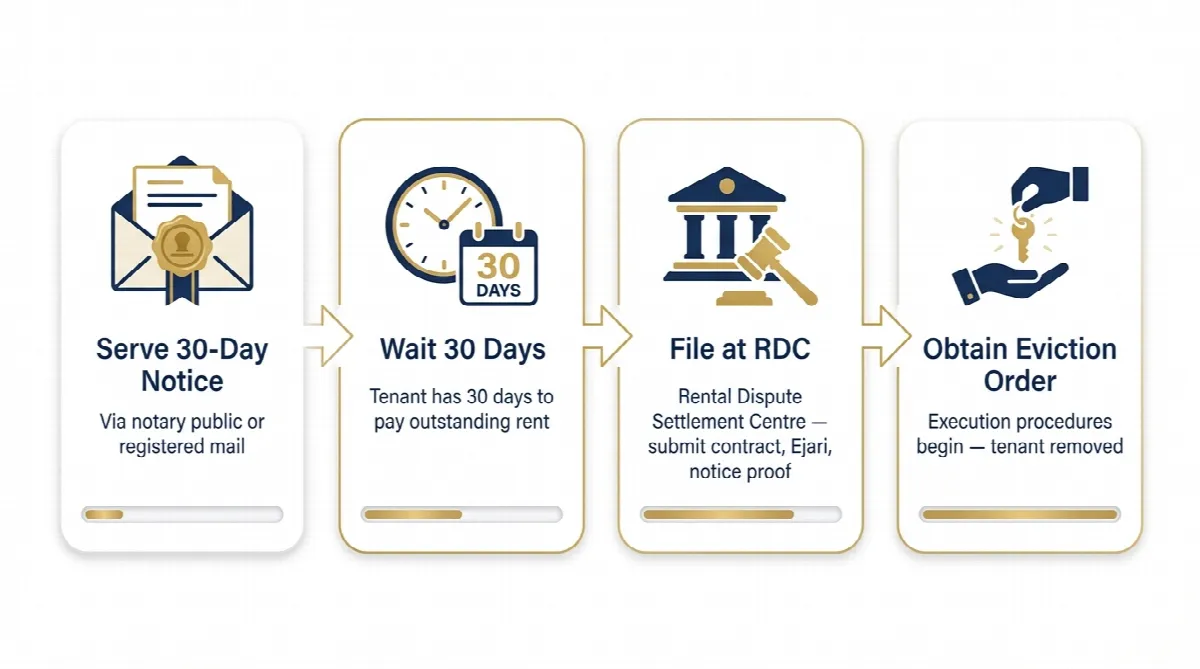
Step 1: Serve a formal 30-day notice
Draft a notice demanding payment of all outstanding rent. Have it delivered through a notary public or sent by registered mail. Keep proof of delivery — you’ll need it when filing your case.
Step 2: Wait 30 days
The tenant has 30 calendar days to settle the debt. During this period, they retain the right to pay and avoid eviction.
Step 3: File a case at the Rental Dispute Settlement Centre (RDC)
If payment isn’t received within 30 days, file a claim at the RDC seeking eviction on grounds of non-payment and recovery of outstanding rent.
The RDC is the judicial body under the Dubai Land Department that handles all rental disputes. You’ll need to submit your tenancy contract, Ejari registration, the notary-delivered notice, and evidence of unpaid rent.
Step 4: Obtain and execute the eviction order
Once the RDC issues an eviction order, execution procedures begin. Only after the tenant has been removed and you have vacant possession can you proceed with selling the property.
What If You Want to Sell the Property?
Wanting to sell adds a second legal pathway. Under Article 25(2)(d) of the same law, a landlord can seek eviction upon expiry of the lease if the property owner wishes to sell.
However, this route requires a 12-month notice served through a notary public or registered mail. The notice must clearly state the reason for eviction.
This is a separate legal mechanism from non-payment eviction. Here’s how the two compare:
Non-payment eviction: Can happen during the lease term. Requires a 30-day payment notice. Filed at RDC after the tenant fails to pay.
Sale-related eviction: Only applies upon lease expiry. Requires 12 months’ notice. Must specify the sale as the reason for non-renewal.
If your tenant isn’t paying rent, the faster route is the non-payment eviction. You don’t need to wait for the contract to expire — the 30-day notice process can begin immediately.
If you’re planning to sell but the tenant is current on payments, you’ll need to follow the 12-month notice procedure and wait until the lease expires.
Common Mistakes Landlords Make
Skipping the notary notice. Sending an informal message asking for payment doesn’t count. The law specifically requires service through a notary public or registered mail. Without this, the RDC will not accept your case.
Trying to lock out the tenant. Changing locks, cutting utilities, or physically removing a tenant without a court order is illegal in Dubai. A recent landmark case saw a landlord ordered to pay Dh700,000 in compensation for executing an unlawful eviction.
Confusing eviction routes. Non-payment eviction and sale-related eviction are separate processes with different timelines and requirements. Using the wrong one wastes time and may result in your case being dismissed.
Not keeping records. Document every missed payment, every communication, and every notice sent. The RDC reviews evidence carefully, and a well-documented case moves faster.
What Are Your Rights as a Landlord?
Dubai’s rental law protects both parties, but landlords have clear recourse when tenants violate their obligations. Under the seven legal grounds for eviction, non-payment of rent is the most commonly used.
Beyond eviction for non-payment, landlords can also seek eviction during the lease term for unauthorised subletting, illegal property use, commercial property vacancy, or if the tenant causes damage to the property.
For evictions upon lease expiry, valid grounds include personal use by the landlord or close family members (subject to a 2-year re-rental ban), property demolition or major renovation, and the intent to sell.
All post-lease evictions require 12 months’ advance notice through proper legal channels.
FAQ
How long does a landlord have to wait before evicting a non-paying tenant in Dubai?
After serving a formal 30-day notice through a notary public or registered mail, the landlord must wait 30 days for the tenant to pay. If the tenant fails to settle the outstanding rent, the landlord can then file an eviction case at the Rental Dispute Settlement Centre.
Can a landlord evict a tenant to sell the property in Dubai?
Yes, but only upon expiry of the lease contract. The landlord must serve a 12-month eviction notice through a notary public or registered mail, clearly stating the intention to sell as the reason for eviction.
What happens if a landlord locks out a tenant without a court order?
This is illegal under Dubai law. Landlords who change locks, disconnect utilities, or forcibly remove tenants without an RDC order face potential lawsuits and compensation claims. One recent case resulted in a Dh700,000 penalty against the landlord.
Can a tenant avoid eviction by paying rent late?
If the tenant pays all outstanding rent within the 30-day notice period, the grounds for eviction are removed. However, repeated late payments may still affect the landlord-tenant relationship and future lease negotiations.
Where do landlords file eviction cases in Dubai?
All rental disputes are handled by the Rental Dispute Settlement Centre (RDC), which operates under the Dubai Land Department. Cases can be filed digitally or in person with supporting documentation including the tenancy contract, Ejari registration, and the formal notice.
Does the 12-month eviction notice apply if the tenant isn’t paying rent?
No. The 12-month notice applies only to evictions upon lease expiry for reasons like selling the property or personal use. For non-payment, the 30-day notice process under Article 25(1)(a) is the appropriate legal route.
Can a landlord increase rent instead of evicting the tenant?
Rent increases in Dubai must follow RERA’s rental index guidelines and require 90 days’ notice before contract expiry. Landlords cannot use excessive rent increases as a strategy to force tenants out — the RDC penalises such behaviour.
Further Reading
- Dubai Landlord Eviction Rights: Legal Grounds & RDC Procedures 2025
- Dubai Landlord Faces Dh700K Penalty: Landmark Ruling Protects Tenant Rights
- Tenant Rights in Dubai: Can Landlords Force Fewer Cheques or Raise Rent?
- Dubai Rental Laws: Early Termination and Refund Rights Explained
- Dubai Tenant Evictions 2024: Landlord Rights & Legal Requirements
- Dubai Rent Increase Calculator 2025: How to Challenge Unfair Hikes
The UAE week, every Monday
The week's stories on jobs, visas, money and daily life in one short email. Unsubscribe in one click.