Qatar Launches 10-Year Residency for Entrepreneurs and Senior Executives
Qatar announces 10-year residency for entrepreneurs and senior executives, plus $2B venture capital expansion. How it compares to UAE and Saudi schemes.
By Vadim Kouznetsov, published

Key Takeaway: Qatar’s Prime Minister has announced a new 10-year residency programme for entrepreneurs and senior executives, alongside a $2 billion expansion of the Qatar Investment Authority’s venture capital fund. This places Qatar alongside the UAE and Saudi Arabia in the Gulf’s growing competition for global talent and investment.
Qatar is joining the long-term residency race across the Gulf.
Prime Minister Sheikh Mohammed bin Abdulrahman Al Thani confirmed on 1 February 2026 that Qatar will introduce a 10-year residency programme targeting entrepreneurs and senior executives. The move signals Qatar’s intent to compete directly with neighbouring countries for skilled professionals and business founders.
What Did Qatar Announce?
Two major developments emerged from the Prime Minister’s statement:
1. A 10-year residency programme specifically for entrepreneurs and senior executives. While full eligibility criteria have not yet been published, the programme follows a pattern established across the GCC — offering extended residency to high-value professionals and business owners.
2. A $2 billion expansion of the Qatar Investment Authority’s venture capital programme. The QIA’s “Fund of Funds” initiative, previously valued at $1 billion, will now grow to $3 billion. This fund attracts venture capital firms to Qatar and supports the country’s broader entrepreneurship ecosystem.
Both initiatives serve a single strategic goal: diversifying Qatar’s economy beyond its gas revenues.
Why Is Qatar Doing This Now?
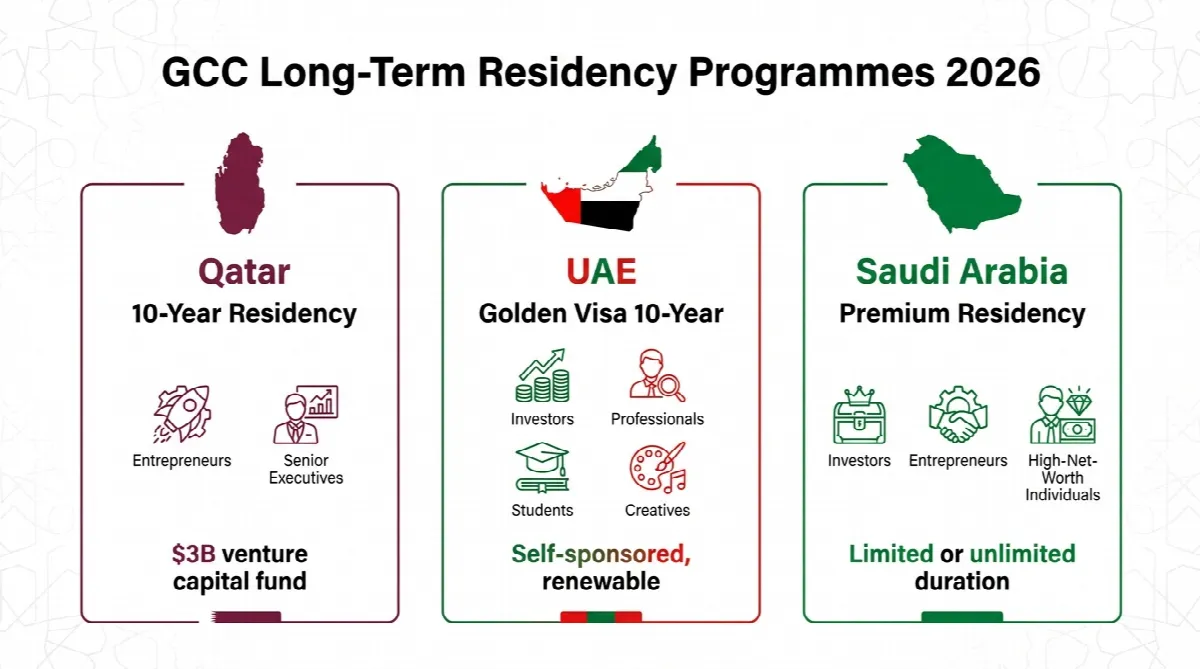
Qatar’s announcement arrives in a Gulf region already reshaped by long-term residency competition. The UAE launched its Golden Visa programme offering 10-year residency to investors, entrepreneurs, and skilled professionals. Saudi Arabia introduced its Premium Residency visa with both limited and unlimited duration options.
These programmes have proven effective at attracting capital, talent, and multinational headquarters to the region. Qatar risks falling behind without a comparable offering.
The timing also reflects broader economic pressures. Gas prices fluctuate, and Qatar — like its neighbours — recognises that sustainable growth depends on building a diversified economy powered by entrepreneurship, technology, and foreign investment.
How Does Qatar’s Programme Compare to the UAE and Saudi Arabia?
Here’s how the three GCC long-term residency programmes stack up based on currently available details:
| Feature | Qatar (New) | UAE Golden Visa | Saudi Premium Residency |
|---|---|---|---|
| Duration | 10 years | 10 years (renewable) | 1 year to unlimited |
| Target | Entrepreneurs, senior executives | Investors, professionals, students, creatives | Investors, entrepreneurs, high-net-worth individuals |
| Self-sponsored | Details pending | Yes | Yes |
| Investment support | $3B venture capital fund | Various startup initiatives | Vision 2030 incentives |
The UAE’s Golden Visa remains the most established programme, offering benefits including self-sponsorship, family sponsorship, and the freedom to stay outside the country for extended periods without losing residency status.
Qatar’s programme will need to match or exceed these provisions to attract top-tier talent already considering UAE or Saudi residency.
What This Means for Gulf Professionals and Entrepreneurs
For professionals working across the GCC — or considering a move to the region — Qatar’s announcement broadens the options considerably. The Gulf job market is already experiencing record growth, with 17,000+ active positions across six countries.
If you’re an entrepreneur: Qatar’s $3 billion venture capital ecosystem could offer funding access that complements its new residency pathway. This makes Doha a stronger contender for startup founders evaluating where to base their operations.
If you’re a senior executive: A 10-year residency removes the uncertainty of short-term visa renewals. Combined with Qatar’s zero income tax environment, this creates a compelling case for C-suite professionals weighing Gulf relocation.
If you’re already in the UAE: The UAE’s visa framework remains comprehensive, with Golden Visa, Green Visa, and freelance options covering most professional categories. Qatar’s move may prompt further enhancements to UAE residency benefits as competition intensifies.
What We Don’t Know Yet
Qatar has not released full details on several critical points:
- Eligibility criteria — minimum investment thresholds, salary requirements, or business revenue benchmarks remain unconfirmed
- Family sponsorship — whether dependants receive similar residency rights
- Property ownership — whether the programme unlocks real estate purchasing privileges
- Application process — no timeline for when applications open
These details will determine whether Qatar’s programme becomes a serious alternative or remains secondary to the UAE’s and Saudi Arabia’s more mature schemes.
Frequently Asked Questions
Who qualifies for Qatar’s new 10-year residency?
The programme targets entrepreneurs and senior executives. Specific eligibility criteria, including minimum investment or salary thresholds, have not been published yet. We will update this article as details emerge.
When does Qatar’s 10-year residency programme launch?
Prime Minister Sheikh Mohammed bin Abdulrahman Al Thani announced the programme on 1 February 2026. An official launch date and application timeline have not been confirmed.
How does Qatar’s residency compare to the UAE Golden Visa?
The UAE Golden Visa offers 10-year renewable residency with self-sponsorship, family sponsorship, and flexible travel benefits. Qatar’s programme targets a narrower audience (entrepreneurs and executives), though full benefit details are still pending.
What is Qatar’s Fund of Funds?
The Fund of Funds is a Qatar Investment Authority initiative that attracts venture capital firms to Qatar. Originally valued at $1 billion, it will expand to $3 billion following the $2 billion increase announced in February 2026.
Does Qatar have income tax?
No. Qatar does not impose personal income tax on residents, similar to the UAE. Corporate tax applies to certain business activities, but individual salaries and earnings remain tax-free.
Can I hold residency in both Qatar and the UAE?
GCC residency rules generally require primary residence in the issuing country. Holding active residency permits in multiple Gulf states simultaneously involves specific legal considerations that vary by jurisdiction. Consult immigration specialists for your particular situation.
Further Reading
The UAE week, every Monday
The week's stories on jobs, visas, money and daily life in one short email. Unsubscribe in one click.