UAE Employee Wins Dh230,000 in Unpaid Wages After Company Fails to Prove Payment
Abu Dhabi labour court awards Dh228,666 to employee after company fails to prove 23 months of salary payments. Learn UAE wage dispute rights and process.
By Vadim Kouznetsov, published

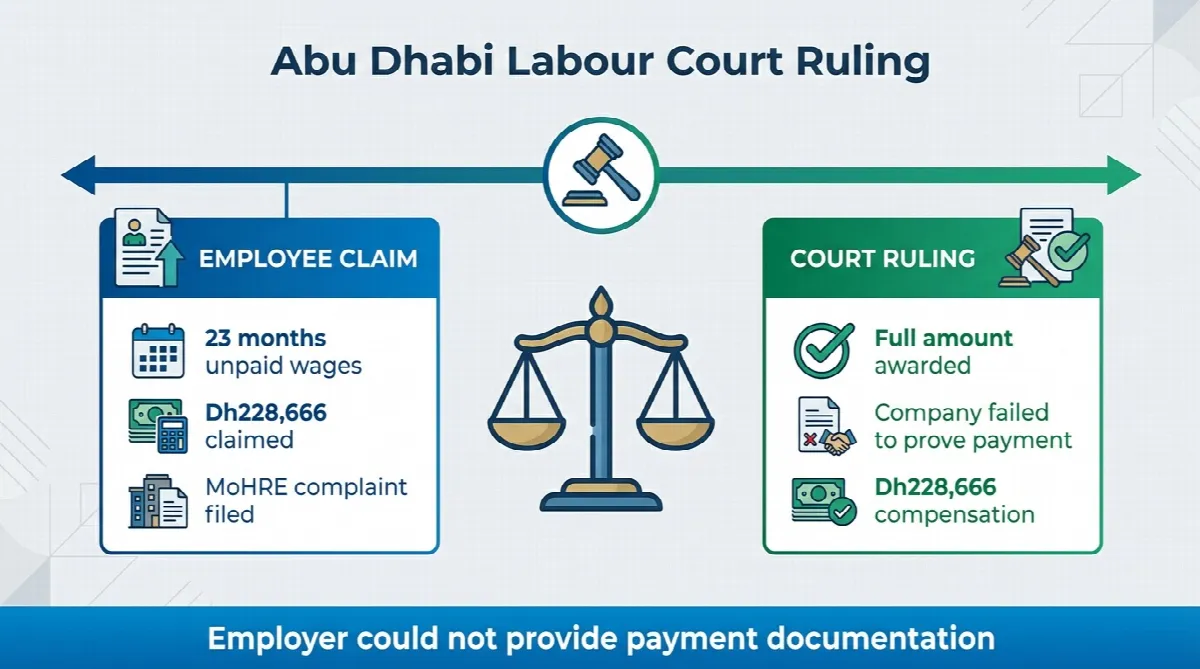
An Abu Dhabi labour court has ordered a company to pay Dh228,666 in compensation to a former employee after failing to prove it had paid his monthly wages for nearly 23 months.
The case highlights how UAE labour law places the burden of proof squarely on employers when salary disputes reach court.
What Happened in This Case?
The employee filed a lawsuit against his former company after pursuing the matter through the Ministry of Human Resources and Emiratisation’s (MoHRE) dispute resolution committee.
He claimed the company had not paid his salary for almost two years. The total amount sought: Dh228,666—the full sum ultimately awarded by the court.
Key details:
- Unpaid period: Approximately 23 months
- Amount claimed: Dh228,666
- Amount awarded: Dh228,666 (in full)
- Dispute process: MoHRE committee first, then Labour Court of First Instance
The company disputed the claim but could not provide documentation proving the wages had been paid.
Why the Court Ruled for the Employee
The court cited two key pieces of UAE employment legislation in its ruling.
Article 22 of Federal Decree-Law No. 33 of 2021
This article states that the amount or type of wage must be specified in the employment contract. If it is not specified, the competent court has the authority to determine it as part of a labour dispute.
The law also obliges employers to pay workers’ wages on time according to systems approved by MoHRE. Salaries must be paid in UAE dirhams unless another currency is agreed upon in the employment contract.
Article 16 of Cabinet Resolution No. 1 of 2022
This regulation requires employers to pay wages on their due dates as stipulated in employment contracts and in line with MoHRE standards.
Critically, all establishments registered with MoHRE must pay salaries through the Wage Protection System or other approved mechanisms and provide proof of payment when requested.
The court concluded that the company had failed to submit sufficient evidence confirming the employee’s wages had been paid. Without that proof, the ruling went in the employee’s favour.
The Burden of Proof Falls on Employers
This case demonstrates a fundamental principle of UAE labour law: employers must be able to prove they’ve paid their workers.
The Wage Protection System (WPS) exists precisely for this reason. It creates an electronic record of all salary payments, protecting both employers and employees in disputes.
| What Employers Must Prove | Required Documentation |
|---|---|
| Wages paid on time | WPS records |
| Correct amounts paid | Bank transfer receipts |
| Payment in agreed currency | Transaction records |
| Compliance with contract | Employment contract terms |
Companies that fail to maintain proper payment records risk losing salary disputes by default—regardless of whether they actually paid the employee.
How UAE Employees Can Protect Themselves
If you’re concerned about unpaid or undocumented wages, take these steps:
1. Check your bank statements
Compare your bank records against your employment contract. Note any months where deposits don’t match your agreed salary.
2. Download your employment contract
Access your official MoHRE-registered contract through the ministry’s website or app. This document confirms your agreed wage.
3. Request WPS statements
Ask your employer for Wage Protection System records showing your payment history.
4. File with MoHRE first
Before going to court, you must pursue the matter through MoHRE’s dispute resolution process. This is a mandatory step.
5. Document everything
Keep records of all communications with your employer regarding salary. These become evidence if the case escalates.
The MoHRE Dispute Resolution Process
UAE labour law requires employees to attempt resolution through MoHRE before filing a court case.
Here’s how the process works:
Step 1: File a complaint through MoHRE’s website, app, or call centre (600590000)
Step 2: MoHRE reviews the complaint and contacts your employer
Step 3: A mediation session is scheduled to resolve the dispute
Step 4: If mediation fails, MoHRE refers the case to the Labour Court
Most complaints are reviewed within 14 days. If your employer fails to attend mediation or refuses to settle, you receive documentation to proceed to court.
What UAE Law Says About Salary Payments
Federal Decree-Law No. 33 of 2021 provides comprehensive protections for workers regarding salary payments.
Employers must:
- Pay wages on agreed dates
- Use approved payment systems (WPS)
- Maintain payment records
- Provide proof of payment when requested
Employees are entitled to:
- Full payment as specified in contracts
- Payment in UAE dirhams (unless otherwise agreed)
- Access to payment records
- Legal recourse for unpaid wages
Understanding your rights under UAE employment law is critical. Even if you’re still employed and in dispute with your employer, you have the right to pursue salary claims.
Why This Case Matters for UAE Workers
This ruling reinforces several important principles:
Documentation is everything. The company lost not because it didn’t pay—but because it couldn’t prove it paid. For employees, this means demanding WPS compliance. For employers, it means maintaining proper records.
The system works. The employee followed the correct process: MoHRE dispute resolution first, then Labour Court. This resulted in full recovery of claimed wages.
23 months is a long time. This case involved nearly two years of alleged unpaid wages. If you experience even one month of delayed payment, report it promptly. Don’t let the situation compound.
Key Takeaway
An Abu Dhabi labour court awarded Dh228,666 to a former employee after his company failed to prove payment of wages for nearly 23 months. The ruling cited Article 22 of Federal Decree-Law No. 33 of 2021 and Article 16 of Cabinet Resolution No. 1 of 2022, which require employers to pay salaries through approved systems like the Wage Protection System and provide proof of payment when requested. The case reinforces that UAE employers bear the burden of proof in salary disputes—without proper documentation, they risk losing claims by default.
FAQs
Can an employer refuse to pay salary in UAE?
No. Under Federal Decree-Law No. 33 of 2021, employers are legally required to pay wages on agreed dates through approved systems like the Wage Protection System. Failure to pay salaries is a violation of UAE labour law, and employees can file complaints with MoHRE.
How do I file a complaint for unpaid salary in UAE?
First file a complaint through MoHRE via their website, app, or call centre (600590000). MoHRE will attempt mediation within 14 days. If mediation fails, the case is referred to the Labour Court. You cannot go directly to court without first pursuing MoHRE resolution.
Who must prove salary was paid—employer or employee?
The employer must prove payment. Under UAE law, employers are required to maintain salary records through the Wage Protection System and provide proof of payment when requested. In this case, the company lost because it could not document that wages had been paid.
How long can I claim unpaid wages in UAE?
Labour claims must typically be filed within one year of the issue arising. However, you should report unpaid wages as soon as possible to strengthen your case and prevent the situation from accumulating over many months.
What is the Wage Protection System in UAE?
The Wage Protection System (WPS) is an electronic salary transfer system mandated by the UAE government. Private sector companies must process all salary payments through banks or financial institutions approved by the Central Bank, creating documented proof of payment that protects both employers and employees in disputes.
Further Reading
The UAE week, every Monday
The week's stories on jobs, visas, money and daily life in one short email. Unsubscribe in one click.