UAE Man Loses Dh400,000 in Fake Investment Scheme, Court Orders Full Refund
Abu Dhabi court orders full Dh396,058 refund plus Dh50,000 compensation after man defrauded by unlicensed trading platform. How UAE victims can recover.
By Vadim Kouznetsov, published
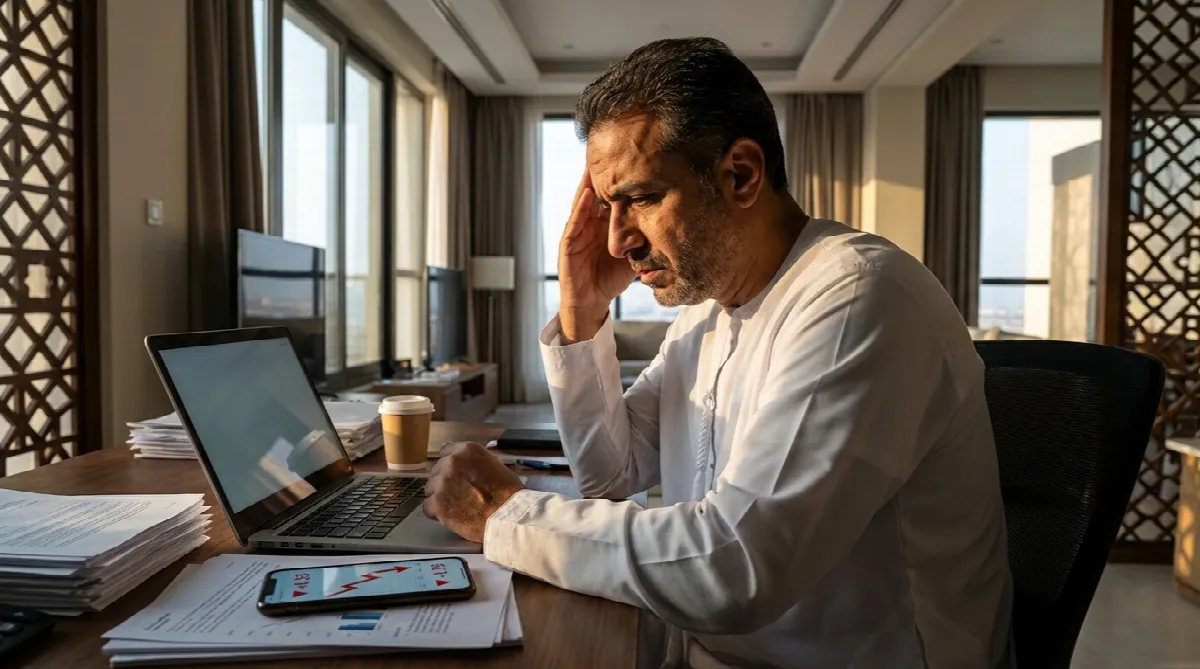
An Abu Dhabi court has ordered a man to repay Dh396,058 after he fraudulently obtained the money by convincing another person to invest in a fake trading platform operated through an unlicensed company.
The victim also received Dh50,000 in compensation for material and moral damages, bringing the total recovery to nearly Dh450,000.
This case highlights how UAE courts are increasingly holding fraudsters financially accountable—and provides a roadmap for victims seeking to recover their losses.
What Happened in This Case?
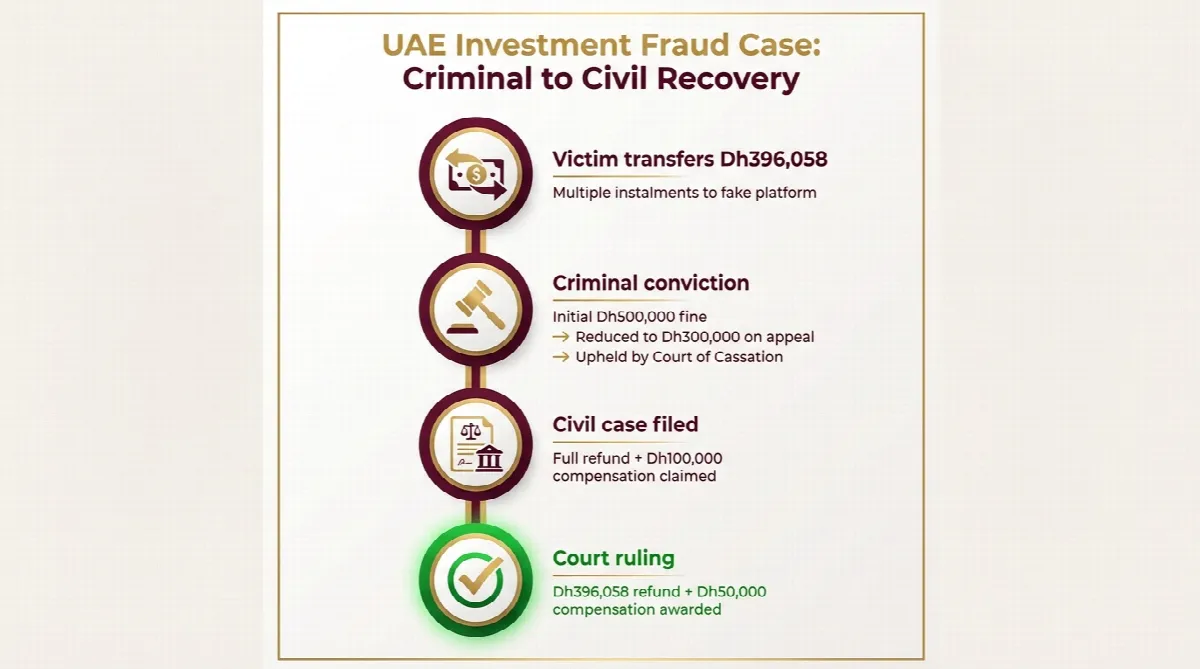
According to Emarat Al Youm, a young man filed a civil case with the Abu Dhabi Family, Civil and Administrative Cases Court after losing Dh396,058 to what he believed was a legitimate investment opportunity.
The defendant had approached him with promises of a safe and profitable trading platform. Convinced by assurances that the opportunity was genuine, the victim transferred funds in several instalments over time.
It later emerged that the company behind the scheme was not licensed to operate in the UAE. The victim had fallen prey to investment fraud—a growing problem across the Emirates.
How the Criminal Case Unfolded
Criminal proceedings were initiated against the defendant following the victim’s complaint. The case progressed through three levels of the UAE judicial system:
| Court Level | Outcome |
|---|---|
| Court of First Instance | Dh500,000 fine |
| Court of Appeal | Reduced to Dh300,000 fine |
| Court of Cassation | Upheld Dh300,000 fine |
The criminal conviction became the foundation for the civil case that followed. Under UAE law, a criminal court’s decision is binding in civil cases when the same actions form the basis of both proceedings.
The Civil Court’s Ruling
The victim filed a separate civil claim seeking:
- Return of the Dh396,058 he had transferred
- Dh100,000 in compensation for financial loss, emotional distress, and related harm
- Court fees and legal costs
The defendant submitted a written defence requesting dismissal of the civil claim and provided documents for the court’s review.
The court’s decision:
The Abu Dhabi Family, Civil and Administrative Cases Court ruled that the defendant must:
- Refund the full Dh396,058 taken from the victim
- Pay Dh50,000 in comprehensive compensation for material and moral damages
- Cover all court fees, expenses, and legal costs
Legal Basis for the Ruling
The court cited key provisions of the UAE Civil Transactions Law in reaching its decision:
On restitution: The law requires anyone who unlawfully takes another person’s property to return it in full. Given the criminal conviction establishing fraud, the defendant was obligated to refund the entire amount.
On compensation: The court found that the defendant’s actions caused both:
- Material damage – loss of capital and missed financial opportunity
- Moral harm – distress, regret, and emotional suffering
The Dh50,000 compensation award addressed both categories of harm.
Why This Case Matters for UAE Residents
This ruling demonstrates several important principles for anyone who has been victimised by investment fraud in the UAE:
Criminal convictions strengthen civil claims: When fraud is proven in criminal court, victims can pursue civil cases with the criminal finding serving as established fact.
Full restitution is possible: UAE courts can order fraudsters to return 100% of misappropriated funds, not just partial amounts.
Compensation covers more than money: Victims can receive awards for emotional suffering, stress, and the lost opportunity cost of their capital.
Fraudsters bear all costs: Courts can order defendants to pay court fees, legal expenses, and all associated costs.
Warning Signs of Fake Investment Schemes
The tactics used in this case mirror patterns seen across investment fraud operations targeting UAE residents:
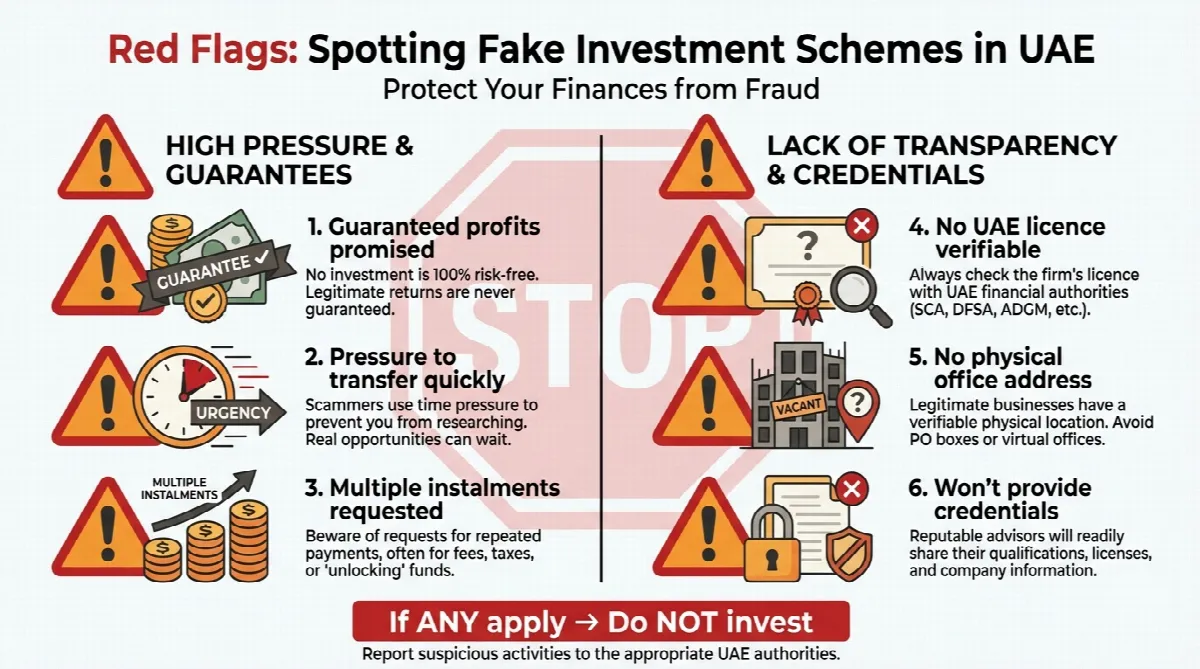
Red flags to watch for:
- Promises of guaranteed profits with minimal risk
- Pressure to transfer funds quickly before “opportunities close”
- Multiple instalments requested over time (building trust before large transfers)
- Companies without verifiable UAE licences
- No physical office address or legitimate corporate registration
- Reluctance to provide regulatory credentials when asked
How to Verify Investment Platforms in the UAE
Before transferring any money to trading platforms or investment schemes, verify legitimacy through official channels:
Securities and Commodities Authority (SCA): Check if the company holds a valid licence to offer investment services in the UAE at sca.gov.ae
Central Bank of the UAE: Verify financial institutions and licensed entities at centralbank.ae
Dubai Financial Services Authority (DFSA): For entities operating in DIFC at dfsa.ae
Abu Dhabi Global Market (ADGM): For entities in the Abu Dhabi financial free zone at adgm.com
If a company cannot provide verifiable licence information from one of these regulators, do not invest.
What to Do If You’ve Been Scammed
If you’ve transferred money to a fraudulent investment platform:
1. Document everything
- Save all communications (emails, WhatsApp messages, call logs)
- Keep bank statements showing transfers
- Screenshot any platform interfaces, accounts, or promises made
2. Report to police immediately
- File a complaint with local police
- Use the UAE’s official reporting channels including Dubai Police eCrime platform or Abu Dhabi Police Aman app
3. Notify your bank
- Alert your bank to the fraudulent transfers
- Request transaction records for legal proceedings
4. Pursue criminal charges first
- A criminal conviction significantly strengthens any subsequent civil case
- The criminal finding becomes binding evidence in civil court
5. File a civil claim for recovery
- Seek full restitution of transferred funds
- Claim compensation for material and moral damages
- Include court fees and legal costs in your claim
Key Takeaway
This Abu Dhabi court case demonstrates that UAE fraud victims can recover their full losses through the legal system. The victim received back all Dh396,058 stolen through the fake investment scheme plus Dh50,000 in compensation for material and moral damages. Criminal convictions for fraud establish binding facts in civil court, making full restitution achievable. Before investing, always verify that trading platforms hold valid licences from UAE regulators such as the SCA, Central Bank, DFSA, or ADGM. If you’ve been defrauded, document everything, report to police, and pursue both criminal and civil proceedings to maximise your chances of recovery.
FAQs
Can I recover money lost to investment fraud in the UAE?
Yes. UAE courts can order fraudsters to return 100% of misappropriated funds. In this case, the victim recovered all Dh396,058 transferred to a fake trading platform, plus Dh50,000 in additional compensation. Filing both criminal charges and a civil claim maximises recovery chances.
How does a criminal conviction help a civil fraud case in the UAE?
Under UAE law, a criminal court’s decision is binding in civil cases when the same actions form the basis of both proceedings. This means once fraud is proven criminally, the victim doesn’t need to re-establish the defendant’s wrongdoing in civil court—the criminal finding serves as established fact for restitution claims.
What compensation can fraud victims receive in UAE courts?
UAE courts can award compensation for both material damage (loss of capital, missed financial opportunity) and moral harm (emotional distress, regret, suffering). In this case, the court awarded Dh50,000 in comprehensive compensation covering both categories, in addition to full restitution of the stolen funds.
How do I verify if an investment platform is legitimate in the UAE?
Check with UAE financial regulators: the Securities and Commodities Authority (sca.gov.ae), Central Bank of the UAE (centralbank.ae), Dubai Financial Services Authority (dfsa.ae), or Abu Dhabi Global Market (adgm.com). Legitimate platforms will have verifiable licence numbers from one of these bodies. If a company cannot provide regulatory credentials, do not invest.
What are warning signs of fake investment schemes?
Red flags include: promises of guaranteed profits with minimal risk, pressure to transfer funds quickly, requests for multiple instalments over time, companies without verifiable UAE licences, no physical office address, and reluctance to provide regulatory credentials. If any of these apply, walk away and report to authorities.
Further Reading
The UAE week, every Monday
The week's stories on jobs, visas, money and daily life in one short email. Unsubscribe in one click.