Emirates Power Bank Ban: No Charging Allowed From October 1, 2025
Emirates bans power bank usage on all flights from Oct 1, 2025. Passengers can carry under 100Wh but cannot charge devices. Safety rules explained.
By Vadim Kouznetsov, published
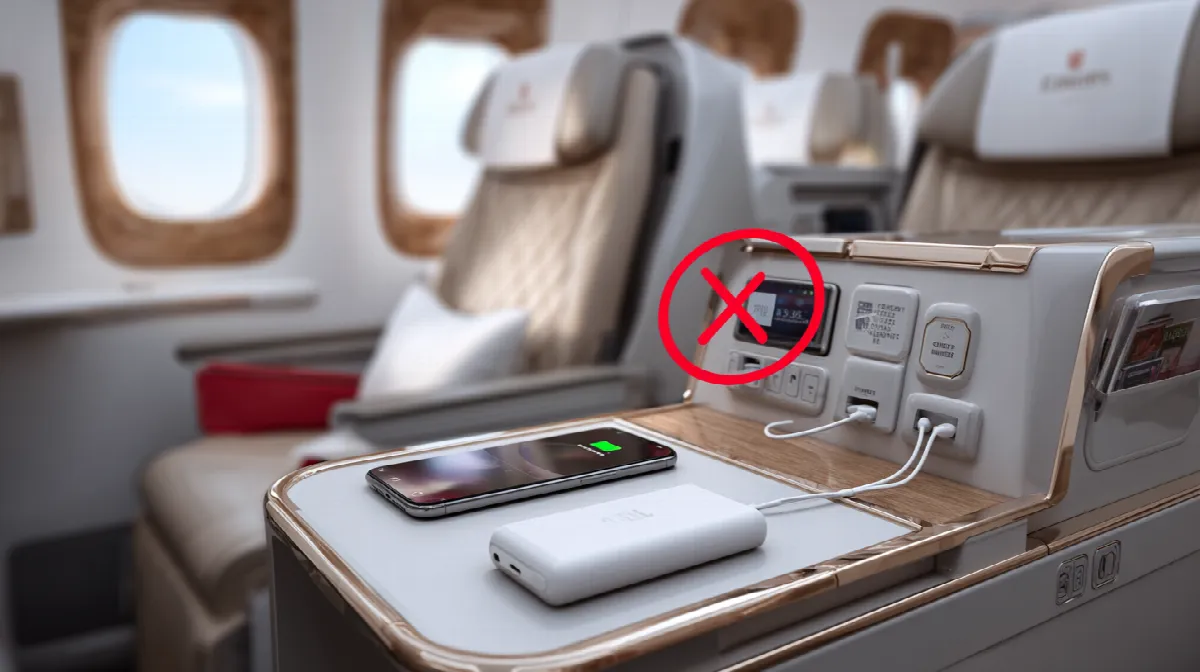
Emirates has implemented a complete ban on using power banks aboard all flights, effective from October 1, 2025. Whilst passengers may carry one power bank in their cabin baggage, using it to charge devices or recharging it onboard is now strictly prohibited across the airline’s entire fleet.
What the New Rules Mean
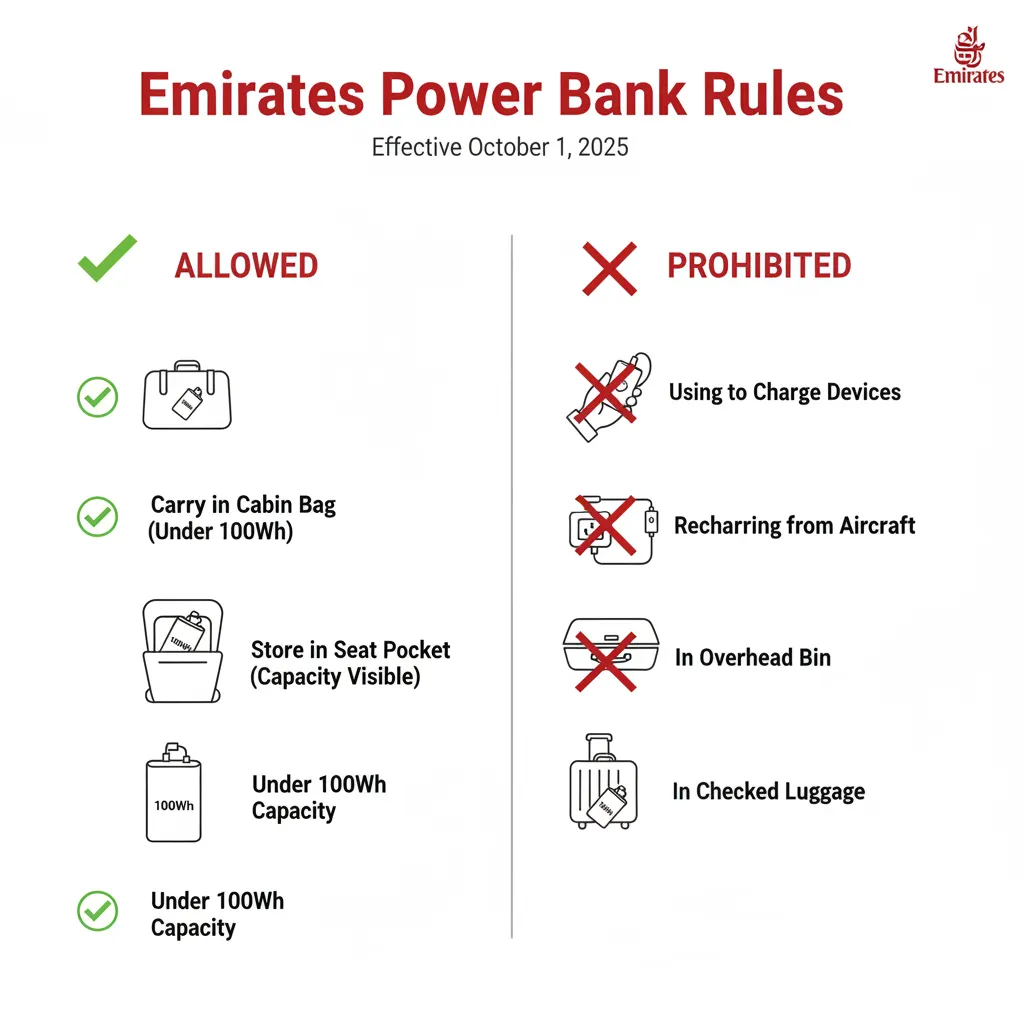
The Dubai-based carrier announced the safety-driven policy change on September 30, 2025, following a comprehensive safety review highlighting lithium battery risks in aviation. Here’s what passengers need to know:
Permitted Actions
- Carry one power bank under 100Wh in cabin baggage only
- Store power banks in seat pockets or under seats (not overhead bins)
- Display capacity rating information on all power banks
Prohibited Actions
- Using power banks to charge any devices onboard
- Recharging power banks using aircraft power supplies
- Storing power banks in checked baggage (already prohibited)
- Carrying power banks without visible capacity ratings
Emirates emphasised that passengers should fully charge all electronic devices before flying, particularly on long-haul journeys. The airline’s fleet offers in-seat charging ports across all aircraft, providing alternative charging options during flights.
Why Emirates Banned Power Bank Usage
The rising popularity of portable chargers has coincided with an increasing number of lithium battery incidents across the global aviation industry. Power banks typically contain lithium-ion or lithium-polymer batteries, which pose significant fire hazards when damaged, overcharged, or manufactured poorly.
Understanding Thermal Runaway
The primary concern involves a process called thermal runaway—a chain reaction where overheating causes lithium batteries to reach temperatures that trigger fires or explosions. Once initiated, thermal runaway becomes extremely difficult to control, creating severe safety risks at cruising altitude.
The ban allows cabin crew to respond quickly to potential emergencies by requiring power banks to remain in easily accessible locations rather than stored in overhead bins where they’re harder to monitor and retrieve.
What Is a 100Wh Power Bank?
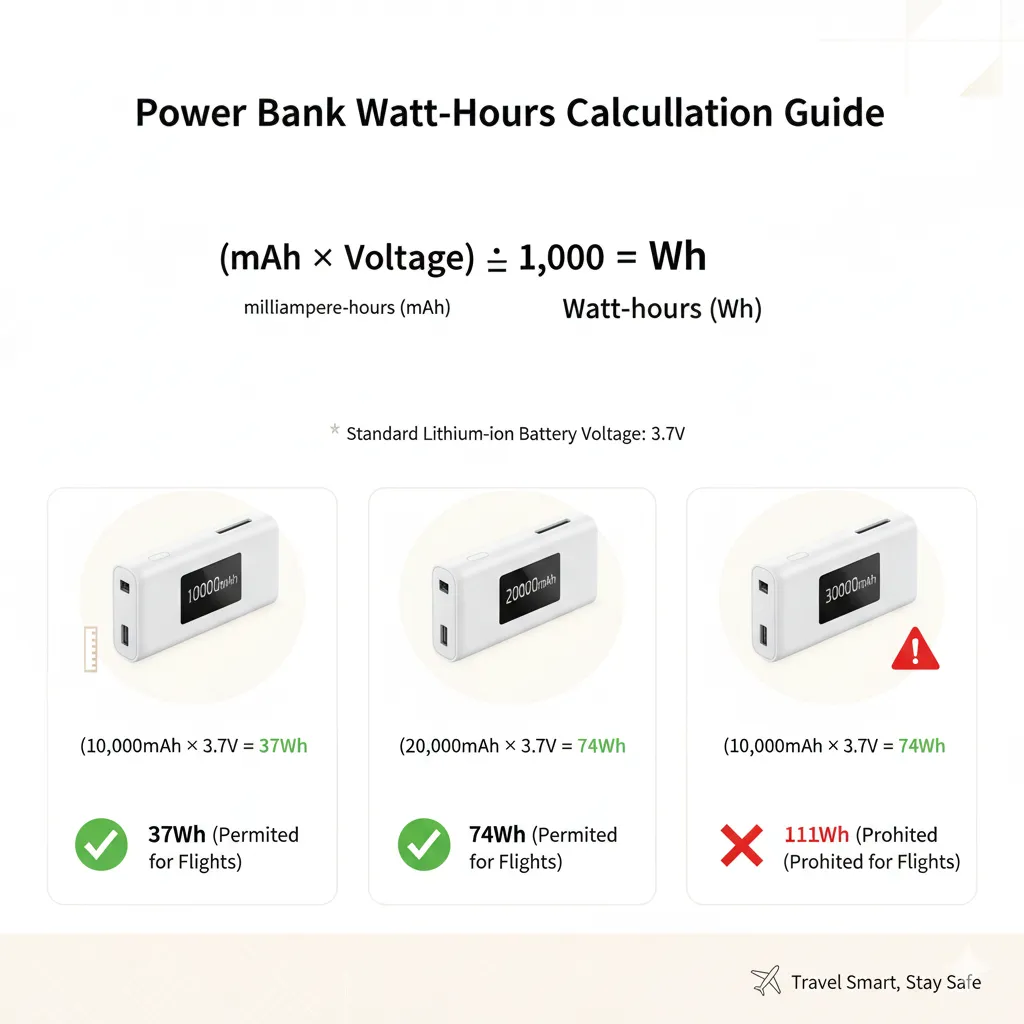
The 100 watt-hour (Wh) limit represents the maximum capacity Emirates permits for carried power banks. Understanding this measurement helps passengers determine compliance:
Converting mAh to Wh: Most power banks display capacity in milliampere-hours (mAh). To calculate watt-hours:
- (mAh × Voltage) ÷ 1,000 = Wh
- Standard power banks use 3.7V batteries
- Example: 27,000mAh × 3.7V ÷ 1,000 = 99.9Wh (permitted)
Common power bank capacities:
- 10,000mAh: Approximately 37Wh (permitted)
- 20,000mAh: Approximately 74Wh (permitted)
- 26,800mAh: Approximately 99Wh (permitted)
- 30,000mAh: Approximately 111Wh (exceeds limit)
Most consumer power banks fall within the 100Wh limit, though high-capacity models designed for laptops may exceed this threshold.
How This Affects Emirates Passengers
For the millions of travellers flying with Emirates annually, the policy represents a significant adjustment to in-flight behaviour. Previously, passengers routinely used portable chargers during flights, particularly on Emirates’ extensive long-haul network.
Impact on Different Traveller Types
Business travellers: Those accustomed to maintaining device connectivity throughout flights must now rely on in-seat power or ensure devices are fully charged pre-flight.
Leisure passengers: Families travelling with multiple devices will need careful battery management, especially on ultra-long routes like Dubai-Auckland or Dubai-Los Angeles.
Digital nomads: Professionals working during flights should plan device usage strategically across Emirates’ comprehensive route network.
In-Seat Charging Alternatives
Emirates has invested substantially in passenger amenities, with in-seat power available throughout its fleet. The airline operates over 250 aircraft serving more than 140 destinations, all equipped with charging capabilities.
Available Charging Options
USB ports: Available at most seats for smartphones and tablets Power outlets: Provided in many aircraft for laptops and larger devices Wireless charging: Selected aircraft feature contactless charging pads
However, Emirates acknowledges that in-seat charging may not always meet passenger needs, particularly during peak aircraft usage when multiple passengers share limited power outlets. Hence the recommendation to pre-charge devices.
Global Aviation Safety Standards
Emirates’ decision aligns with broader industry trends prioritising lithium battery safety. The International Civil Aviation Organization (ICAO) and International Air Transport Association (IATA) have progressively strengthened regulations governing portable electronic devices.
Industry-Wide Concerns
Aviation authorities worldwide have documented numerous lithium battery incidents, including:
- Smoke events in passenger cabins
- Cargo hold fires traced to electronic devices
- Emergency landings prompted by battery malfunctions
- Serious injuries from battery explosions
These incidents drive regulatory evolution, with airlines implementing increasingly stringent policies. Emirates’ proactive stance reflects commitment to passenger safety ahead of potential regulatory requirements.
Enforcement and Compliance
Emirates cabin crew will enforce the new rules throughout all flight phases. Passengers observed using power banks face potential consequences including:
- Immediate confiscation of the device
- Documentation in the passenger’s travel record
- Possible denial of future travel with Emirates
- Referral to aviation authorities for serious violations
The airline emphasized that compliance protects all passengers and crew members, positioning safety as non-negotiable.
Comparison with Other Airlines
Emirates’ comprehensive ban places it among the stricter carriers regarding power bank usage. Many airlines currently permit limited power bank use, though policies vary significantly:
Permissive policies: Some carriers allow power bank use throughout flights with capacity restrictions.
Moderate restrictions: Others permit use after reaching cruising altitude but prohibit charging during taxi, take-off, and landing.
Strict bans: A growing number, now including Emirates, prohibit all onboard use whilst permitting carriage only.
Industry observers anticipate other major carriers may follow Emirates’ lead, particularly given the airline’s reputation for operational excellence and safety standards.
Preparing for Your Emirates Flight
Passengers flying Emirates should take several preparatory steps to comply with the new regulations:
Before Your Flight
- Check power bank capacity: Verify your device displays capacity information and remains under 100Wh
- Charge all devices fully: Ensure smartphones, tablets, laptops, and other electronics reach 100% before airport departure
- Remove power banks from checked bags: Transfer any portable chargers to cabin baggage
- Pack charging cables: Bring appropriate cables for in-seat charging systems
- Download content offline: Pre-load entertainment, work documents, and other materials
At the Airport
- Complete device charging at airport charging stations
- Utilize power outlets in lounges (Emirates offers extensive lounge networks)
- Consider purchasing approved charging accessories if needed
Impact on Long-Haul Flights
Emirates operates some of the world’s longest non-stop flights, including Dubai to Auckland (approximately 16 hours) and Dubai to Los Angeles (around 16 hours). On these ultra-long routes, the power bank ban requires more careful planning.
Battery Management Strategies
Prioritize device usage: Determine which devices require power throughout the flight versus those needed only at destination.
Leverage in-seat entertainment: Use Emirates’ award-winning ICE system rather than personal device content to preserve battery.
Enable power-saving modes: Activate low-power settings on all devices to extend battery life.
Bring backup devices: Consider carrying multiple devices if continuous connectivity proves essential.
For professionals working in the UAE who frequently travel on Emirates, establishing effective battery management routines becomes particularly important.
Safety as Priority
Emirates consistently emphasizes safety as its top operational priority. The airline’s safety record speaks to this commitment, with decades of incident-free operations across challenging routes and conditions.
The power bank policy represents another layer in comprehensive safety protocols encompassing aircraft maintenance, crew training, operational procedures, and passenger guidelines. Emirates’ reputation for excellence extends beyond luxury amenities to fundamental safety practices.
What Happens If You Forget?
Passengers arriving at gates with power banks face several scenarios depending on specific circumstances:
Declared at check-in: Power banks properly packed in cabin baggage proceed without issue, provided they remain unused during flight.
Discovered at security: If security screening reveals prohibited items, passengers may need to discard non-compliant power banks or make alternative arrangements.
Noticed during boarding: Gate agents may request passengers demonstrate power bank capacity ratings before boarding.
Emirates recommends passengers familiarize themselves with all carry-on restrictions well before arriving at Dubai International Airport, particularly during peak travel periods.
Frequently Asked Questions
Can I charge my phone using Emirates’ in-seat power?
Yes, all Emirates aircraft feature in-seat charging options. Bring appropriate cables to connect devices to USB ports or power outlets at your seat.
What if my power bank doesn’t display capacity information?
Power banks without visible capacity ratings are prohibited. Only devices clearly showing watt-hour or milliampere-hour ratings are permitted.
Are laptop batteries affected by this rule?
No, internal batteries in laptops, tablets, and smartphones remain unaffected. The ban applies only to external/portable battery packs.
What happens if my power bank is 101Wh?
Power banks exceeding 100Wh are prohibited entirely—you cannot carry them in cabin or checked baggage on Emirates flights.
Can I use my power bank in Dubai Airport before boarding?
Yes, power bank use is permitted throughout Dubai International Airport. The restriction applies only once boarding begins.
Will Emirates provide power banks for passenger use?
No, Emirates will not supply power banks. The airline provides in-seat charging as the official onboard solution.
Do Emirates’ premium cabins have different rules?
No, the power bank usage ban applies uniformly across Economy, Business, and First Class cabins.
Key Takeaway
Emirates has banned all power bank usage on flights from October 1, 2025, following a safety review of lithium battery risks. Passengers may carry one power bank under 100Wh in cabin baggage but cannot use it to charge devices or recharge it onboard. All Emirates aircraft feature in-seat charging, though passengers should fully charge devices before flying, especially on long-haul routes. The policy prioritises passenger and crew safety by enabling quick response to battery emergencies.
Further Reading
- Emirates Careers 2025: Complete Application Guide
- Emirates Named ‘World’s Best Airline’ in 2024 Telegraph Travel Study
- Dubai Airport: Why It’s the World’s Most Famous Aviation Hub
- Is Dubai Safe to Visit Now? 2024 Travel Advisory & Safety Guide
- Work in the UAE: Complete Guide to Finding Jobs in 2025
- Dubai Airport Alert: DXB Expects 5.2M Passengers During Holiday Rush
The UAE week, every Monday
The week's stories on jobs, visas, money and daily life in one short email. Unsubscribe in one click.