Emirates October Power Bank Ban: New Travel Rules Explained
Emirates bans power bank use from October 1, 2025. Learn new travel rules, safety reasons, and alternatives for charging devices during flights.
By Vadim Kouznetsov, published
Emirates has implemented strict new power bank regulations starting October 1, 2025, prohibiting all in-flight use of rechargeable battery packs while allowing passengers to carry one power bank in cabin baggage only. This significant policy change affects all Emirates flights and requires immediate passenger awareness to avoid travel disruptions.
New Power Bank Rules Take Effect October 1, 2025
The Dubai-based airline’s updated travel policy represents a major shift in how passengers can manage device charging during flights, prioritising safety over convenience.
Key Changes Effective October 1:
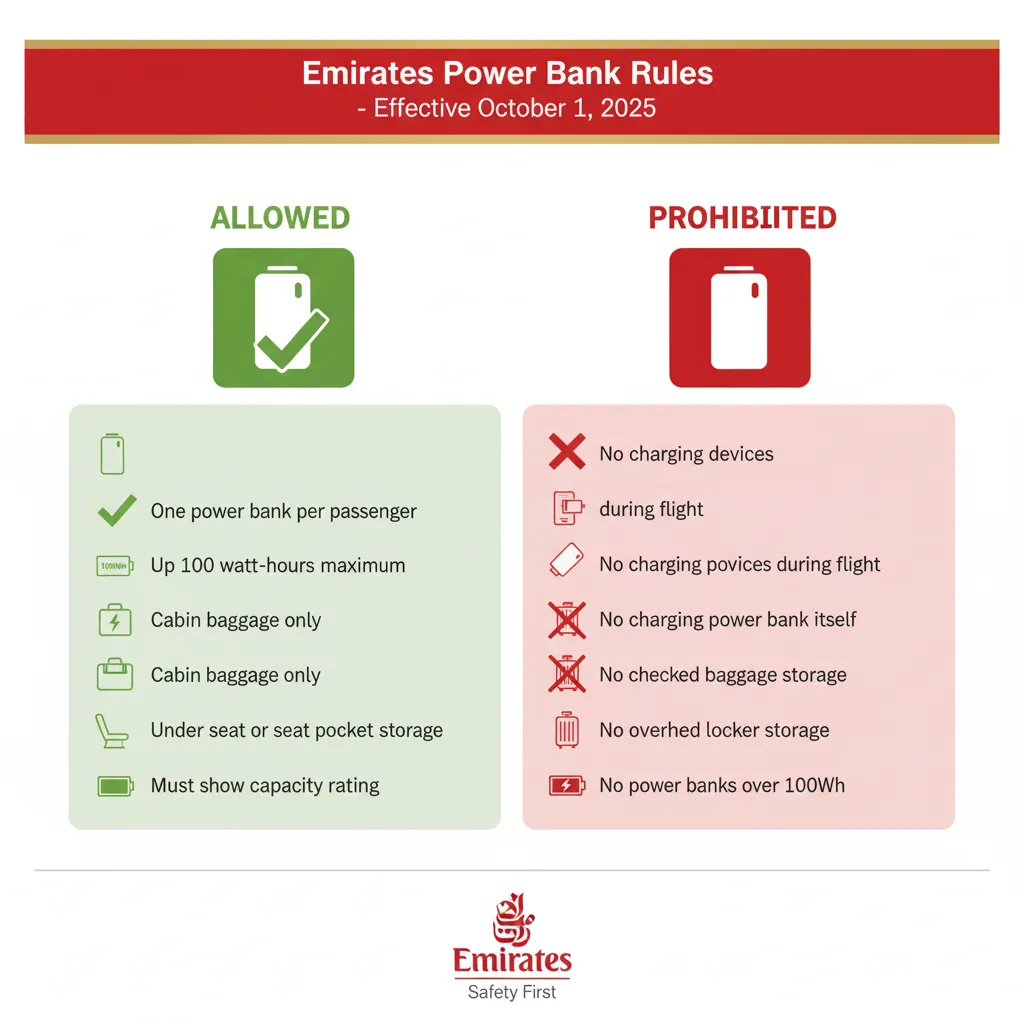
- Complete ban on using power banks during flights
- No charging devices with power banks while airborne
- One power bank per passenger maximum (up to 100 watt-hours)
- Power banks must remain in cabin baggage only
- Storage restricted to under seat or seat pocket areas
- Overhead locker storage prohibited for power banks
These regulations apply to all Emirates flights departing from Dubai International Airport and other Emirates destinations worldwide.
What Passengers Can and Cannot Do
Understanding the specific restrictions helps ensure compliance with Emirates’ new safety protocols:
Permitted Actions:
- Carry one power bank per passenger (maximum 100Wh capacity)
- Transport power banks in cabin baggage or personal items
- Keep power banks under the seat or in seat pockets
- Ensure power banks display clear capacity ratings
Prohibited Actions:
- Using power banks to charge any device during flight
- Charging the power bank itself while airborne
- Storing power banks in checked luggage (existing rule)
- Placing power banks in overhead lockers
- Carrying power banks exceeding 100 watt-hours capacity
Safety Reasons Behind Emirates’ Policy Change
Emirates implemented these restrictions following comprehensive safety reviews highlighting significant risks associated with lithium-ion battery technology in aviation environments.
Primary Safety Concerns:
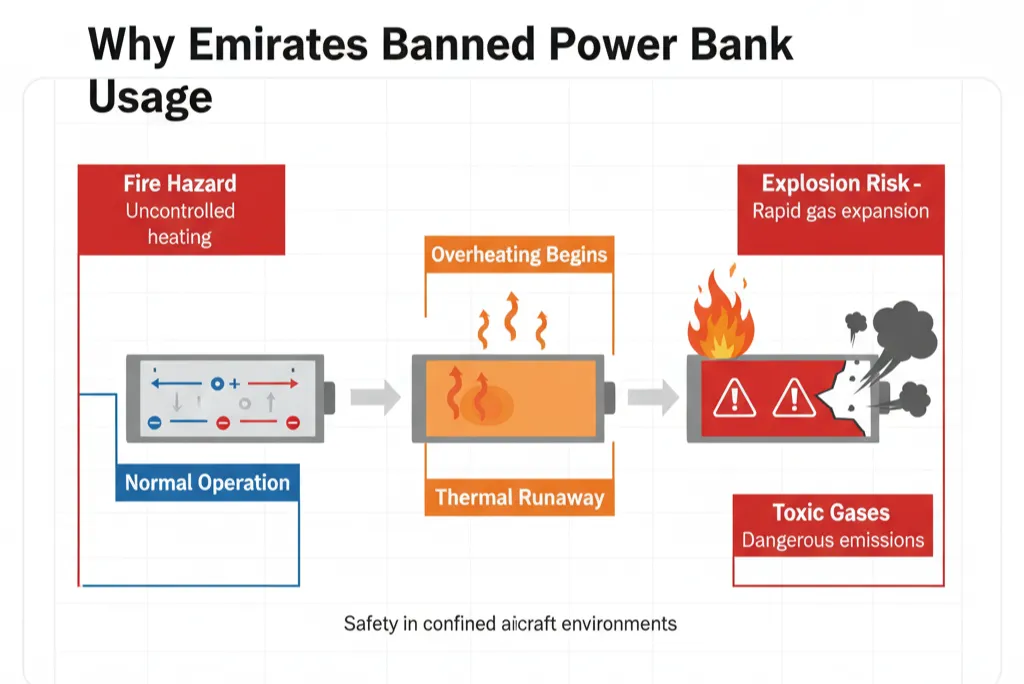
Thermal Runaway Risk: Power banks operate by moving ions between electrodes during charging and discharge cycles. When batteries become overcharged or damaged, they can trigger “thermal runaway”—a condition where batteries generate heat faster than they can dissipate it, causing rapid, uncontrollable temperature increases.
Fire and Explosion Hazards: Thermal runaway can lead to fires, explosions, and toxic gas release, creating serious safety risks in confined aircraft environments where immediate evacuation may not be possible.
Toxic Gas Emission: Damaged or overheating lithium-ion batteries can release dangerous gases, posing respiratory and health risks to passengers and crew in pressurised cabin environments.
Emirates states that these measures are “designed to minimise onboard risks” and align with evolving international aviation safety standards.
How This Affects Business Travellers and Frequent Flyers
The power bank restrictions particularly impact professionals who rely heavily on portable charging during long-haul flights:
Business Travel Implications:
- Extended flights without device charging capabilities
- Need for alternative charging strategies during travel
- Potential productivity limitations on long-haul routes
- Increased reliance on aircraft power systems
Recommended Alternatives:
- Utilise Emirates’ seat-back power outlets and USB ports
- Charge devices fully before boarding
- Take advantage of airport charging stations during layovers
- Consider investing in devices with longer battery life
Etihad Airways Clarifies Electronic Device Rules
While Emirates updates power bank policies, UAE’s other major carrier has provided clarity on broader electronic device regulations.
Etihad’s Electronic Device Policy:
- Up to 15 electronic devices allowed per passenger
- Devices permitted in both cabin and checked baggage
- Bluetooth speakers (including JBL models) allowed in checked luggage
- All devices in checked baggage must be fully powered off
- Spare batteries and power banks prohibited in checked luggage
Etihad emphasises that devices in checked baggage must be “fully powered off (not in sleep mode) and secured against damage,” providing clearer guidance for passengers carrying multiple electronic items.
Emirates’ Broader Electronic Device Regulations
The power bank ban accompanies Emirates’ existing electronic device restrictions that passengers should understand:
15-Device Limit:
- Maximum 15 personal electronic devices per passenger
- Devices must be packed separately, not attached to other items
- Improperly packed or excess devices may be confiscated at check-in
- Rule applies to both cabin and checked baggage
Prohibited Motorised Devices:
- Smart bags with built-in lithium batteries
- Hoverboards and personal mobility devices
- Mini Segways and electric scooters
- Any device with large lithium battery systems
These items cannot be transported as either checked or cabin baggage, regardless of other airlines’ policies.
International Variations in Power Bank Policies
Emirates joins a growing number of airlines implementing stricter power bank regulations, though policies vary significantly across carriers:
Airlines with Similar Restrictions:
- Singapore Airlines: Complete usage ban during flights
- Scoot: No power bank usage while airborne
- Various European carriers: Limited usage policies
Airlines with Different Policies:
- Many US carriers: Usage permitted with restrictions
- Some Asian airlines: Capacity-based limitations only
- Regional carriers: Varying enforcement levels
Passengers should verify airline-specific policies before travel, as regulations continue evolving across the industry.
Practical Tips for Emirates Passengers
Adapting to the new power bank rules requires strategic planning for device management during flights:
Pre-Flight Preparation:
- Charge all devices to maximum capacity before departure
- Download offline content for entertainment during flights
- Identify aircraft charging options for your specific aircraft type
- Pack essential cables for aircraft power outlets
During Flight:
- Use Emirates’ seat power outlets efficiently
- Prioritise device usage based on importance
- Take advantage of USB ports at your seat
- Manage screen brightness to conserve battery life
Airport Strategies:
- Utilise charging stations during layovers
- Arrive early to allow time for device charging
- Identify charging areas in departure gates
- Consider portable charging cases for smaller devices
Impact on Different Types of Travellers
The power bank restrictions affect various passenger categories differently:
Leisure Travellers:
- May rely more heavily on entertainment devices
- Often carry cameras requiring frequent charging
- Generally more flexible with device usage timing
Business Professionals:
- Require consistent device availability for work
- Often carry multiple devices needing charging
- May need to adjust work patterns during flights
Families with Children:
- Increased challenges managing multiple devices
- Entertainment needs for extended flight durations
- Potential need for additional planning strategies
Emirates’ Dangerous Goods Policy Context
The power bank restrictions form part of Emirates’ comprehensive Dangerous Goods Policy, which addresses various safety concerns in aviation:
Policy Scope:
- Lithium battery regulations across all device categories
- Chemical and hazardous material restrictions
- Pressurised container limitations
- Electronic cigarette and vaping device rules
Passengers can access full details through Emirates’ official Dangerous Goods Policy page for complete guidance on restricted items.
Future Implications for Air Travel
Emirates’ power bank ban may signal broader industry trends toward stricter electronic device regulations:
Potential Industry Changes:
- Other airlines may adopt similar policies
- Enhanced safety protocols for lithium batteries
- Improved aircraft charging infrastructure to compensate
- Development of alternative portable power solutions
Passenger Adaptation:
- Increased reliance on aircraft power systems
- Changes in device purchasing decisions
- Modified travel preparation routines
- Greater awareness of battery safety issues
Compliance and Enforcement
Emirates will enforce power bank regulations through multiple checkpoints:
Check-in Screening:
- Staff trained to identify and restrict prohibited items
- Baggage screening for compliance verification
- Passenger education about new restrictions
Cabin Crew Monitoring:
- Active enforcement during flight service
- Immediate intervention if power bank usage detected
- Clear communication of policy requirements to passengers
Key Takeaway
Emirates’ October 1, 2025 power bank ban prohibits all in-flight use of rechargeable battery packs while allowing one power bank per passenger (up to 100Wh) in cabin baggage only. This safety-focused policy change requires passengers to rely on aircraft charging systems and strategic device management, reflecting growing aviation industry concerns about lithium-ion battery risks and thermal runaway incidents.
Frequently Asked Questions
Q: Can I still bring a power bank on Emirates flights after October 1, 2025? A: Yes, you can carry one power bank up to 100 watt-hours in cabin baggage, but you cannot use it to charge devices or charge the power bank itself during the flight.
Q: Where can I store my power bank during an Emirates flight? A: Power banks must be stored under your seat or in the seat pocket. Overhead locker storage is prohibited, and power banks are never allowed in checked luggage.
Q: What happens if my power bank exceeds 100 watt-hours? A: Power banks exceeding 100Wh are not permitted on Emirates flights. Check your power bank’s capacity rating before travelling, as items may be confiscated if they exceed limits.
Q: Are there charging alternatives on Emirates flights? A: Yes, Emirates aircraft feature seat-back power outlets and USB ports. Passengers should rely on these aircraft systems and charge devices fully before boarding.
Q: Does this rule apply to all Emirates flights or just certain routes? A: The power bank usage ban applies to all Emirates flights worldwide from October 1, 2025, regardless of departure or destination airport.
Further Reading:
The UAE week, every Monday
The week's stories on jobs, visas, money and daily life in one short email. Unsubscribe in one click.