UAE Employer Compensation Claims 2025: Evidence Requirements & Rights
Can UAE employers claim compensation without evidence? Learn about worker liability, evidence requirements, and legal protections under UAE Labour Law.
By Vadim Kouznetsov, published

Key Takeaway
UAE employers cannot claim compensation from workers without proper evidence. Under Federal Decree-Law No. 35 of 2022, claimants must prove their allegations with documentation showing error, damage, and causal connection between worker actions and company losses.
Thousands of workers across the UAE face allegations from employers seeking compensation for alleged breaches of contract, trade secret violations, or business losses. Understanding your rights and the legal requirements for such claims can protect you from unfounded demands and wrongful termination consequences.
Recent legal developments have strengthened worker protections, requiring employers to meet strict evidence standards before courts will consider compensation claims. This shift represents a significant improvement in employment law fairness across Dubai, Abu Dhabi, and the Northern Emirates.
Understanding UAE Labour Law Article 44(5)
The UAE Labour Law grants employers specific termination rights under Article 44(5), allowing dismissal when workers disclose trade secrets related to industrial or intellectual property. However, this provision requires substantial proof of actual wrongdoing and demonstrable harm.
Employers must establish that the worker’s actions resulted in genuine losses, missed business opportunities, or personal gain obtained through confidential information misuse. Mere suspicion or circumstantial evidence cannot support compensation claims or justify immediate termination.
The law protects workers from arbitrary dismissal by requiring employers to demonstrate clear violations rather than relying on assumptions or incomplete investigations. This protection applies equally to all employment categories, from entry-level positions to senior management roles.
Evidence Requirements Under UAE Law
Federal Decree-Law No. 35 of 2022 governs evidence standards in civil and commercial disputes, including employment-related compensation claims. The law places the burden of proof squarely on the claiming party—in this case, the employer.
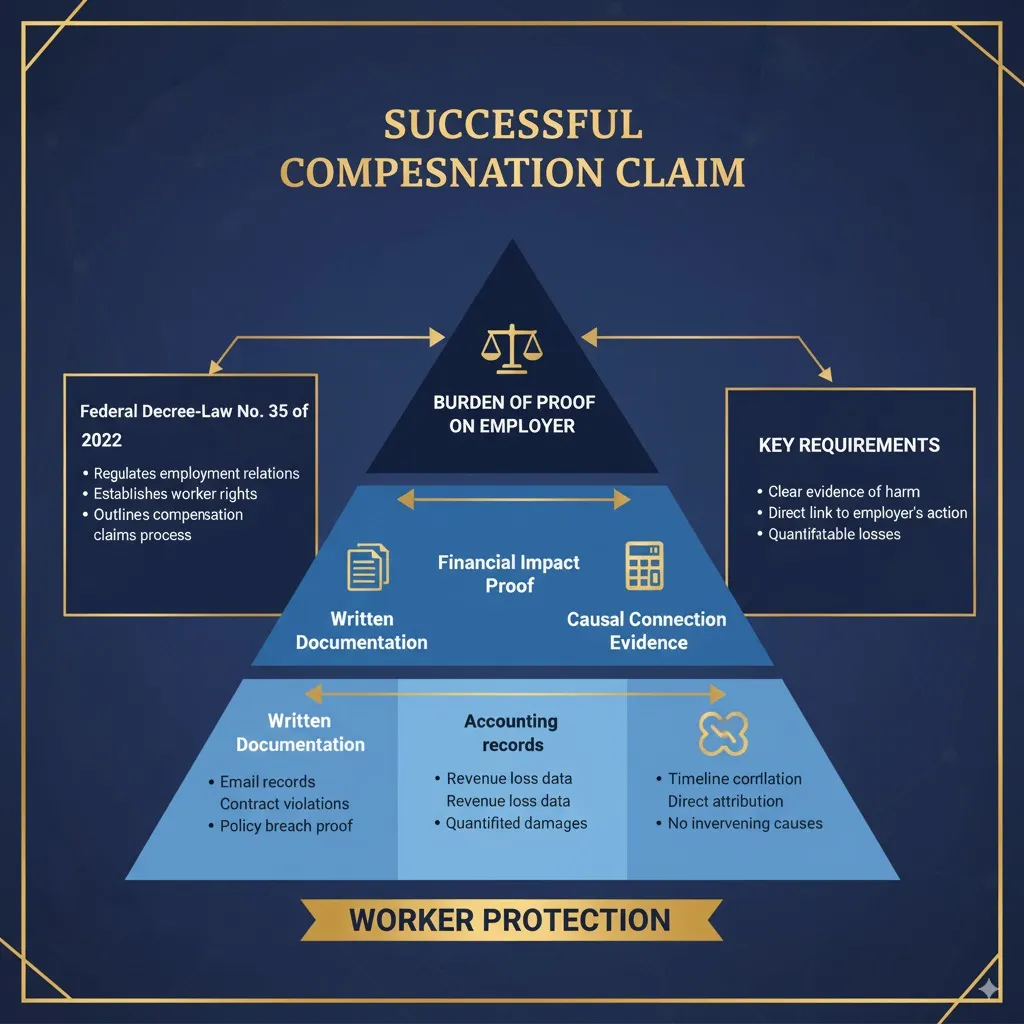
Documentation Standards: Employers must provide written evidence of confidentiality breaches, such as recorded communications, documented information transfers, or verified customer contact records. Screenshots, witness statements, and business correspondence serve as primary evidence sources.
Damage Quantification: Companies claiming financial losses must demonstrate specific monetary harm through accounting records, lost contract documentation, or measurable revenue reductions directly attributed to the worker’s alleged actions.
Causal Connection: Perhaps most critically, employers must establish a clear link between the worker’s behaviour and claimed damages. Correlation without causation proves insufficient for successful compensation claims.
The Three-Condition Test for Contractual Liability
UAE courts apply a rigorous three-part assessment before holding workers liable for company losses. All conditions must be satisfied simultaneously for liability to exist.
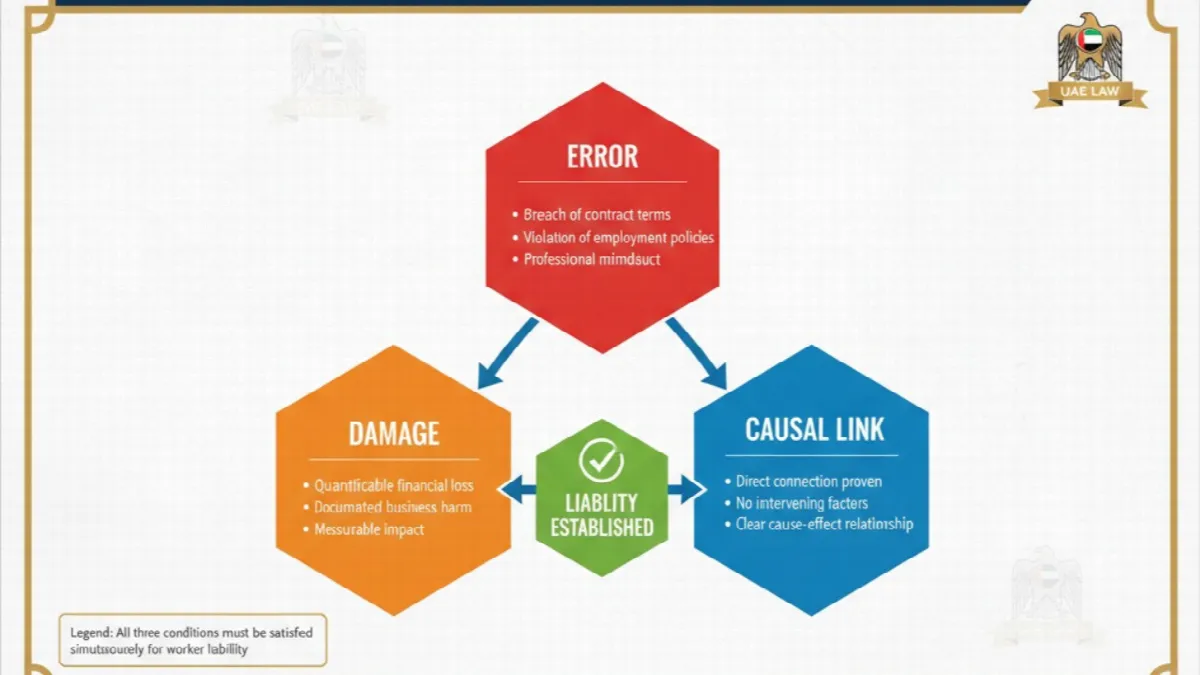
Error Requirement: The worker must have committed a clear breach of contractual obligations, employment terms, or reasonable professional standards. Simple mistakes or performance issues typically don’t qualify as compensable errors.
Actual Damage: Companies must suffer genuine, quantifiable harm rather than speculative or potential losses. Future revenue projections or theoretical competitive disadvantages don’t meet this standard.
Causal Link: Courts require direct connection between the worker’s actions and claimed damages. Multiple contributing factors or market conditions that influence company performance can break this essential chain of causation.
Common Employer Compensation Claims
Several scenarios frequently arise in UAE employment disputes where employers seek worker compensation:
Trade Secret Disclosure: Claims involving confidential customer lists, pricing strategies, or proprietary processes require detailed proof of information sharing and resulting business harm.
Customer Solicitation: Allegations of workers contacting company clients for personal benefit demand evidence of actual communication and demonstrated revenue impact.
Competitive Intelligence: Cases involving workers sharing strategic information with competitors need documentation of information transfer and measurable business consequences.
Contract Violations: Breach of non-compete or confidentiality agreements requires proof of specific violations and quantified damages resulting from those breaches.
Worker Protection Strategies
Employees facing compensation claims should take immediate protective action to safeguard their rights and financial interests.
Document Preservation: Maintain comprehensive records of all work communications, project contributions, and performance evaluations. These materials often prove crucial in disputing unfounded allegations.
Communication Monitoring: Be cautious about electronic communications, social media interactions, and client relationships. Modern employment disputes frequently centre on digital evidence interpretation.
Legal Consultation: Seek professional legal advice immediately upon receiving compensation demands or termination notices alleging contractual breaches. Early intervention can prevent escalation and protect your interests.
Evidence Gathering: Collect supportive documentation demonstrating your professional conduct, adherence to company policies, and positive contributions to business operations.
Defending Against Unfounded Claims
Workers can successfully challenge employer compensation demands by focusing on evidence gaps and procedural requirements.
Challenge Evidence Quality: Question the authenticity, completeness, and relevance of employer documentation. Digital evidence particularly requires careful examination for manipulation or context distortion.
Dispute Damage Calculations: Examine company financial records, market conditions, and alternative explanations for claimed losses. Many businesses experience revenue fluctuations due to factors unrelated to employee conduct.
Question Causation: Highlight multiple variables affecting business performance, including market competition, economic conditions, management decisions, and operational changes that could explain claimed damages.
Court Proceedings and Outcomes
UAE labour courts take evidence requirements seriously, frequently dismissing compensation claims lacking proper substantiation. Recent case precedents favour workers when employers cannot meet evidentiary standards.
Successful defence strategies focus on procedural compliance, evidence quality, and burden of proof requirements. Courts increasingly scrutinise employer claims, particularly those involving circumstantial evidence or speculative damages.
Workers who successfully defend against unfounded compensation claims may be entitled to wrongful termination compensation, end-of-service benefits, and legal cost recovery depending on case circumstances.
Frequently Asked Questions
Can my employer claim compensation without providing evidence?
No, UAE law requires employers to provide substantial evidence proving wrongdoing, damages, and causal connection. Courts will dismiss claims lacking proper documentation and proof of actual losses.
What constitutes sufficient evidence for employer compensation claims?
Employers must provide written documentation of policy violations, quantified financial damages, witness statements, and clear proof connecting the worker’s actions to claimed losses. Circumstantial evidence alone is insufficient.
How can I protect myself from unfounded compensation demands?
Maintain detailed records of your work communications and performance, follow company policies strictly, document your contributions, and seek legal advice immediately if facing allegations or termination.
What happens if the court finds the compensation claim invalid?
If courts dismiss employer compensation claims due to insufficient evidence, workers may be entitled to wrongful termination compensation, unpaid benefits, and potentially legal cost recovery.
Can employers terminate workers during compensation claim proceedings?
Employers can terminate workers for legitimate policy violations, but termination doesn’t validate compensation claims. Both termination justification and compensation demands require separate evidence and legal assessment.
How long do employers have to file compensation claims?
UAE law sets specific limitation periods for civil claims. Employers typically must file compensation demands within prescribed timeframes, though specific periods depend on claim type and circumstances.
What should I do if my employer demands immediate payment?
Never agree to immediate payment without legal consultation. Request detailed documentation of claims, seek professional legal advice, and understand your rights before making any financial commitments.
Further Reading
The UAE week, every Monday
The week's stories on jobs, visas, money and daily life in one short email. Unsubscribe in one click.