Dubai Issues New Contracting Law 2025: Major Changes for Construction
Sheikh Mohammed issues Law No. 7 of 2025 regulating Dubai contractors. Electronic registry, new penalties up to Dh200,000, and certification requirements reshape construction industry.
By Vadim Kouznetsov, published

Bottom Line: Sheikh Mohammed bin Rashid Al Maktoum’s new Law No. 7 of 2025 transforms Dubai’s contracting sector with unified standards, electronic registration system, and penalties up to Dh200,000 for violations, directly impacting thousands of construction professionals and contractors across all development zones.
Dubai’s construction landscape is experiencing a significant regulatory shift. His Highness Sheikh Mohammed bin Rashid Al Maktoum, Vice President and Prime Minister of the UAE and Ruler of Dubai, has issued Law No. 7 of 2025 to regulate contracting activities throughout the emirate. This legislation promises to reshape how contractors operate in one of the world’s most dynamic construction markets.
What the New Dubai Contracting Law Changes
The comprehensive legislation establishes clear frameworks for contractor classification based on expertise, qualifications, and operational capabilities. Unlike previous regulations, this law creates a unified approach across all Dubai zones, including special development areas and free zones such as the Dubai International Financial Centre (DIFC).
Key Requirements for Contractors
All contractors operating in Dubai must comply with relevant legislation and work strictly within their approved classification limits. The law prohibits exceeding technical or financial capacity and bans subcontracting without prior approval. These restrictions aim to prevent project failures and protect stakeholders from financial losses.
Construction professionals working in Dubai will need to adapt quickly to these changes. The law directly affects project managers, civil engineers, architects, and technical staff who must now obtain professional competency certificates. This certification requirement raises professional standards across the industry.

Electronic Registration System Transforms Operations
Dubai Municipality will establish and manage an integrated electronic registry for all contracting activities. This digital platform connects with the ‘Invest in Dubai’ system, creating a central hub for contractor information. The electronic system promises to streamline processes that previously required multiple government visits and paper submissions.
The municipality also develops industry codes of conduct and categorises contractors by specialisation fields including construction, building, and demolition work. This systematic approach helps clients identify qualified contractors more efficiently whilst reducing administrative burden.
New Committee Oversees Industry Standards
The Contracting Activities Regulation and Development Committee represents a major institutional change. Chaired by Dubai Municipality, this committee includes representatives from relevant government entities and holds significant authority over contracting approvals.
The committee assigns supervising authorities, oversees law implementation, and resolves jurisdictional conflicts between regulatory bodies. It also adopts sector-wide ethical codes and works closely with public and private stakeholders to improve industry practices.
Substantial Penalties for Non-Compliance
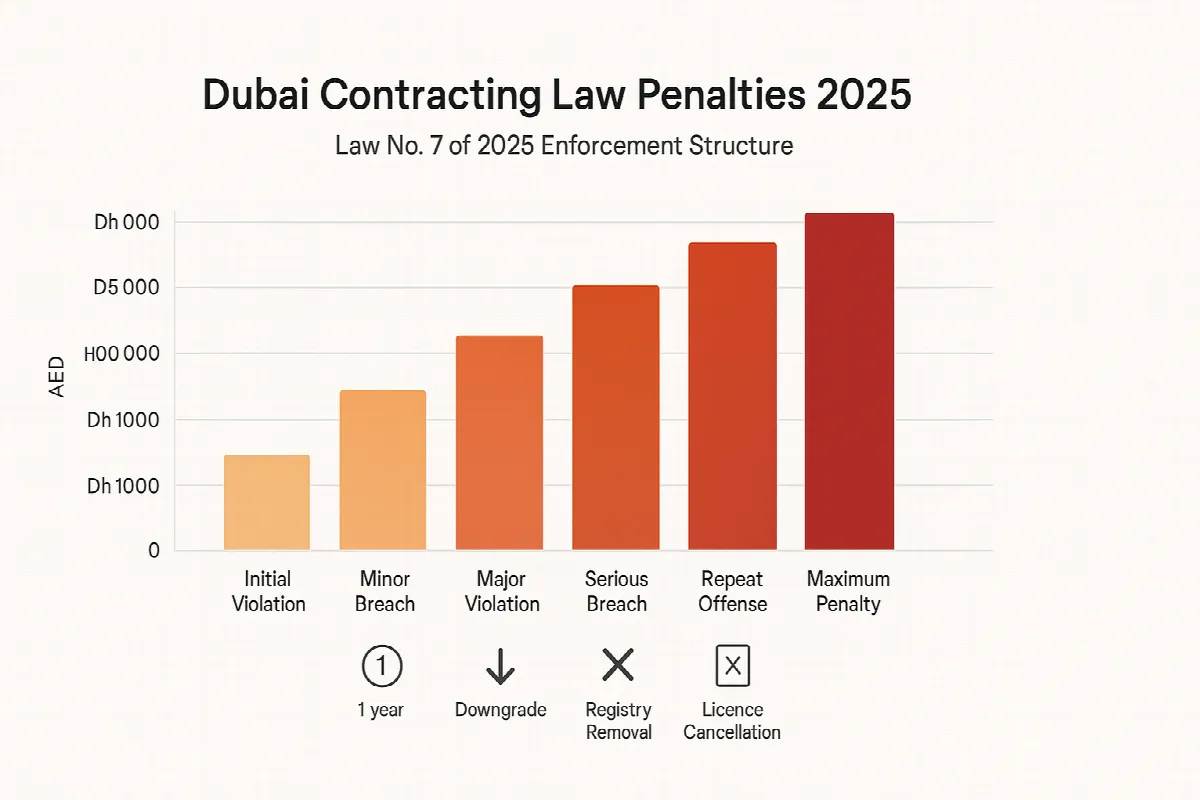
Violations carry hefty financial consequences ranging from Dh1,000 to Dh100,000 for initial infractions. Repeated violations within twelve months can double penalties up to Dh200,000, demonstrating the government’s commitment to enforcement.
Beyond monetary fines, violators face:
- Temporary suspension from contracting activities for up to one year
- Classification downgrades
- Removal from the official contractor registry
- Commercial licence cancellation
- Technical staff suspension and certificate revocation
These severe penalties emphasise the importance of compliance for anyone working in Dubai’s construction sector.
Impact on Employment and Career Opportunities
This regulatory change creates significant opportunities for compliance professionals, legal advisors, and quality assurance specialists. Construction companies will need experts who understand the new requirements and can navigate the electronic registration system.
Technical personnel must obtain professional competency certificates, creating demand for training providers and certification bodies. The emphasis on professional standards aligns with Dubai’s focus on high-demand future careers, particularly in construction technology and sustainability.
Legal professionals specialising in construction law will see increased demand as companies seek guidance on compliance strategies. The new committee structure also creates government positions for regulatory specialists and oversight professionals.
Timeline and Transition Requirements
All existing contractors have one year to regularise their status under the new law. The Committee may extend this period for another year if necessary. Companies with expiring registrations during this transition can renew after signing compliance declarations.
This transition period allows businesses to adapt their operations and train staff on new requirements. However, the relatively short timeframe means contractors must act quickly to avoid disruptions.
Industry Response and Implementation
The updated system builds upon Dubai Municipality’s recent announcement of major changes to its ‘Contractors and Engineering Offices Evaluation System’, scheduled for early 2026. These parallel developments indicate a comprehensive transformation of Dubai’s construction regulatory environment.
Two engineering consultancy firms have already faced six-month suspensions for violating regulations and ethics, demonstrating that enforcement has begun even before full implementation. This action signals that authorities are serious about maintaining professional standards.
Connection to Broader Economic Development
The new law supports Dubai’s rapid urban and economic development by improving transparency and coordination between authorities. As the emirate continues expanding its infrastructure and attracting international investment, standardised contracting practices become essential for maintaining quality and timelines.
This regulatory framework positions Dubai competitively against other international construction markets by demonstrating commitment to professional standards and investor protection. The changes also support the UAE’s broader economic diversification goals beyond oil dependency.
Preparing for Changes
Construction professionals should begin preparing immediately by:
- Reviewing current company classifications and capabilities
- Identifying required professional certificates
- Understanding new electronic registration requirements
- Developing compliance procedures
- Training staff on updated regulations
Companies may also benefit from consulting legal experts familiar with UAE construction law and engaging with professional development programmes to meet certification requirements.
The new contracting law represents Dubai’s commitment to maintaining world-class construction standards whilst supporting continued economic growth. For construction professionals and contractors, adapting to these changes quickly will determine success in Dubai’s evolving market.
Key Takeaway
Dubai’s new contracting law fundamentally restructures the construction industry with mandatory electronic registration, professional certification requirements, and severe penalties for non-compliance. Construction professionals must adapt quickly during the one-year transition period to maintain their market position in one of the world’s most competitive construction markets.
Further Reading
The UAE week, every Monday
The week's stories on jobs, visas, money and daily life in one short email. Unsubscribe in one click.