Dubai Workers Push for Legal Affordable Housing After Partition Crackdown
Dubai’s crackdown on illegal room partitions displaces thousands of workers who now demand structured, affordable housing solutions that prioritise safety.
By Vadim Kouznetsov, published

Dubai’s crackdown on illegal room partitions has displaced thousands of workers, who now call for structured, affordable housing solutions that prioritise safety whilst considering financial constraints.
Dubai authorities have intensified enforcement against illegal room partitions and bed spaces across the emirate, creating a housing crisis for thousands of workers who relied on these low-cost accommodations. Whilst residents appreciate the government’s commitment to improving living conditions and preventing health risks, they urgently seek legal alternatives that balance safety with affordability.
The Human Cost of Housing Enforcement
The enforcement has created significant hardship for workers earning modest salaries. Many have been forced to relocate to neighbouring emirates, facing lengthy commutes and uncertainty about their living arrangements.
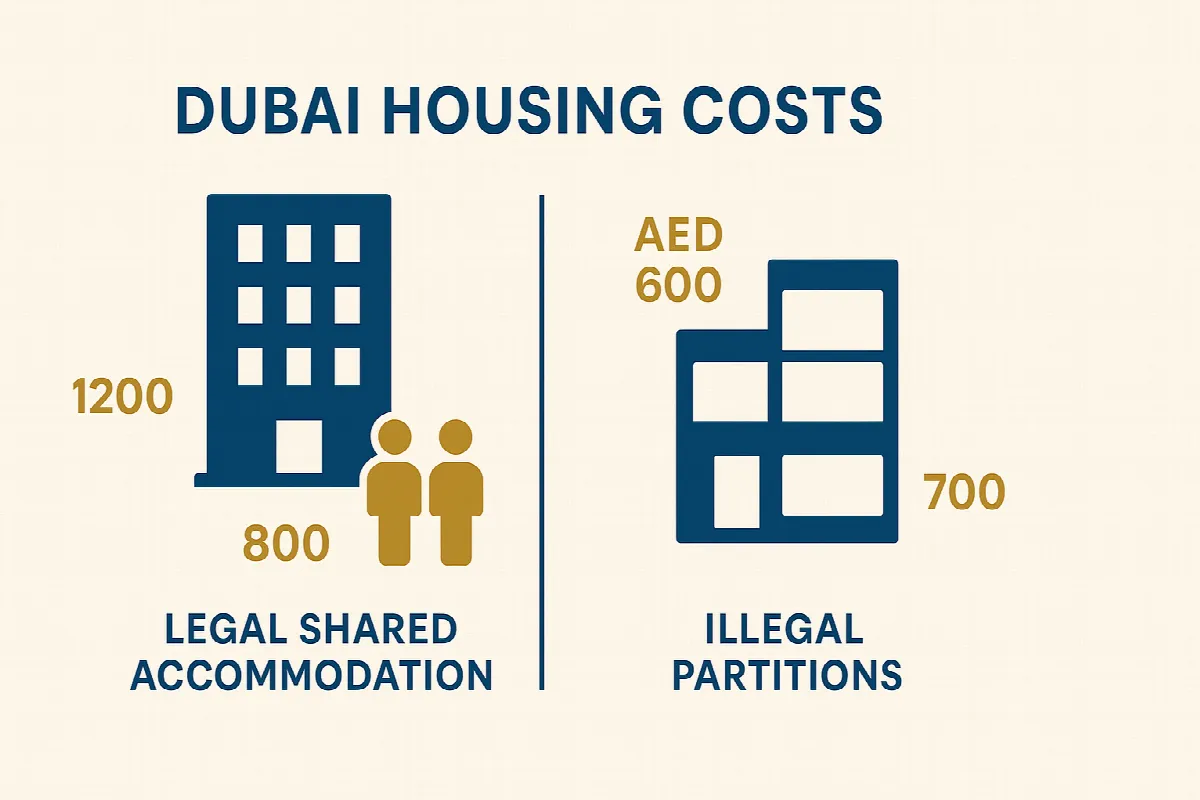
Zubair, a 29-year-old logistics executive, exemplifies this struggle. After his shared loft in Al Muraqqabat was cleared, he relocated to Sharjah, reducing his monthly rent from AED 1,200 to AED 600. However, this savings comes at a considerable personal cost: over three hours daily on public transport, arriving at work exhausted.
“I understand why the crackdown is happening,” Zubair explained. “Living in cramped places is not good for health. The government is trying to protect us and we appreciate that. We just hope there is a way we can live affordably within the rules.”
Workers’ Proposed Solutions
Affected residents have proposed practical solutions that could address both safety concerns and affordability needs:
Regulated Bed Space Guidelines
Zubair suggested establishing clearer guidelines for bed spaces, including fixed rental rates for each area. “Let people rent rooms with proper ventilation, size, and safety, but also make sure landlords don’t accommodate 15 people to earn more,” he recommended.
Designated Shared Accommodation Zones
Anusha, who worked at a salon in Karama, previously paid AED 900 for a bed space that was small but manageable and close to work. She now stays temporarily with a friend, struggling to find affordable accommodation near her workplace.
“Maybe some buildings or zones can be allowed to have shared rooms, with proper approval and inspections,” she suggested. This would help people earning AED 2,000 to AED 3,000 monthly. “If it’s too expensive, people will go back to overcrowding. If we have clear limits, everyone can live better.”
Fair Rent Regulation
Mohammed Danish, a delivery rider paying AED 700 for a shared room in Sharjah, experiences daily exhaustion from his Dubai commute. “In Dubai, everything was nearby — work, metro, food. Now, the travel takes up a major time of my day,” he said.
He believes there should be a system where occupancy limits are clearly defined and rent is fixed accordingly. “Some landlords were charging AED 700 to AED 800 for just a mattress space. That’s not fair. If they can only keep two people in 10 sqm, then the rent should be fixed accordingly.”
Community Suggestions for Dedicated Housing
Many residents have shared suggestions on social media platforms about affordable housing solutions. They recall that Dubai previously had neighbourhoods with low-cost housing, such as Sheikh Hamdan Colony in Al Qusais, older housing in Satwa, and parts of Karama that offered decent accommodation at budget-friendly prices.
“With the population of Dubai growing so fast, maybe it’s time to think of affordable housing zones for working-class bachelors too,” one resident commented.
Another suggested: “By constructing apartments for bachelors can help avoid the problem of overcrowding in residential buildings.”
Understanding the Legal Framework
According to Mohammed Kawasmi, partner in real estate at Al Tamimi & Co., Dubai law allows one person per 5.0 square metres of space in villas and apartments. “The minimum space for occupancy, dealt with by Dubai Municipality building code, states that for residential accommodation or shared sleeping purposes, the allocated space per individual is 5.0 square metres from the net area,” Kawasmi explained.
More than one person within 5.0 square metres constitutes overcrowding and violates local laws. This regulation forms the basis for the ongoing enforcement actions across Dubai.
The Path Forward
Workers affected by the crackdown consistently express understanding of the government’s safety concerns whilst requesting practical solutions. “The authorities are not trying to make our lives harder,” Zubair noted. “They want to make sure we are not stuck in claustrophobic and airless rooms and that if there’s a fire or emergency, we are not trapped.”
“But we need a little help, something legal, safe, and affordable,” he added.
The situation highlights the need for a structured approach that addresses both worker safety and housing affordability. As Dubai continues to grow, finding solutions that protect workers whilst maintaining safety standards remains a priority for both residents and authorities.
Supporting Workers Through Housing Challenges
The ongoing enforcement demonstrates Dubai’s commitment to improving living standards across all segments of society. However, the experiences of workers like Zubair, Anusha, and Mohammed Danish illustrate the need for comprehensive solutions that consider both safety and affordability.
For workers navigating these housing challenges, understanding Dubai’s rental laws and tenant rights remains crucial. Additionally, exploring budget-friendly areas in Dubai can help identify legal alternatives that fit within modest salary ranges.
Key Takeaway: Dubai’s crackdown on illegal room partitions has created housing challenges for thousands of workers who now seek structured, affordable solutions. Whilst residents understand and support safety measures, they call for clear guidelines, designated zones, and fair rent regulations that balance worker welfare with legal compliance. The situation underscores the need for comprehensive housing policies that address both safety standards and affordability concerns for Dubai’s essential workforce.
Further Reading
- Dubai’s Occupancy Laws: Essential Guide for Property Owners and Tenants
- Sub-letting Apartments in Dubai: Legal Requirements for Tenants 2025
- The Complete Cost to Live in Dubai as an Expat in 2025
- Living in Dubai on 5,000 AED: Survival Guide & Budget Breakdown
- Dubai Rental Market 2024: Surge in Affordable Housing Demand
The UAE week, every Monday
The week's stories on jobs, visas, money and daily life in one short email. Unsubscribe in one click.