DXB Airport Closing 2032: Al Maktoum Takes Over, Massive Redevelopment Planned
Dubai International Airport confirms closure by 2032 as Al Maktoum expands. Discover the massive 29 sq km redevelopment plans transforming DXB into a sustainable urban district.
By Vadim Kouznetsov, published

DXB’s transformation into a mixed-use urban district represents one of the world’s most significant airport redevelopment opportunities, with experts envisioning a climate-resilient city within the city
Key Takeaway
Dubai International Airport will officially close by 2032-2034 as all operations transition to the expanded Al Maktoum International Airport. The DXB site presents a unprecedented 29 square kilometre redevelopment opportunity that could transform into a sustainable, mixed-use urban district, becoming a global model for airport redevelopment projects.
The aviation world is witnessing a historic moment as Dubai confirms the inevitable closure of Dubai International Airport (DXB), one of the busiest airports globally. With the first phase of Al Maktoum International Airport set for completion by 2032, this transition marks the end of an era for the iconic airport that has served as the gateway to the Middle East for decades.
Paul Griffiths, CEO of Dubai Airports, made the official confirmation at the Arabian Travel Market, emphasising that redevelopment of the DXB area is now a key strategic focus. “We’re right up against Sharjah in the north,” he noted, “so redeveloping the area could help spread the city out and potentially ease current traffic challenges.”
The Scale of Opportunity
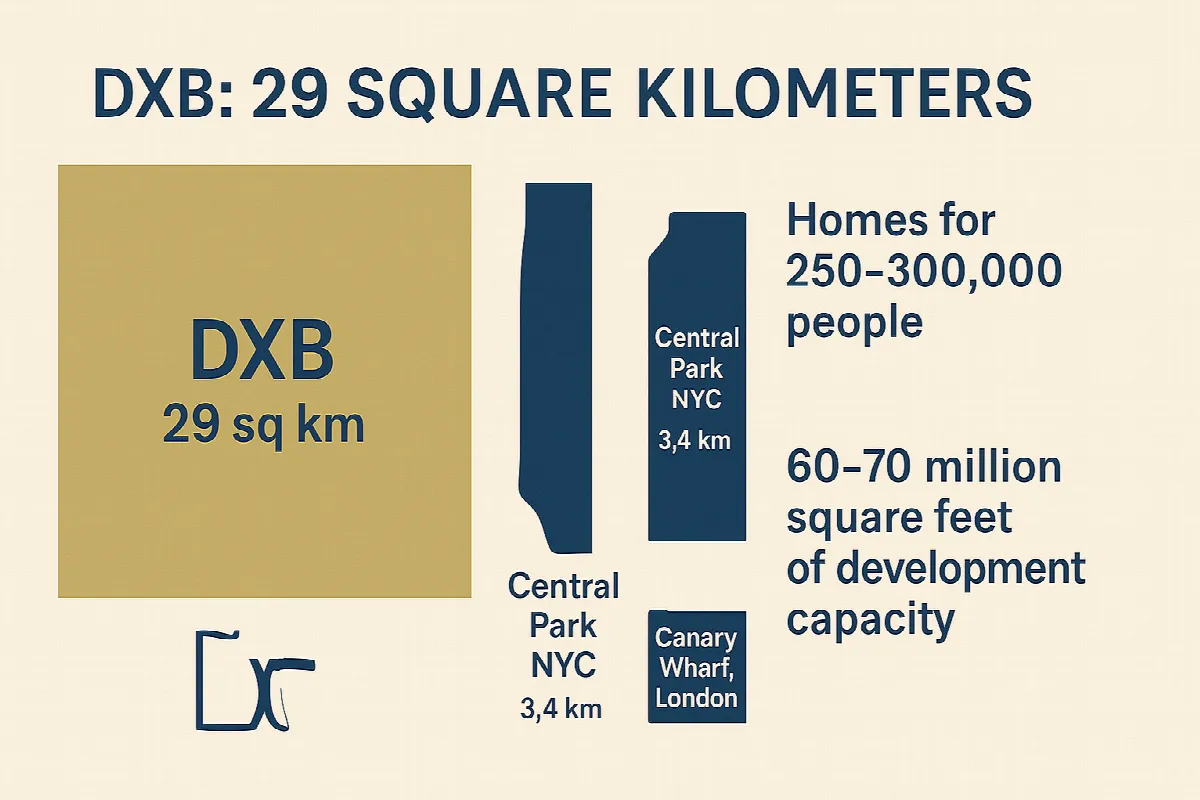
The magnitude of this redevelopment opportunity cannot be overstated. With more than 29 square kilometres of prime urban land in the heart of Dubai, the DXB site represents one of the world’s largest available plots for mixed-use transformation. Ibrahim Abdulkarim, Deputy Head of Sales at Metropolitan Premium Properties, highlighted the strategic advantages: “With existing infrastructure and transport links, it’s a strong candidate for large-scale development.”
To put this in perspective, the DXB site is five times larger than Monaco and could accommodate a population equivalent to a medium-sized city. This scale offers developers and urban planners an almost unprecedented canvas for creating an entirely new district within Dubai.
Vision for the Future
Urban planning experts have outlined ambitious visions for the site’s transformation. Dr Rana Shakaa, visiting Assistant Professor in the Urban Planning Programme at American University of Sharjah, emphasises the importance of data-driven decision-making: “Any redevelopment plan must be rooted in understanding Dubai’s evolving urban needs, demographic trends, and mobility patterns.”
The academic community envisions a forward-looking development focused on creating a low-carbon, mixed-use district that integrates technology for environmental sustainability, equitable access, and quality of life. This approach would set new standards for urban development in the region.
A Model for Desert Cities
Phillip Dunn, Senior Manager of Sustainability at Expo City Dubai, presents perhaps the most ambitious vision for the site. He believes it should be “transformed into a climate-resilient, biodiverse, and inclusive urban nature district — a model for desert cities globally.”
His comprehensive plan includes:
- Public spaces and rewilded zones designed for wellbeing and climate adaptation
- Urban cooling systems that capture carbon and host diverse wildlife
- Nature-as-therapy concepts providing health benefits to residents
- A ‘Living Lab’ for urban biodiversity similar to Terra, where community engagement, research, and innovation converge
This vision prioritises walkability, public transit, and diverse housing options, particularly for mid- and low-income residents, addressing Dubai’s growing need for inclusive development.
Learning from Global Examples
The redevelopment isn’t without precedent. Tatiana Tonu, CEO at Object 1, references the successful transformation of Berlin’s former Tempelhof Airport, where the shift of operations led to repurposing vast airport land for residential and public development. “In that case, as in Dubai’s, freeing up urban land for livable spaces marked a turning point in city planning,” she explained.
This international example demonstrates how airports can be transformed into thriving urban communities while preserving their historical significance and architectural heritage.
Economic Impact and Real Estate Potential
The redevelopment represents a “win-win situation” according to industry experts. The initiative promises benefits on multiple levels: urban, economic, and environmental. With Dubai’s property market experiencing significant growth, the DXB site could become a prime investment destination.
Real estate developers have already expressed strong interest in the site, recognising its potential for:
- High-end residential developments
- Commercial and business districts
- Hospitality and entertainment sectors
- Public spaces and cultural facilities
The central location and existing infrastructure make it particularly attractive for mixed-use development that could accommodate hundreds of thousands of residents and workers.
Preserving Airport Heritage
While looking towards the future, experts stress the importance of preserving DXB’s rich aviation heritage. Dr Rana Shakaa advocates for not overlooking “its past as one of the world’s longest-operating airports,” emphasising the need to preserve architectural traces and experiential elements of the airport.
This approach would honour DXB’s legacy while creating something entirely new, potentially incorporating aviation-themed elements into the new urban landscape.
The Transition Timeline
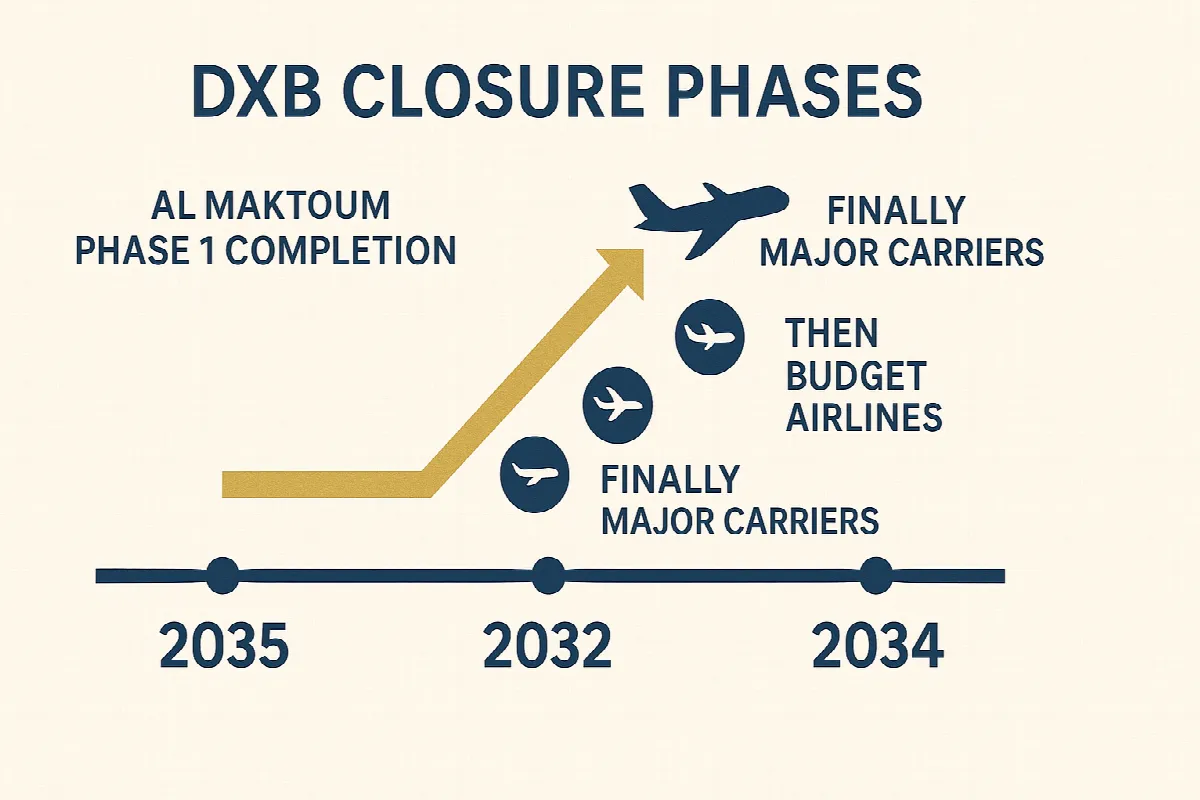
The closure won’t happen overnight. The transition to Al Maktoum International will occur in phases, with cargo and budget airlines moving first, followed by major carriers. DXB will continue operating and receiving upgrades to maintain world-class standards until the complete transition around 2034.
Al Maktoum International Airport’s expansion includes a $35 billion investment that will create the world’s largest airport, capable of handling 260 million passengers annually – nearly triple DXB’s current capacity.
Impact on Travel and Tourism
For the millions of travellers who pass through DXB annually – including approximately 17,000 UK visitors daily – the transition will be carefully managed to prevent disruption. The new Al Maktoum hub promises enhanced facilities, including five runways, 400 gates, and cutting-edge technology for seamless passenger experiences.
Dubai’s aviation sector continues to create employment opportunities, with projections indicating 185,000 new jobs by 2030. The DXB redevelopment could contribute significantly to this employment growth through construction, retail, hospitality, and service sectors.
Employment Opportunities in the New Development
The redevelopment of DXB presents massive employment potential across multiple sectors. From construction and engineering during the development phase to long-term positions in retail, hospitality, property management, and emerging green technologies, the project could generate tens of thousands of jobs.
For professionals seeking opportunities in Dubai’s evolving urban landscape, professional CV services can help candidates achieve 3x more interviews by creating resumes tailored for the UAE market’s growing sectors, including urban development, sustainability, and real estate.
Global Significance
The DXB redevelopment carries implications beyond Dubai’s borders. As one of the largest airport-to-urban transformation projects ever undertaken, it will serve as a case study for other cities facing similar transitions. The emphasis on sustainability, climate resilience, and biodiversity could establish new international standards for urban redevelopment.
The project aligns with Dubai’s broader vision of becoming a global leader in sustainable urban development, reinforcing its position as a forward-thinking city that balances economic growth with environmental responsibility.
Conclusion
The closure of Dubai International Airport marks the end of an era, but more importantly, it heralds the beginning of an exciting new chapter in urban development. The transformation of 29 square kilometres of prime land into a sustainable, mixed-use district represents not just a local opportunity, but a global experiment in urban planning.
With ambitious visions ranging from climate-resilient communities to innovation labs, the DXB redevelopment could set new benchmarks for how cities integrate sustainability, technology, and livability. As Dubai continues its evolution as a global hub, this project will likely become a defining element of the emirate’s urban landscape.
The success of this transformation will depend on careful planning, stakeholder engagement, and a commitment to creating inclusive, sustainable communities. If executed thoughtfully, the former DXB site could become a model for urban regeneration projects worldwide, demonstrating how infrastructure transitions can create opportunities for innovative, sustainable development.
Related Articles:
The UAE week, every Monday
The week's stories on jobs, visas, money and daily life in one short email. Unsubscribe in one click.