UAE Freelancers Guide: Choosing the Right Bank Account for Your Business
Discover whether UAE freelancers should open personal or business bank accounts, essential documentation needed, and top digital banking options for self-employed professionals.
By Vadim Kouznetsov, published

Understanding Banking Options for Freelancers in the UAE
Starting a freelance career in the UAE opens up exciting opportunities, but managing your finances properly requires careful consideration—particularly when it comes to banking. Many freelancers face confusion about whether to use personal or business accounts and what documentation they need to provide without a traditional salary certificate.
With the rise of digital banking and specialised solutions for self-employed professionals, freelancers now have more options than ever. However, choosing the appropriate banking setup is crucial for long-term success and compliance with UAE regulations.
Personal vs Business Accounts: Making the Right Choice
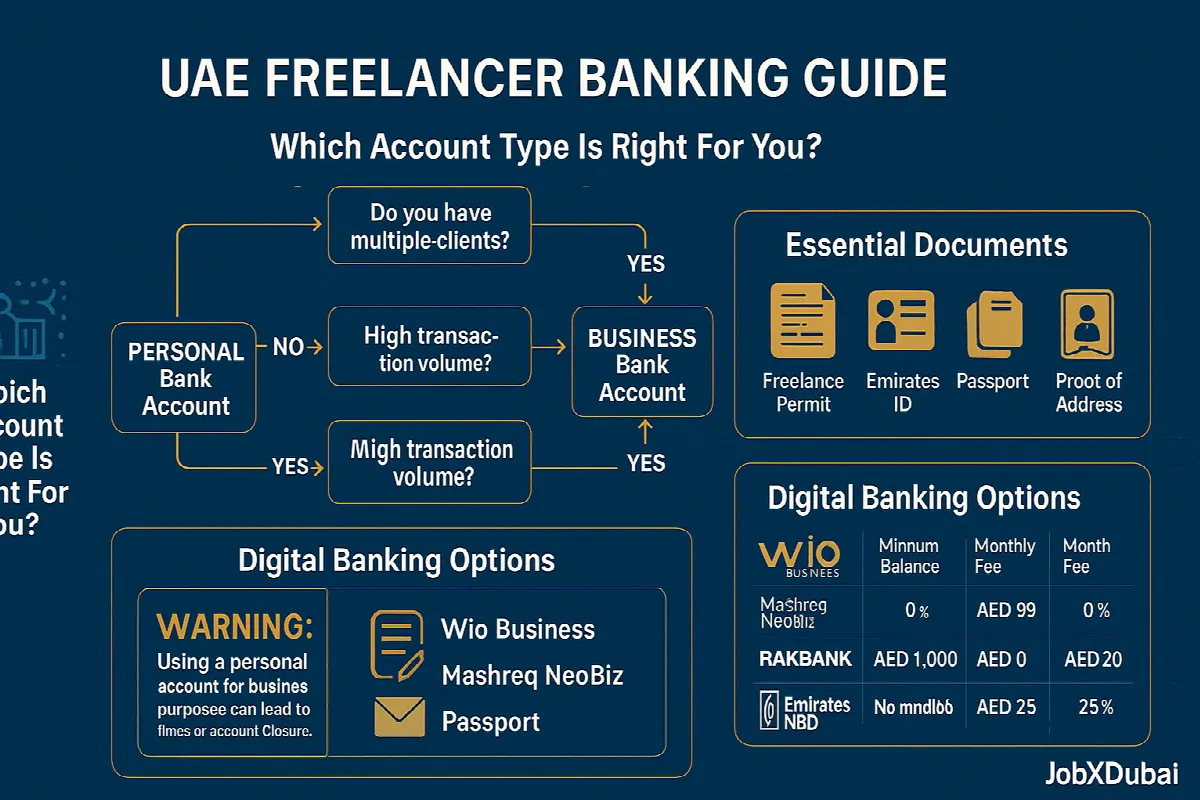
One of the first decisions freelancers must make is whether to open a personal or business account. This choice largely depends on the nature of your freelance work and transaction patterns.
According to David Walsh, Business Development Manager at Connect Resources: “Some freelancers, such as personal trainers, hairdressers, and photographers, may have a different purpose than a freelancer working as a social media content creator or a marketing contractor.”
When a Personal Account Might Work
If your freelance activities involve minimal invoicing and primarily cash transactions, a personal account might be sufficient. For example:
- Personal trainers collecting session fees
- Photographers handling occasional client payments
- Tutors receiving direct payments from students
Walsh explains: “If your purpose for having a bank account involves little to no invoicing, such as in the case of a personal trainer—then a personal bank account may be more suitable. Some banks require a minimum balance for business accounts, and falling below this threshold could result in fines.”
When You Need a Business Account
For freelancers engaged in more complex activities, especially those managing multiple clients and requiring regular invoicing, a business account becomes essential:
- Social media content creators
- Marketing consultants
- Web developers
- Graphic designers
- Copywriters
“If you are a social media content creator working remotely in the UAE and require invoicing support to invoice multiple clients, then a business bank account would definitely be more suitable as they offer more business-related support, and some banks may block business-related transactions on personal bank accounts,” Walsh advises.
Legal Requirements: Avoiding Serious Consequences
Using the wrong type of account for your freelance activities isn’t just inconvenient—it can have serious legal repercussions.
Maryia Vinahradava, Director of Corporate Services at Virtuzone, highlights an important warning: “Despite this, many freelancers still mistakenly believe they can use their personal bank accounts for business purposes. This misconception can lead to serious consequences: as soon as a bank identifies business activity on a personal account, it is likely to shut it down and blacklist the individual, making future banking extremely difficult.”
Under UAE Commercial Law, anyone conducting business activities must hold a valid trade licence, including freelancers. UAE banking regulations mandate that all business activities must be conducted through properly designated business accounts.
Essential Documentation for Freelancer Banking
When opening a bank account as a freelancer in the UAE, you’ll need to prepare several key documents:
- Valid freelance permit or licence
- Passport with valid visa
- Emirates ID
- Proof of address (utility bill, rental contract)
- CV or professional profile (for background verification)
For business accounts, additional documentation may include:
- Description of your business activities
- Information about your mode of operation
- Details about key clients or partners
- Recent personal bank statements (for verification)
The Rise of Digital Banking Solutions for Freelancers
Traditional banks often impose high minimum balance requirements and strict compliance procedures that can be challenging for freelancers to meet. Fortunately, the UAE’s financial landscape is evolving rapidly.
“Today, there are at least five digital banking solutions that cater specifically to freelancers and solo entrepreneurs. These banks provide low entry barriers with no minimum balance and typically a Dh100 monthly maintenance fee, as well as a more flexible and understanding approach to compliance,” notes Vinahradava.
Sarah Negga, Relationship Manager at Luxe Incorporations, recommends several digital banking options:
- Wio Business: “It’s fully digital, straightforward to open, and doesn’t require a minimum balance, just a monthly subscription fee. With built-in tools like invoicing and payment links, it’s particularly friendly for solo professionals.”
- Mashreq NeoBiz: Offers a smooth digital onboarding process designed with small businesses in mind.
- RAKBANK: Known for being flexible, especially for those just starting their freelance journey.
- Emirates NBD: Provides SME account packages suitable for various freelancing activities.
Additional fintech solutions like YAP, XPence, and Zand offer digital-first services, including virtual cards and real-time expense tracking—particularly beneficial for freelancers working with international clients.
Navigating Compliance Checks Successfully
Even with digital banking options, compliance remains a critical aspect of the account opening process. Banks are required to conduct thorough checks to ensure your business activities are legitimate and low-risk.
“Banks will still conduct compliance checks to ensure your activity is legitimate and low-risk. The more transparent and straightforward your business setup, the smoother this process will be,” explains Negga.
To facilitate a smoother banking experience:
- Maintain clear, organised documentation
- Be transparent about your business activities
- Choose appropriate business categories on your licence
- Consider working with business setup experts who can help position your freelance operation as low-risk
Making Your Final Decision
When selecting a bank for your freelance activities in the UAE, consider these factors:
- Transaction volume: How many transactions will you process monthly?
- Client base: Are your clients primarily local or international?
- Growth plans: Do you expect to expand your freelance operation soon?
- Digital needs: How important are mobile banking features and integrations?
- Fee structure: Can you maintain minimum balances, or would you prefer a subscription model?
Looking Ahead: The Future of Freelancer Banking in the UAE
As the UAE continues to position itself as a hub for freelancers and independent professionals, banking solutions are likely to become even more tailored to their specific needs.
Digital-first options will continue to evolve, offering more integrated services such as accounting software connections, automated tax calculations, and simplified international payments—all designed to help freelancers focus on their core business rather than administrative tasks.
By understanding the banking landscape now and making informed choices, you’ll set your freelance career on solid financial footing for success in the dynamic UAE market.
Are you a freelancer in the UAE? What banking challenges have you faced? Share your experiences in the comments below!
Additional Reading Material
The UAE week, every Monday
The week's stories on jobs, visas, money and daily life in one short email. Unsubscribe in one click.