Power Bank Airline Bans: Essential Guide for Dubai Travellers in 2025
Airlines are banning power banks due to fire risks. Learn about new regulations, capacity limits and safety tips for Dubai flyers in our 2025 guide.
By Vadim Kouznetsov, published

Airlines worldwide are implementing stricter regulations on power banks, creating potential challenges for travellers who depend on these portable chargers. The aviation industry’s growing concern stems from the fire risks associated with lithium-ion batteries used in these devices, particularly in the confined space of aircraft cabins.
Recent Incidents Prompting Safety Measures
Several alarming incidents have pushed airlines to take decisive action:
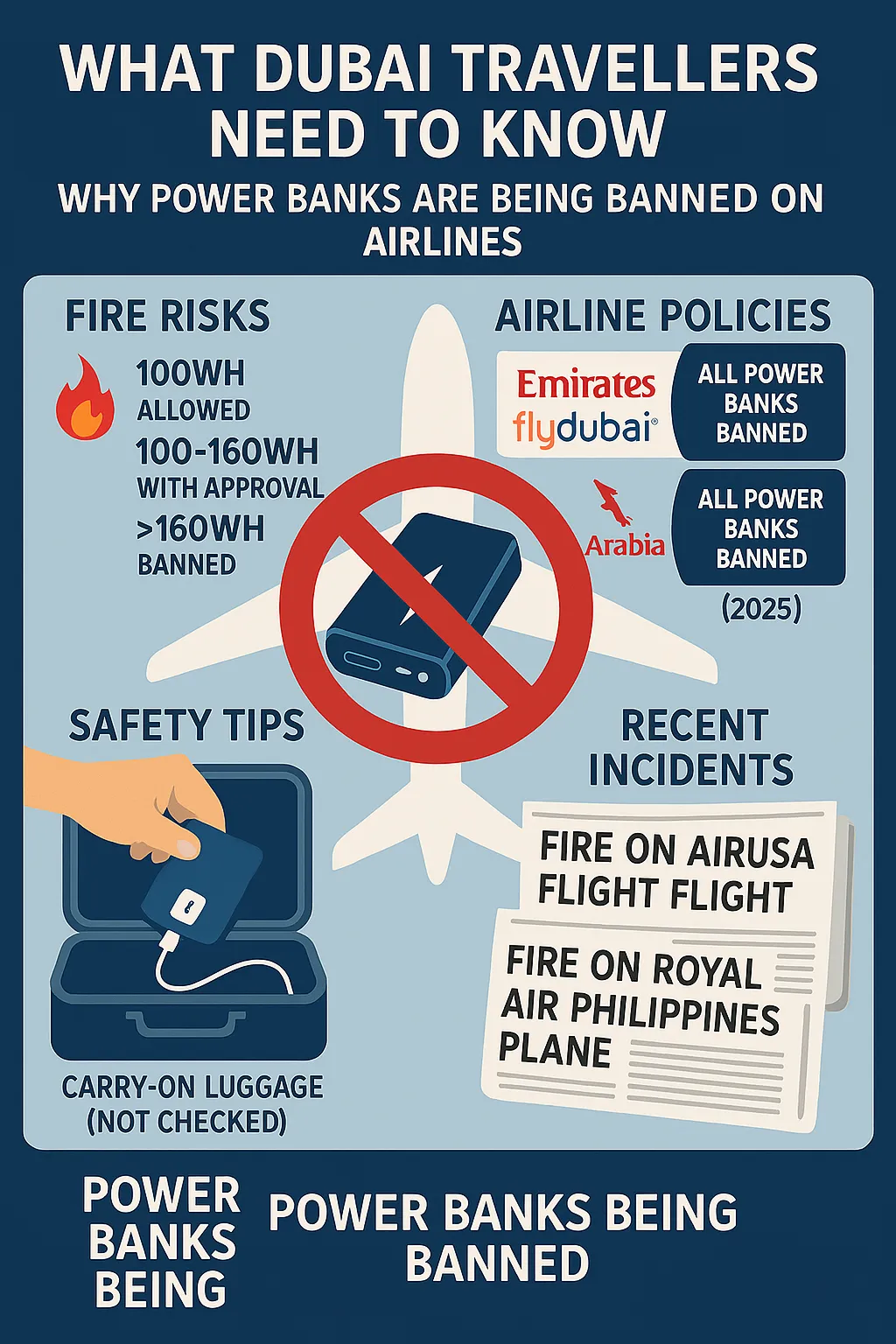
- On January 28, 2025, an Air Busan Airbus A321 caught fire at Gimhae International Airport. Investigators later confirmed a power bank was the likely cause.
- A separate incident aboard a Royal Air Philippines flight resulted in cabin smoke after a power bank explosion, as documented in passenger videos shared online.
These events, while infrequent, highlight the genuine dangers these devices can pose during flights.
Understanding the Fire Risks
Power banks utilise lithium-ion batteries prized for their high energy density, but this efficiency comes with inherent risks:
- They can overheat, ignite, or explode when damaged, exposed to extreme temperatures, or due to internal defects
- “Thermal runaway” — a critical failure mode — can cause uncontrollable heating and ignition
- The pressurised, dry air environment of an aircraft cabin can increase malfunction probability
Current Airline Policies in 2025
Major carriers have implemented specific guidelines regarding power banks:
UAE-Based Airlines
The UAE’s General Civil Aviation Authority (GCAA) allows passengers to carry power banks on Emirates, Etihad, Flydubai, and Air Arabia, provided they follow these rules:
- Each battery must be individually protected to prevent short circuits
- Power banks are strictly prohibited in checked luggage
- Usage restrictions apply during flights
International Carriers
Several major airlines have announced specific policies:
- Eva Air: Complete ban on use and charging during flights (effective March 1, 2025)
- China Airlines: Ban on use or charging during flights (effective March 1, 2025)
- Thai Airways: Prohibited onboard from March 15, 2025
- Qantas Airways: Must be stored in carry-on luggage with no in-flight use permitted
- Emirates: Allowed onboard but with usage and charging restrictions
- Singapore Airlines: Permitted within specific capacity limits but banned from connection to in-seat power systems
- Cathay Pacific: Prior approval required for high-capacity units with in-flight use prohibited
- Korean Air: Up to 5 power banks (100Wh each) allowed, must be kept on person rather than in overhead bins
Capacity Limits You Need to Know
Airlines typically follow safety guidelines established by aviation authorities like IATA, FAA, and EASA:
- Under 100 Wh: Generally allowed in carry-on luggage without special approval
- 100-160 Wh: Permitted only with airline approval
- Over 160 Wh: Completely banned on passenger aircraft
It’s crucial to check the watt-hour (Wh) rating printed on your device. If this information is missing, security may confiscate the item at checkpoints.
Travel Tips for Dubai Passengers
To avoid disruptions and maintain safety:
- Always pack power banks in your carry-on luggage, never in checked bags
- Fully charge your devices before boarding
- Consider using airport charging stations as alternatives
- Check your specific airline’s policy before travel, especially when carrying higher-capacity units
- Keep your power bank easily accessible for security screening
- Verify the watt-hour rating of your device is clearly visible
Looking Ahead
As the aviation industry continues to address safety concerns related to lithium-ion batteries, travellers should expect policies to evolve. The International Air Transport Association (IATA) regularly updates its safety protocols, which airlines then implement in their regulations.
For Dubai residents and visitors travelling through the city’s busy airports, staying informed about these changing regulations will help prevent unexpected issues at security checkpoints and ensure smooth journeys.
Key Takeaway
The ban on power bank usage during flights stems from genuine safety concerns regarding lithium-ion battery fires in pressurised aircraft cabins. While policies vary slightly between airlines, the trend is clear: restricted use, regulated high-capacity devices, and prohibition in checked luggage. Dubai travellers should verify their power banks comply with watt-hour limitations and check specific airline policies before flying to avoid disruptions.
Additional Reading Material
The UAE week, every Monday
The week's stories on jobs, visas, money and daily life in one short email. Unsubscribe in one click.