How the 2025 INR Rate Cut Affects UAE’s Indian Expats: Money Transfer Guide
Latest INR falls to 22.58 after RBI’s April rate cut. Discover optimal timing, methods, and strategies for UAE-India remittances in our expert 2025 guide.
By Vadim Kouznetsov, published

The Indian rupee has weakened to 22.58 against the dirham following the Reserve Bank of India’s second interest rate cut of 2025. For UAE’s 2.75 million Indian expatriates, this currency shift creates a strategic opportunity for remittances. Our analysis reveals optimal timing strategies, potential future trends, and how to maximize your money transfers in this volatile market.
The Latest INR Developments: What’s Happening Now
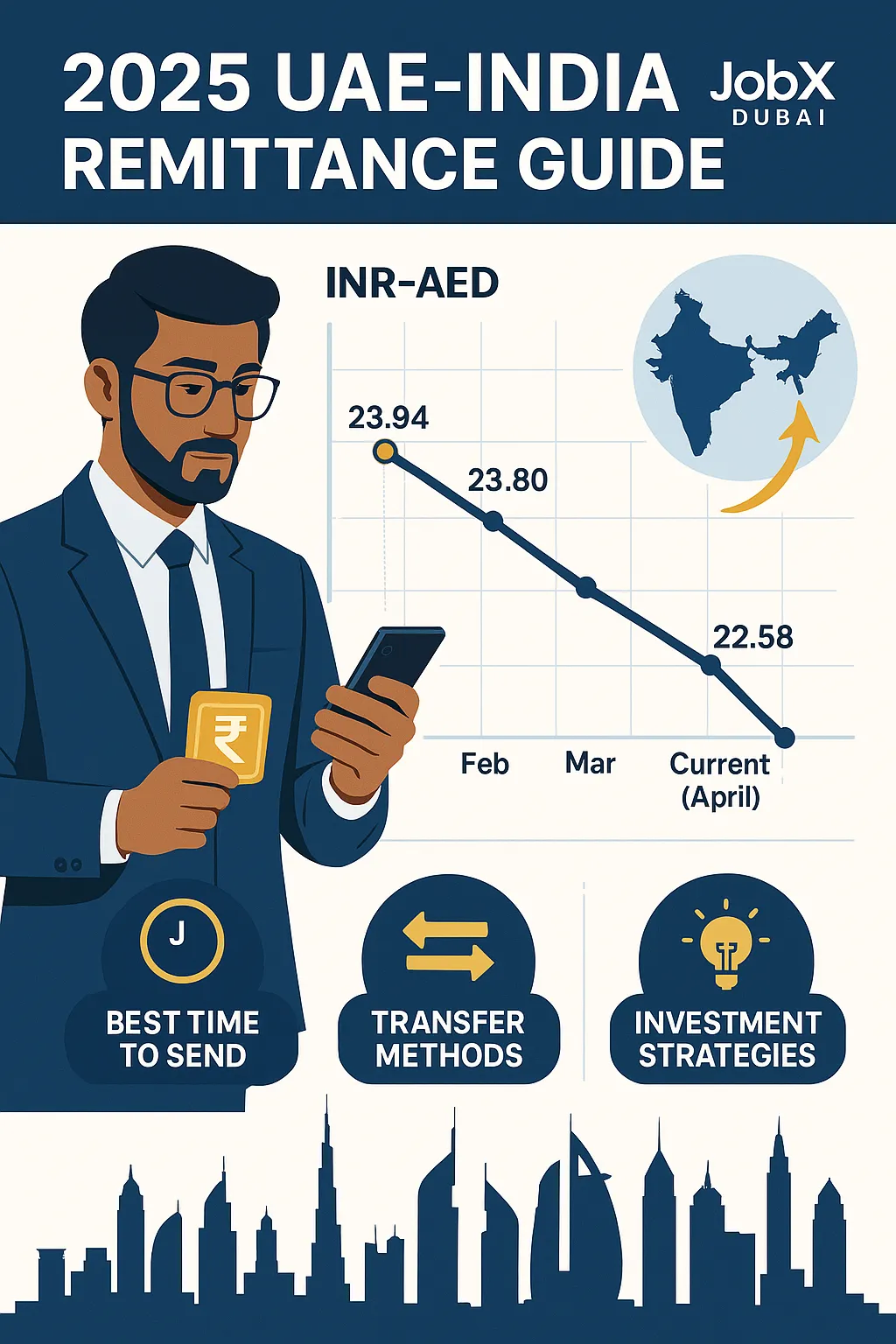
The Reserve Bank of India has implemented its second interest rate cut of 2025, reducing the base rate by 0.25% to 6%. This monetary policy shift has immediately pressured the Indian rupee, which now trades at 22.58 to one dirham – a significant movement from its recent stronger position of 23.2-23.3.
“A RBI cut will further support the potential trend of INR depreciation,” notes Krishnan Ramachandran, CEO of Barjeel Geojit Financial Services, highlighting the typical correlation between interest rate reductions and currency weakening.
For Indian professionals in Dubai and the broader UAE, this currency fluctuation represents a potential windfall opportunity for remittances, with financial experts suggesting the rupee could return to the 23.80 levels last observed in early March 2025.
Understanding the 2025 Remittance Landscape
Current Exchange Rate Trajectory
The rupee has experienced approximately 1.90% depreciation, now trading at 86.64 against the US dollar. According to Foram Chedda, Technical Analyst at ChartAnalytics.co.in, “This move confirms that the recent strength in the rupee was temporary. The broader bias continues to favor a weaker Rupee.”
Key factors influencing this trajectory include:
- RBI’s consecutive interest rate cuts (February and April 2025)
- Global trade tensions affecting emerging market currencies
- Current account deficit pressures on the Indian economy
- Foreign investment flows responding to monetary policy changes
Historical Context and Future Projections
The rupee reached its weakest point against the dirham at 23.94 on February 10, 2025. Current market indicators suggest a potential return to similar levels:
| Period | INR-AED Rate | Market Context |
|---|---|---|
| February 2025 | 23.94 | Historical low point |
| March 2025 | 23.80 | Previous weak position |
| Early April 2025 | 23.2-23.3 | Temporary strengthening |
| Current (April 9, 2025) | 22.58 | Post-rate cut pressure |
| Projected (Q2 2025) | 23.50-23.80 | Analyst consensus range |
Strategic Remittance Planning for UAE Expats
Optimal Timing Strategies
For the 1.3 million Indian professionals sending money home from the UAE, timing is crucial. Based on current market indicators:
- Short-term opportunity: The immediate post-rate cut period offers favorable rates compared to early April’s stronger rupee
- Medium-term strategy: Analysts project further weakening, suggesting partial transfers now with reserves for potentially better rates
- Long-term planning: Setting up automated transfers at predetermined threshold rates (e.g., when INR exceeds 23.50)
“The current 23.50 plus levels mean INR is showing signs of potentially going back to 23.80 levels,” advises Neelesh Gopalan, Senior FX analyst at a Dubai fintech, suggesting a window of opportunity for strategic transfers.
Transfer Method Comparison
| Period | INR-AED Rate | Market Context |
|---|---|---|
| February 2025 | 23.94 | Historical low point |
| March 2025 | 23.80 | Previous weak position |
| Early April 2025 | 23.2-23.3 | Temporary strengthening |
| Current (April 9, 2025) | 22.58 | Post-rate cut pressure |
| Projected (Q2 2025) | 23.50-23.80 | Analyst consensus range |
Impact on Investment and Financial Planning
Real Estate Investment Opportunities
The weakened rupee creates advantageous conditions for property investment in India. With the same dirham amount, UAE-based Indians can now secure higher-value properties in key Indian markets.
Property analysts report that major developers in Mumbai, Bangalore, and Delhi are launching special NRI investment packages to capitalize on this currency advantage. The combination of currency gains and India’s projected 6.8% GDP growth in 2025 makes real estate a particularly attractive option.
Wealth Management Considerations
Financial advisors recommend these strategies for UAE-based Indian professionals:
- Increase allocation to Indian equity markets, which remain resilient despite global pressures
- Consider rupee-denominated bonds offering attractive yields (currently 7.2-7.5% annually)
- Explore NRI-specific bank deposit schemes with premium interest rates
- Review retirement planning to incorporate currency advantages
Banking Impact: What It Means for Your Accounts
NRE/NRO Account Implications
The RBI rate cut will likely influence the interest rates offered on Non-Resident External (NRE) and Non-Resident Ordinary (NRO) accounts. While banks didn’t reduce rates after February’s cut, this second reduction increases the likelihood of adjustments.
Analysts project:
- Potential reduction of 0.15-0.25% in NRE fixed deposit rates
- Minimal impact on savings account interest rates
- Possible introduction of special tenure deposits to attract NRI funds
Home Loan Considerations
For UAE Indians with existing or planned home loans in India, the impact may be limited. As Anuj Puri, Chairman of Anarock Group, explains:
“Home loan borrowers may not see much meaningful or immediate interest rate relief. Banks have not transmitted earlier rate cuts to borrowers because of higher funding costs, pressure on net interest margins, higher NPAs, and a cautious lending climate.”
However, for those considering new property purchases, even a partial reduction in home loan rates could enhance affordability, particularly in the mid-market segment.
Industry-Specific Implications for UAE Indians
Technology and IT Services Professionals
For the 185,000+ Indian IT professionals in the UAE, the weakened rupee presents unique considerations:
- Increased value of dirham-based savings when converted to rupees
- Enhanced benefits from employer stock options denominated in INR
- Opportunity to fund startup investments in India’s technology hubs
- Strategic timing for knowledge worker visa applications and relocations
The technology sector, representing 38% of Indian professionals in the UAE, stands to gain significantly from optimized remittance strategies.
Construction and Engineering Sector
With 22% of UAE’s Indian workforce employed in construction and engineering, this sector faces specific opportunities:
- Improved returns on investments in India’s infrastructure projects
- Enhanced value of skills certification and training investments
- Opportunity to leverage UAE experience for premium positions in India’s growing urban development initiatives
Cultural and Practical Remittance Tips
Avoiding Common Mistakes
Many expatriates miss maximizing their remittance value due to these common oversights:
- Failing to compare exchange rates across providers (potential 1-2% difference)
- Overlooking transaction fees that erode value on smaller transfers
- Not considering the timing of transfers relative to market movements
- Missing tax implications of different remittance approaches
Building a Strategic Remittance Plan
For optimal results, establish a disciplined approach:
- Set target exchange rate thresholds for automatic transfers
- Diversify transfer timing rather than sending all funds at once
- Compare total cost (fees plus exchange rate margin) rather than just the advertised rate
- Consider value-added services like direct bill payments or investment allocations
Conclusion: Making the Most of Current Opportunities
The current currency scenario presents a strategic window for UAE’s Indian expatriates. With the rupee showing clear signs of further weakening and potentially returning to earlier 2025 lows, now represents an opportune moment to evaluate your remittance strategy.
Additional Reading Material
The UAE week, every Monday
The week's stories on jobs, visas, money and daily life in one short email. Unsubscribe in one click.