UAE Leads GCC Remittance Market: India Receives Record $129.4 Billion in 2024
UAE remains the Gulf’s top remittance source, sending $21.6B to India despite GCC’s slight dip to $131.5B. Advanced economies now dominate South Asian transfers.
By Vadim Kouznetsov, published

Last updated: 8 April 2025
The UAE has maintained its position as the Gulf’s top remittance source country, contributing a substantial $21.6 billion to India’s record-breaking $129.4 billion inflow in 2024. This performance comes despite a minor 0.4% decrease in overall GCC remittance outflows, highlighting Dubai’s resilient economic landscape and strategic importance in global money transfer systems. For professionals in the UAE’s financial and expatriate services sectors, understanding these shifting remittance patterns reveals key opportunities in an evolving market.
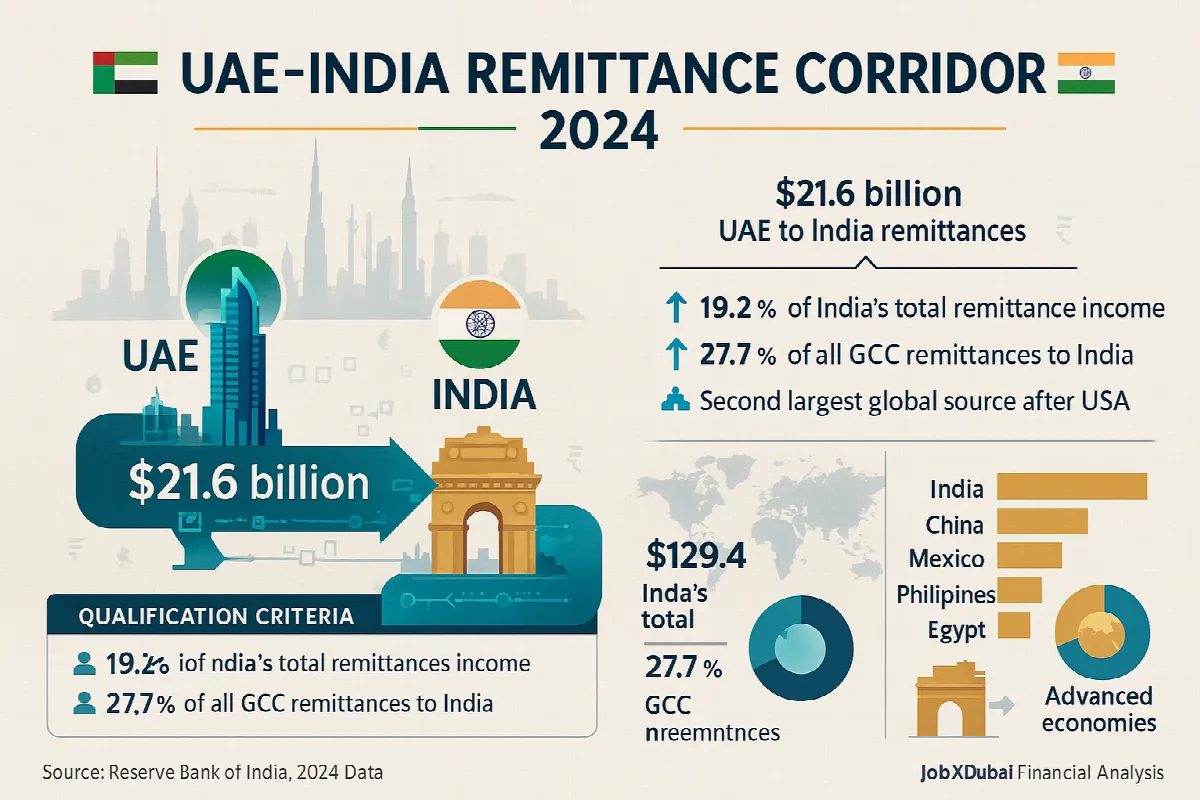
UAE Remittance Leadership: Market Position and Growth Trends
While advanced economies have collectively surpassed the GCC in total remittance volumes to South Asia, the UAE stands as a critical pillar in the global remittance architecture. The Emirates has solidified its position as the second-largest source of remittances to India globally, behind only the United States.
UAE’s Dominant Regional Performance
Recent data reveals the UAE’s commanding position within the GCC remittance landscape:
- Contributed $21.6 billion to India alone (19.2% of India’s total inflows)
- Accounts for 27.7% of all GCC-to-India remittances
- Maintains ranking as the second-largest global source of remittances to India
- Demonstrated resilience despite regional outflow adjustments
The implementation of a rupee-dirham payment agreement has further strengthened the UAE’s position by streamlining transactions between the two nations, reducing friction in the remittance process.
GCC Regional Context and Adjustments
The broader GCC region experienced a slight contraction in remittance outflows:
- Total GCC remittances decreased by 0.4% to $131.5 billion in 2023
- Saudi Arabia, Kuwait, Oman, and Qatar collectively contributed 11% to India’s inflows
- Policy shifts, including Saudi Arabia’s family reunification initiatives, have influenced remittance patterns
- Post-pandemic economic adjustments continue to reshape regional money transfer dynamics
India’s Record-Breaking Remittance Performance
India’s position as the world’s leading remittance recipient continues to strengthen, with 2024 marking unprecedented growth in inward transfers.
Historical Growth and Recent Milestones
The scale of India’s remittance achievement is remarkable in both historical and global contexts:
- Record $129.4 billion in total remittances received in 2024
- An extraordinary $36 billion inflow in the December 2024 quarter alone
- Third consecutive year with inflows exceeding $100 billion
- Leading global remittance rankings consistently since 2008
Demographic Drivers of Growth
India’s expanding diaspora has been the primary engine behind this sustained remittance growth:
- Migrant population has tripled since 1990, from 6.6 million to 18.5 million in 2024
- Approximately 50% of Indian expatriates reside in GCC countries
- Dual migration streams: skilled professionals to advanced economies and blue-collar workers to the Gulf
- Evolving diaspora composition with increasing representation in tech and healthcare sectors
Comparative Global Remittance Landscape
The global remittance market continues to grow, with South Asia showing particularly strong performance compared to other regions.
Global Rankings and Performance
India’s dominance in the global remittance market is clear when compared with other major recipient countries:
| Country | 2024 Remittance Inflows | Global Share | YoY Growth |
|---|---|---|---|
| India | $129.4 billion | 18.9% | +11.8% |
| Mexico | $68 billion | 9.9% | +7.2% |
| China | $48 billion | 7.0% | -2.3% |
| Philippines | $38 billion | 5.5% | +4.9% |
| Pakistan | $33 billion | 4.8% | +10.2% |
Source: Reserve Bank of India, World Bank Remittance Data, 2024
Regional Growth Patterns
South Asia has outperformed the global average in remittance growth:
- Global remittances to low- and middle-income countries: $685 billion in 2024
- South Asia’s remittance growth: 11.8% (compared to global average of 5.8%)
- China experienced continued decline, reaching a two-decade low share of 5.3%
- Pakistan and Bangladesh contributed significantly to South Asia’s strong performance
Shifting Source Dynamics: Advanced Economies vs. GCC
A notable trend in 2024 was the changing balance between remittance sources, with important implications for financial service providers and policy planners.
Advanced Economies’ Growing Influence
For the first time, advanced economies have collectively overtaken the GCC as the primary source of remittances to South Asia:
- Advanced economies now contribute the largest share of India’s remittance inflows
- Driven by increased migration of skilled professionals to the US, UK, Canada, and Australia
- Higher per-capita remittance values from skilled workers in developed economies
- Reflects India’s success in exporting tech talent and healthcare professionals globally
GCC’s Enduring Importance
Despite the shift, the Gulf region remains an essential pillar of the remittance ecosystem:
- The UAE maintained its position as the region’s top contributor
- GCC countries collectively remain a critical remittance corridor
- Economic recovery in the region could stabilize outflow volumes
- Historical connections continue to support strong remittance relationships
“The Gulf’s share has softened, but its economic recovery could stabilise outflows,” notes Priya Sharma, an economist at HSBC. “Family reunification policies in Saudi Arabia may temper flows, yet the UAE’s dominance signals resilience.”
Financial Technology and Remittance Efficiency
Technological innovation continues to reshape the remittance landscape, with important advantages for certain corridors.
Cost Efficiency Advantages
India benefits from one of the world’s most cost-effective remittance environments:
- Average cost of sending remittances to India: 4.2% per transaction
- Global average remittance cost: 6.3% per transaction
- Cost efficiency supports higher volume and frequency of transfers
- Digital platforms have dramatically reduced transaction frictions
Innovation Driving Future Growth
Several technological developments are further enhancing remittance efficiency:
- India’s Unified Payments Interface (UPI) integration with cross-border systems
- Bilateral payment agreements reducing conversion costs
- Blockchain and fintech solutions lowering intermediary fees
- Mobile payment adoption accelerating transfer speed and convenience
“India’s remittance growth reflects an evolving diaspora — more IT experts in advanced economies and steady GCC contributions,” said Priya Sharma. “Innovations like India’s Unified Payments Interface (UPI) and bilateral agreements could further bolster inflows.”
Future Outlook and Strategic Implications
The Reserve Bank of India and international analysts project continued strong growth in the remittance sector, with important implications for the UAE’s position.
Five-Year Projections
Medium-term forecasts suggest sustained expansion of remittance volumes:
- RBI projects Indian remittance inflows could reach $160 billion by 2029
- Growth drivers include continued skilled migration to Western economies
- GCC economic diversification may create new employment categories
- UAE-India economic ties expected to strengthen further through bilateral initiatives
Strategic Considerations for UAE Stakeholders
For UAE-based financial institutions and policy makers, several strategic considerations emerge:
- Opportunity to strengthen remittance infrastructure with India given the sheer volume of transfers
- Potential for expanding digital payment corridors to maintain competitive advantage
- Investment in specialized services for high-value professional expatriates from India
- Development of value-added financial products targeted at the Indian diaspora
Employment Implications for UAE Professionals
The shifting remittance landscape has important implications for professionals working in Dubai’s financial services and related sectors.
Growth Sectors Aligned with Remittance Trends
Several business sectors are positioned to benefit from the UAE’s strong remittance position:
- Financial technology specialists: Developing and implementing cross-border payment solutions
- Banking professionals: Managing institutional relationships with Indian counterparts
- Compliance experts: Navigating evolving regulatory frameworks for international transfers
- Marketing specialists: Targeting the diverse Indian expatriate community segments
Skill Development Priorities
Professionals seeking to capitalize on these trends should focus on developing:
- Knowledge of digital payment systems and blockchain applications
- Understanding of India-UAE bilateral financial regulations
- Customer experience design for remittance products
- Data analytics capabilities for tracking remittance pattern changes
Conclusion: UAE’s Central Role in a Changing Landscape
The UAE’s position as the Gulf’s remittance leader underscores Dubai’s continued economic centrality despite shifting global patterns. With India receiving a record $129.4 billion in 2024 and the UAE contributing $21.6 billion of that total, the bilateral remittance corridor remains one of the world’s most significant.
As advanced economies collectively overtake the GCC in remittance volumes to South Asia, the UAE’s resilience stands out. The integration of financial technology, implementation of bilateral payment agreements, and the Emirates’ strategic position as a global business hub ensure its continued importance in the remittance ecosystem.
For professionals in Dubai’s financial and expatriate services sectors, these trends present opportunities to develop specialized expertise in one of the world’s most dynamic remittance corridors. As the RBI projects Indian remittances to reach $160 billion by 2029, the UAE’s remittance relationship with India is poised for continued growth and evolution.
“As global economic uncertainties loom, the interplay between advanced economies and a reviving GCC will shape the next chapter of this vital lifeline,” analysts conclude, highlighting the strategic importance of the UAE-India remittance corridor in the years ahead.
Additional Reading Material
The UAE week, every Monday
The week's stories on jobs, visas, money and daily life in one short email. Unsubscribe in one click.