Dubai Crypto Wallet Swap: Woman Jailed, to Pay Dh4.3 Million After $1M Fraud
Woman jailed 2 months, deported from UAE after crypto hardware wallet swap stole $1M. Dubai court awards Dh4.3M compensation. How to protect your crypto.
By Vadim Kouznetsov, published

A woman who secretly swapped a cryptocurrency hardware wallet during a business meeting in Dubai has been jailed for two months, fined, and ordered deported from the UAE after courts found she played a central role in defrauding an investor of digital assets worth approximately $1 million.
The Dubai civil court subsequently ordered her to pay Dh4.3 million in compensation, plus 5% annual legal interest until full payment.
This case marks a significant ruling on cryptocurrency theft under UAE law, with courts explicitly recognising digital currencies as financial property protected by legislation.
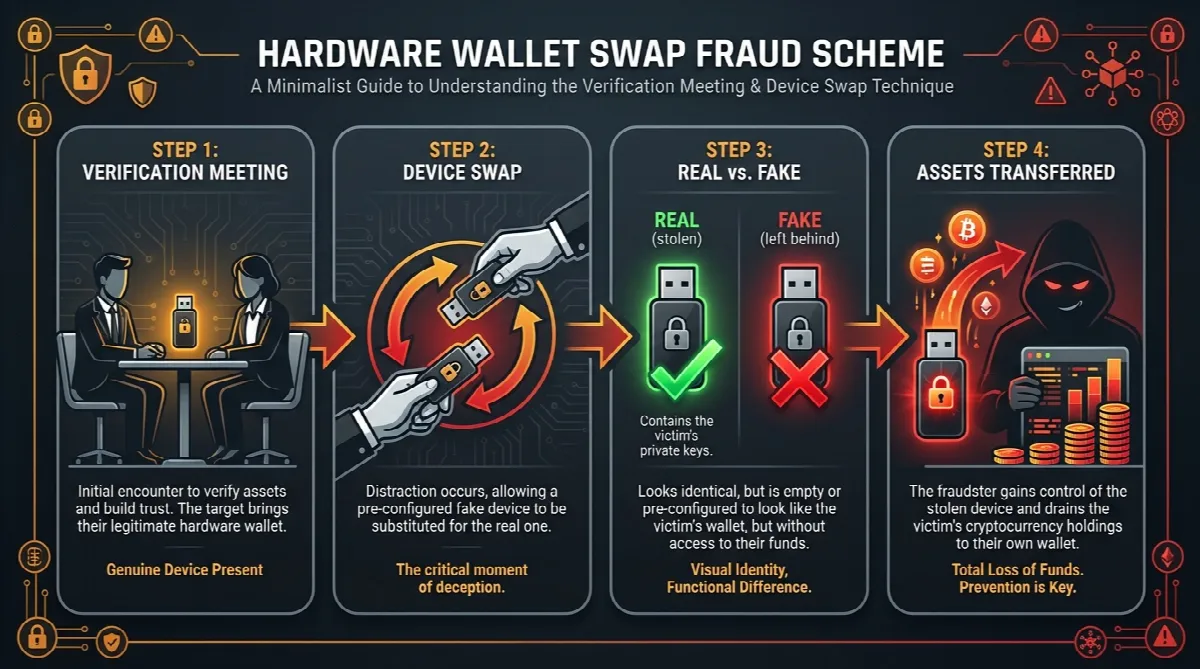
How Did the Crypto Wallet Swap Fraud Work?
Court records reveal a calculated scheme that exploited trust during what appeared to be a legitimate business verification process.
The fraud began when the investor was introduced to a man who claimed to operate an investment company. The man expressed interest in financing a business project.
Before finalising any agreement, he requested “proof of financial capability”—asking the investor to demonstrate ownership of substantial cryptocurrency holdings.
A verification meeting was arranged in Dubai. However, the man failed to attend at the last minute, sending his wife to act on his behalf instead.
During the meeting, the woman conducted the verification procedure. While handling the investor’s hardware wallet—a physical device containing private access keys to cryptocurrency—she discreetly switched it with an identical-looking device she had prepared in advance.
The swap allowed the cryptocurrency to be transferred out of the investor’s control without his immediate knowledge.
What Were the Court Penalties?
The case proceeded through both criminal and civil courts in Dubai.
Criminal conviction:
- Two months’ imprisonment
- Fine equal to the value of stolen assets at the time of the offence
- Mandatory deportation from the UAE
The Dubai Court of Appeal upheld the criminal ruling.
Civil compensation:
Following the criminal judgement, the investor filed a civil lawsuit seeking compensation for financial losses and lost profits. He argued that the cryptocurrency’s value had increased after the theft.
The civil court ruled in his favour, ordering the defendant to pay:
- Dh4.3 million in compensation
- 5% annual legal interest until full payment
Why Is This Case Significant for UAE Crypto Investors?
The ruling establishes an important legal precedent. The court explicitly stated that digital currencies are recognised as financial property and are protected under UAE law.
This aligns with the UAE’s broader legal framework for combating cryptocurrency fraud. Under Federal Decree Law No. 34 of 2021, penalties for financial fraud can include imprisonment and fines between Dh200,000 to Dh2 million.
The civil court’s decision to award compensation reflecting the cryptocurrency’s increased value after the theft also sets a meaningful standard for future cases involving volatile digital assets.
What Happened to the Husband?
The woman’s husband, identified in court documents as a key participant in the scheme, remains at large.
Authorities continue investigating his involvement in orchestrating the fraud.
How to Protect Yourself from Hardware Wallet Scams
This case highlights risks that cryptocurrency investors face, particularly during in-person transactions or verification processes.
Red flags to watch:
- Requests to physically hand over your hardware wallet
- Last-minute changes to meeting participants
- “Proof of funds” requests before legitimate business agreements
- Pressure to demonstrate holdings to strangers
Protection measures:
- Never allow others to handle your hardware wallet unsupervised
- Verify all parties’ identities before cryptocurrency-related meetings
- Use regulated platforms for large transactions
- Report suspicious investment approaches to UAE authorities
- Keep private keys secure and never share them
The UAE Central Bank and police have issued warnings about emerging cyber fraud schemes targeting residents, with cryptocurrency scams becoming increasingly sophisticated.
What Legal Protections Exist for Crypto Investors in the UAE?
UAE law provides several protections for cryptocurrency investors who fall victim to fraud:
Criminal prosecution: Fraud involving digital assets can be prosecuted under UAE cybercrime laws, with perpetrators facing imprisonment, fines, and deportation for foreign nationals.
Civil compensation: Victims can file civil lawsuits seeking compensation for actual losses and, as this case demonstrates, potentially for appreciated value of stolen assets.
Interest awards: Courts may award legal interest (typically 5% annually) on compensation amounts until full payment.
Asset recovery: The UAE’s legal system allows for asset tracing and recovery efforts, though success depends on whether perpetrators’ assets can be located.
For bank fraud and scam compensation, similar legal frameworks apply, though cryptocurrency cases may involve additional complexity due to the decentralised nature of digital assets.
Key Takeaway
A Dubai court has jailed a woman for two months and ordered her deportation after she swapped a cryptocurrency hardware wallet during a fake verification meeting, stealing approximately $1 million in digital assets. The civil court awarded the victim Dh4.3 million in compensation plus 5% annual interest, ruling that digital currencies are recognised as financial property under UAE law. Crypto investors should never allow others to handle their hardware wallets and should verify all parties before in-person transactions.
FAQs
Is cryptocurrency theft a crime in Dubai?
Yes. UAE courts treat cryptocurrency as financial property protected under law. Theft of digital assets can result in criminal prosecution, imprisonment, fines, and deportation for foreign nationals. Victims can also pursue civil compensation for losses.
What penalties apply for crypto fraud in the UAE?
Penalties vary based on the offence severity. This case resulted in two months’ imprisonment, a fine matching the stolen amount, and mandatory deportation. Under Federal Decree Law No. 34 of 2021, financial fraud can carry fines between Dh200,000 to Dh2 million plus imprisonment.
Can I claim compensation if my cryptocurrency is stolen in Dubai?
Yes. Victims can file civil lawsuits seeking compensation for stolen cryptocurrency. Dubai courts may award the asset value at time of theft or current market value, plus legal interest until payment. This case awarded Dh4.3 million compensation plus 5% annual interest.
How do hardware wallet scams work?
Fraudsters create scenarios requiring physical access to victims’ hardware wallets, then swap genuine devices with identical-looking fakes. The thieves retain the original wallet containing private keys, enabling them to transfer cryptocurrency without the victim’s immediate knowledge.
How do I report cryptocurrency fraud in the UAE?
Report through Dubai Police eCrime portal, the Ministry of Interior app, Abu Dhabi Police Aman platform, or the My Safe Society app. Contact your bank if financial details were compromised. Consider consulting a legal professional specialising in UAE cybercrime laws.
Further Reading
The UAE week, every Monday
The week's stories on jobs, visas, money and daily life in one short email. Unsubscribe in one click.